Alexandr Wang 做客 TBPN(Meta Connect 2025)
Alexandr Wang on TBPN (from Meta Connect 2025)
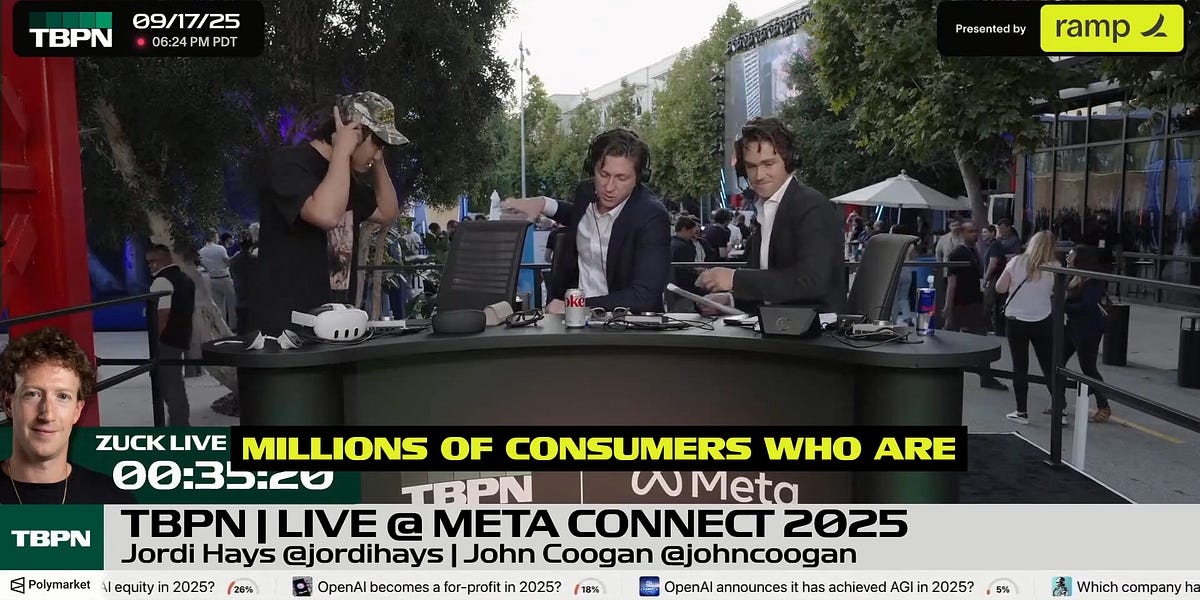
Speaker 02: Alex Lang, coming onto the stream. Let me tell you about Profound. Try Profound.com. Get your brand mentioned in LLM searches. Reach millions of consumers who are using AI to discover new products and brands. Alex, good to see you. Congratulations on the new gig.
Speaker 01: My man.
Speaker 02: How are you doing?
Speaker 01: How are you? Good to see you guys. Do I do anything?
Speaker 02: No, no, you're good. We can hear you. Talk to us about the first day on the job. How are you settling in? How's it going?
Speaker 01: Honestly, it's been incredible. It's like a lot of fun. I think, you know, building an AI lab in 60 days flat is kind of an incredible activity. But, you know, it's a good way.
Speaker 02: Give me your pitch if you were trying to hire me if I'm some hotshot AI scientist.
Speaker 01: I think Meta has everything necessary to achieve super intelligence. There are no obstacles. We have the business model to support building literally hundreds of billions of dollars of compute to be able to actually produce the technology. We have an incredibly talent dense team. Our team is smaller and more talent dense than any of the other labs. The other labs are like 10 times bigger. And our team is about 100 people of cracked AI scientists. Yes. That's how we're going to get there and we're going to be incredibly bold and we have the scale of products and business to be able to deploy super intelligence to every person on the planet.
Speaker 02: What are you looking for in that 100 people? Are you doing two pizza teams? Who's fitting in really well right now?
Speaker 01: I think that the AI researchers are all pretty incredibly kind and lovely people. And so I think we've been able to just build a team of great people. Everybody's trying to build super intelligence. Everybody is excited to be able to build potentially the most important technology of all time. And my job is ensuring that we have the conditions to be able to do that.
Speaker 02: Yeah, talk to me about the pillars, how you're thinking about research, safety, product, how all that comes together.
Speaker 00: In the position of MSL as opposed to other labs where you have pretty much every human in the world that you can actually distribute these products to.
Speaker 01: Yeah. So we kind of split the team into three pieces, infrastructure, research, and product. Research obviously has this job of building these models, which will ultimately be super intelligent over time. Um, product is responsible for ensuring that, uh, you know, over time they do get distributed and used in novel and interesting ways by the world. And then infrastructure is this very difficult challenge of building, you know, literally the largest data centers in the world and continue to scale those over time.
Um, I think that over time, not only having the distribution of all Meta's products, but also truly having this incredibly talented team is going to prove to be a huge differentiator. I think that one of our guidelines for building the team is that people have to be in the very top handful from one of the other labs. And if you just do that, if you just build a team of the very best people from the industry, you're going to be very successful.
Speaker 00: Talk about the advantage of having a hardware team that's been at it for a decade versus maybe starting in the last year. How closely are you in touch with them in terms of kind of showing what capabilities will be coming down the pipeline from the MSL side?
Speaker 01: I mean, the amount of engineering that has gone into this thing is absolutely incredible. They have like the transparent versions. We can see all the fucking shit that... People have painstakingly engineered over the course of a decade.
Speaker 00: We've done a couple of demos over the last month or so, but this is a product that people are going to be able to have their hands on in two weeks. 100%.
Speaker 01: I think... you know glasses are the natural delivery mechanism for super intelligence like it is you need something that will see what you see hear what you hear and they can
Speaker 02: easily deliver information to you yeah it's literally right next to the the human
Speaker 01: sensors the human sensors and the human brain the human sensors next to the to the digital digital sensors yeah exactly merge yeah yeah the merge this is the merge slap together yeah it's happening And I think it, like, I mean, like, my view is, like, it will literally just feel like cognitive enhancement. You will just, you will gain 100 IQ points by having your superintelligence right next to you.
Speaker 00: Yeah, are you, like, talk about chatbots, right? It feels like the chatbot meta, like, is here, but it's not, it doesn't feel like what's going to be the most important thing in a decade from now.
Speaker 01: Yeah, I mean, I think fundamentally, if you look at the AI industry, there's been relatively low innovation on the product side. ChatGPT was one of the first products that we had, and chat was one of the first products, and it still is the dominant product for AI delivery. And then on code, you've seen innovation with cursor and code and all these other products. But yeah, we're just still in the, like, from a product innovation standpoint, we're still very much in some local maxima.
And any, like, this is true of any consumer product, there are going to be many innings of innovation that come along the way. And so our bet is that we're going to be able to be pretty bold and iterate and build some very innovative new product experiences.
Speaker 02: Do you buy into that idea of AI writing 90% of your code? Is that just you're writing 10 times as much code or you can write the same amount as a thousand person team with 100 people? What does that actually mean when people throw around that 90% of code will be written by AI?
Speaker 01: Yeah, I think it's impossible to understate the degree to which I've been radicalized by AI coding. Like, I think that fundamentally the role of an engineer is just like very different now than it was before. And, you know, I think it like feels obviously true that for any engineer, including me, like I've written a bunch of code in my life, like literally all the code I've written in my life will be replaced by what will be able to have been produced by an AI model within the next five years.
Speaker 02: Yeah, what's your advice for young people then?
Speaker 01: I think you just have to figure out how to use the tools maximally. I think like it's actually in some ways like this incredible moment of discontinuity where if you just happen to spend like 10,000 hours playing with the tools and figuring out how to use them better than other people, that's like a huge advantage. And adults all have jobs. So we're not, like you guys are on freaking TBB. They're not vibe coding.
Speaker 00: Like where's your cloud code? Yeah, it is interesting. We were at YC Demo Day last week and talking and looking at the eras of the sneaker flippers, the people doing Minecraft servers, and it feels like the people today are going to be leveraging the tools, not just to learn them, but actually making money from them while they're in middle school, high school, etc.
Speaker 01: I think it's exactly that kind of thing. It's almost like when personal computers first came about, or just computing in general, the people who spent the most time with it and grew up with it had this immense advantage in the future economy, like the Bill Gates of the world, or even the Mark Zuckerbergs of the world. So I think that that moment is happening right now. And if you are 13 years old, you should spend all of your time vibe coding, and that's how you should live your life. It's amazing.
Speaker 02: Well, thank you so much for coming on the show. We'll have to have you back for a longer conversation. This is fantastic.
Speaker 00: Congrats on the new gig.
Speaker 02: We'll talk to you soon. In the meantime, let me tell you about Turbo Puffer, TurboPuffer.com, serverless vector and full-text storage built from first principles and object storage, fast, 10x cheaper, and extremely scalable. Used by the best. We have Andrew Bosworth. Bos, how you doing? Good. Welcome.
Speaker 00: Wander. It's a vacation home, but better. Go to wander.com slash TBPN.