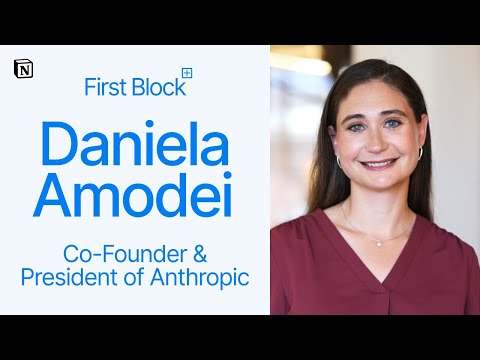
Daniela Amodei · Anthropic

First Block 专访:Anthropic 联创 Daniela Amodei

2023-12-19 · First Block (Notion) · 40m · 原文链接

→ 在 AI 访谈库中阅读(可切换中英、记录进度)
Daniela 讲述从 Stripe、OpenAI 到共同创立 Anthropic 的历程,以及如何从第一天起构建负责任的 AI 公司。

I oversaw the team that did gpt2 when I was at open Ai and I think the distance between gpt2 and like Claude one feels smaller than between like Claude one and clae 2 right like it feel it feels like things have just rapidly rapidly improved but early early days of Claude training Claude would sometimes sort of like invent creative mode so it was like I'm stuck in Dragon mode and we're like I don't know what that is or where you got that from there was quite a lot of like messiness in the middle to kind of get to the product that is available on the market today welcome to first block a notion Series where Founders and Executives from the world's leading companies tell us what it was like to navigate the many firsts of their startup journey and what they learned from that experience I am Akay kotari Notions co-founder and CEO Our Guest today is Daniela amod co-founder and president of anthropic anthropic is the AI safety and research company behind Claude the frontier model used by millions of businesses and consumers for its emphasis on safety and performance thanks for coming over yeah thanks so much for having me yeah we're so excited to have you on this program um I guess to start off uh why did you start anthropic well first of all thanks for having me I've been looking forward to doing this really all week uh really all month so it's a it's a pleasure to be here had uh six co-founders and we had all been working together at open aai and really kind of felt there was this opportunity for us to go start something on our own where we were really putting safety kind of at the center of all of the work that we had done uh we were a cohesive team we'd worked on uh gpt3 and scaling laws and we really felt like there was this kind of unique moment where we could kind of go off build something really from scratch where we were able to kind of ensure that like safety and this kind of focus on making humans at the center of generative AI was something we could do so one thing that's unique is one of your co-founders is also your brother uh um so can you tell a little bit more about like how's it been working with a sibling yeah so Dario and I are I think like pretty unusually close for siblings so we have been really close since we were little kids and I think we always kind of had this dream of getting to work together on on something and our careers took like fairly fairly different paths we you know he's he sort of started uh he's a physics PhD and he really started you know his his career on sort of that side of the house and eventually kind of you know moved into working in biophysics thinking about ways to apply uh you know biophysics to to health and eventually moved into Tech worked at Google brain uh and and I think at the same time I was sort of going on this other path of uh working in global health I spent time working in politics and we both eventually sort of wound up in Tech but we were always really like United around this sort of vision of wanting to do something good for the world and so it was really kind of a special opportunity we saw to be able to go off and found something together in one of your interviews uh in time recently you said since you were kids uh you felt very aligned um it's something that you don't I guess often hear um and so do you you two ever disagree and how do how do you handle that yeah I mean do siblings ever disagree definitely never we've never disagreed on anything uh of course we disagree sometimes but you know I think Dario and I again were sort of unusually like United around the sort of vision of the type of company we want to build the sort of problems that we want to work on and something I think that makes our relationship you know unique especially at anthropic is we have these sort of clearly divided kind of zones of ownership at work he's this sort of technical Visionary and I think really saw where kind of the field of generative AI was was heading and I feel like he is often thinking about like the five to 10 year time frame right and really my role is around you know what is the one to two year time frame right how do we take these incredible kind of technical Visionary ideas and turn them into something you know tangible that people can use today and so while that's you know it doesn't mean we never disagree it just means there sort of uh areas of of kind of ownership that make it a little bit easier to to be in concert together so it's like different Horizons and it's very complimentary in some exactly exactly yeah that's really cool I also looking at like your last decade you know you you worked at some story companies from stripe to open AI to anthropic how is it different to be a co-founder now like what's different about that it's uh it's a really funny question because I I think when we started anthropic I sort of assumed like oh if you've done one hypergrowth company you've kind of done them all and when I started at stripe it was around 40 people I left around 12200 open AI was a sort of a similar starting size to around 250 and I thought that 0 to 40 range it can't be that hard right I've sort of seen it before but it's completely different and I think being a Founder you really quickly learn all of the things you're bad at right which are which are many and you know in a lot of ways I was actually very fortunate because I had so many co-founders that were sort of on this journey with me and often it's you know like one person or maybe two people and we were all kind of able to learn together but there's so many things that go into the very sort of beginning founding of a company right we had to figure out uh simple stuff like how to run payroll which like we messed up multiple times right we had to find an Office in the midst of covid that was its own kind of interesting Journey but also you know fundraising and figuring out who we wanted to hire and setting up kind of initial processes for a company was completely different from you know zero to 40 than from 40 on I guess one other unique thing is maybe having six co-founders right uh how is that for you how do you all distribute the work you all do internally one of the things that sort of special about this founding group is that we had all been working really closely together already and some of the relationships actually even predated open AI there were folks in that group who had worked together at Google research at Google brain um and some you know even before that you know Dario and Jared who's our chief science officer uh knew each other from a physics Fellowship from like 15 years before so there was really just going into it a lot of context and sort of trust a lot of time that we really spent working together and so in a lot of ways when we kind of got there we all had a great sense of each other's kind of strengths and weaknesses it felt really easy to kind of divide up the work and as the company has scaled we've changed a lot of what it is that we focus on some of those co-founders are still managers some of them have gone back to doing you know individual contributor really senior high level work and it really has been kind of amazing to just get to watch this group of people really spread throughout the company and kind of seed that culture that we initially started with so one uh thing we were talking about before this that you have a very broad role like looking sort of all of the managers inside the company can you talk a little bit about sort of how do you uh sort of think about this like technical research side of the world at the same time also thinking a lot about sort of this commercial go market yeah and then maybe like the third thing I think a lot which is like foundationally how you're building building the company up also right uh how do you sort of balance these different areas it's such it's such a good question and it's also evolving as the as the company evolves I you know there's some component of it that feels like any startup right we're we're sort of building the proverbial airplane like while it's taking off but I do think something that is a little unique about it just compared to other places I've worked is we we really started and kind of invested in the research organization for the first you know year year and a half of time we didn't even have a go to market team until 2023 and part of what was so interesting about that was we really almost got to build this kind of cohesive culture with this clear set of goals and then we almost like went and did it again right we said okay now that we've gone and kind of developed these really transformative powerful safe AI systems how can we now sort of bring them to Market in line with our values and I think part of what's been so like incredible about that journey is it's you really you really like you build one one part of the airplane right we're like okay we actually have the base now and now we're building the controls right or we're flushing out the wings and of course there's times where you're like oh man like this knob I should have like that knob I built it too slow I should have built this other knob you know slower but but in general I think it's it's part of the like joy and uniqueness of this type of business to be able to have research impacts and publish papers and have policy impact right and coordinate with governments and Civil Society and also be a a tech startup right that's building a product that's pushing it to customers that's seeing how the technology is really being used in the world on kind of a day-to-day basis do you have a schedule like how do you think through like if you're like like let's say this week is there a way you think about these different things sort of like different days or or or or does it change every quarter every six months well let me tell you the like Perfect Day the perfect week of what it would look like and then a little more in reality that every you know everyone has their own kind of quirks but there's so much context switching in any kind of management or leadership role but I think for a place like anthropic in particular it's really it's really heightened right because thinking about safety papers and what we're publishing and the research we're developing and what areas we should be exploring is really different from trying to go win a big customer or build interviewing ahead of product right those are just completely different parts of your brain and so I'll I generally try to have my days a little bit aligned like focus on research on Monday and policy and comms on Tuesday and Engineering on Wednesday in reality it's probably like 70% hit rate to because things come up interviews or rescheduling or things like that but you it sounds a little bit bit tactical but I do think having sort of a little bit of of space to really go deep on each of the areas is is kind of the the dream let's talk a little bit about hiding I think this is something that a lot of entrepreneurs are very curious about um could you take us back to like so you have six co-founders you start with that could you talk a little bit about maybe the first few hires you all made um how did you think about sort of building the team and the sort of the processes maybe you po through anthropic is so unusual in terms of the types of people that we are looking for and that we attract we're a highly highly interdisciplinary group of people and so what that means is you know we have people on staff who were former you know neuroscientists or biologists in their previous life who are kind of coming to study large language models the way that they used to study the human brain but we also have you know product Engineers from you know name companies like the ones I used to work for who have been in Silicon Valley and bring that kind of expertise to the company we have policy leaders and Business Leaders and operators and so I think our kind of early hiring we were really looking for people that understood the mission of the company and the values and really embodied it right they were there to help build these very powerful transformative systems make them accessible make them fair and do it in a way that felt you know safe and really with kind of humans again kind of in the driver's seat all of us kind of did so many different things in the early days and we're only really now getting to the stage where we're looking much more for Specialists than generalists did anything change from like going from like technical hideing because it sounds like first couple years with research uh it's always interesting to me I think for us like we went from I think tapping a lot into our networks and I think like early days of notion probably almost like subcultured of people who really taught a lot about tools and craft in some ways and then and then we sort of built it more into a process and I'm curious if you all went through like a similar Evolution yeah that's a that's a great question I think that does that does resonate that sounds pretty similar you know when we when we first got off the ground in 2021 we were you know mostly mostly researchers right mostly like ml AI researchers and that's a fair small group of people like in the world right that kind of do this type of work and I think that was not entirely network-based but almost right it was a lot of you know people that we knew through extended you know networks and things like that also as you sort of expand the set of things that you're doing at a company you can attract more and different types of people and I think you know we have grown really quickly and so my sense is that we kind of went through that pace that that change a little bit more rapidly like sort of at a faster Pace maybe than than your average Tech startup so let's uh uh change to different topic let's talk about Cloud 2 um congrats on the launch recently um you all talked about it as as an AI assistant that is being trained to be honest harmless and helpful uh I guess my question to you is how do you train the model to reflect these values that HH framework that you talked about helpful honest harmless we use it internally all the time right we'll sort of use it for talking about you know emergent behavior that we're seeing in Claud for how we approach it with customers for the training that we do really of the large language models themselves but internally we have different research teams that basically focus on on each of those and it's a little more complicated than that because sometimes you know the teams work on things together or there's some overlap but each of those challenges are really um you know pretty different in terms of of how we approach them so honesty is of course trying to reduce the sort of ever pesky hallucinations right large language models every llm in the world today suffers from some hallucination and the honesty team's job is to try and get that number as low as possible on the helpfulness side really what we're looking for is you know is this model answering your question right so if you are talking to it or if it's searching over something is it really doing what it is that you want it to do and then on the harmlessness front we're trying to reduce the chances of it producing toxic or biased outputs but also trying to reduce the chance of it just helping somebody to commit a crime right or produce violent content or things like that and part of what's been so interesting from from a research perspective is that many of these kind of HHH qualities are sort of there's trade-offs between them right you can have a perfectly harmless or a perfectly har model today if you want one it just wouldn't be very helpful right it would just say like I can't answer your question to every question you ask it and so really I think the kind of interesting Challenge and opportunity is how to kind of raise the watermark on all of them together can you talk a little bit more about the trade-off like because that seems super interesting in that I guess another way to think about it could be like maybe something's very honest and but that could be more harmful and so can you walk a little through little bit through like how you all think about these trade-offs and like how do you get the watermarks up on all three yeah so first of all it's definitely more of an art than a science uh than you would expect we you know we use constitutional AI to help kind of raise the watermark on all three together we sort of have instructed Claude to say these are the goals right we want you to be as helpful honest and harmless as possible but I think even beyond that there are kind of particular tradeoffs and I think even if you were to get Claude to be sort of a perfectly performant model there would still be trade-offs that an individual or a business would have to make kind of depending on what their goals are for the model right you might want a really creative partner that is going to develop more kind of risky language and so you might want to tune down the harmlessness score just a little bit um but that that still has to have some guardrails around it but that really varies depending on the business or the use case so so even modulo not being at the point where the models are perfect you still have that set of trade-offs right so for a while we have really been kind of exploring this trade-off between especially kind of uh you know harmlessness and helpfulness but I think Honesty plays into that too and I don't think there's an easy answer and again like even if we got them perfectly probably your mileage might vary are there any fun stories associated with like training CLA yeah many fun stories I mean I think even just like zooming out a little bit something I like reflect on a lot is just how much these models have improved in such a short period of time uh I oversaw the team that did gpt2 when I was at open Ai and I think the distance between gpt2 and like Claude one feels smaller than between like Claude one and clae 2 right like it it feels like things have just rapidly rapidly improved but early early days of Claude training um we at one point like Claude was really convinced that the best way for you to lose weight was to go on an all potato diet we have no idea where this came from it was just like really stuck on this idea for a while uh Claude would sometimes sort of like invent creative mode so was like I'm stuck in Dragon mode and we're like I don't know what that is or where you got that from uh what are some other good ones I mean there was a time where we had really really been tuning up harmlessness um in like one branch of the model that we were playing around with and so Claude was just really concerned about your well-being whatever question you would ask it so like Claude you know we would say like hey can you tell me who the 34th president of the United States was and it was like I'm so concerned about you here's a link to some therapy you know guidelines if you need help like please reach out to a friend so um it's definitely there's quite a lot of like messiness in the middle to kind of get to the product that is available on the market today I love french fries so I'm going to tell my wife that Claude one agrees with my diet only potatoes all day yeah plain potatoes actually like this this whole aspect of evaluating the models evaluating like what your assistant is doing is super hard and like uh like we struggle a lot with that also because I think you know people have such different use cases how do you think through all of that yeah I think I think it's such a a preent question especially for generative AI right and I don't think we have like a perfect answer but I think this kind of concept of like tunability is really important and you know that's not to say that there shouldn't be kind of again guard rails right there's sort of a range within we say hey there's a level of harmlessness that is required in the model or a level of honesty or helpfulness but I do think that there's some kind of room for you know exploring and fine-tuning uh with an individual customer just because you you might even sort of outside that framework you might just want the model to respond differently and something that Claude I think is uniquely good at is taking that kind of direction right so if you are trying to use it for um helping you to create you know fiction you can say hey I want you to be more flowery in your language or can you kind of write in this tone but if you're writing a business brief you can say this is a technical business document please keep your responses short and I think sort of some of the magic of using this kind of Junior assistant comes from the ability to to really tell it how you want it to work with you that's a good segue I think the I've always curious about this question uh especially companies like anthropic I mean you building this technology you talk about the junior assistant right how do you all use claw internally uh do you all have uh maybe the next Generation uh you know Claud just as as teammates right now I'm just kind of curious about that space I I do think we have found Claude immensely useful at anthrop IC I think there's kind of a few a few ways that we use it just day-to-day the first is you know we've just grown so quickly we communicate so much across slack in particular and I think having you know this claw and slack integration was actually something we we built in- house first right we were trying to synthesize you know a lot of research discussions or technical discussions that were happening maybe a new hire joins and they're like what happened before I got here yeah and Claude is great at just taking and summarizing this huge Corpus of information and really distilling the most important points so Claude has been great in helping support really the scaling of the business and the scaling of the company itself we actually have something called uh the anthropic times which is Claude basically summarizing like the most talked about threads in slack and so if you were out of the office or you just can't keep up with all the slack channels you can go through and and read them but we use Claud to summarize information you know in meetings right in meeting it's it's a great first drafter so I think really we feel it's important to actually make use of the products ourselves before we we put them on the market so one of the things I mean AI is obviously top of mind for everyone right now there's a lot of Founders working in this space um uh as a Founder can you talk a little bit about sort of like what it is like to build this product and Company uh you know on this Cutting Edge right and and sort of lessons you've learned that other Founders could learn from I I have genuinely been like amazed and sort of impressed by how rapidly the technology is developing and I think especially for folks who are you know taking the leap to found a company building on top of generative AI or using generative AI I think part of the again sort of challenge but also opportunity is the research itself and the sort of capabilities of the models themselves are evolving so quickly that like product roadmap questions are kind of research questions right like today you know Claud you can't rely on it to never hallucinate but like maybe in the future you'll be able to or it can't yet integrate you know X or Y feature that you really want but we probably can fix that right in a few months or years of time and so I think it's it's almost like contrary to standard found advice where you're like pick a thing and go run on the thing and don't change it until you've really achieved exactly what you're looking for from a product Market fit perspective I think having a little more of an eye of you know flexibility and sort of Imagining the potential for what this might be able to do six months from now it's it's kind of unusual advice but I think that is something that that we've really found important at anthropic too yeah it's kind of an interesting challenge because it's also dizzying just like how fast it's changing and so I think kind of the flip side is like things that you think are sort of like this really Innovative thing today like feels like gets commoditized tomorrow yeah uh and I I like your advice of sort of like thinking out almost like a little bit further out Horizons yeah of what could be possible and and thinking through what how you get there yeah yeah sometimes we get questions about our product road map especially from bigger customers and about 80% of the time it's actually question about our research road map you know they're like when are you going to be able to build feature X and we're like Well when the model can do that right so it's it's just a unique it's a unique challenge for sure I guess because it's so fast moving how do you all think about like going first to Market versus being the best in Market I don't necessarily think that they're intention you know first of all I do think we feel a lot of conviction that what we put on the market should be the best highest quality safest model that we're able to produce right and I think we have a similar approach to how we develop our products and we feel very strongly that when we bring something to others they're going to be depending on it right if if you're a startup or a medium-sized business or a large business and you take the leap to integrate with us we want you to know that like that product and that service is always going to be available and that it's going to be reliable and that we're giving you the best quality we can across all of those different dimensions that we've been talking about in safety and so I think really our commitment to that level of kind of quality in our products is something that probably supersedes those questions so we talked about you and Dario being aligned but let's talk about alignment in AI uh alignment uh seems to be top of mind for for you all as you built started anthropic um can you talk a little bit about how do you ensure your approach to AI remains safe and responsible into the future so we this is really important question and it's one we talk about a lot at anthropic um we you know we recently published something called our responsible scaling policy and this is basically you know a set of public commitments that we are making about how we will train and test our models and the implications for what we will do if we have concerns about the safety of them and I think part of why we felt it was really important to kind of put that out there now is these models are becoming you know much more powerful much more capable and while I think there is incredible potential upside and benefit of these tools or we wouldn't we wouldn't be building them I also think it's really important that you know companies and sort of the ecosystem as a whole takes some accountability for the potential externalities that could create right and so I think the responsible scaling commitments are kind of one one version of that for us can you talk a little bit about the tradeoffs like that that that it creates like you know I guess like safety versus capability of the model and especially with the backdrop of like now like more and more companies instead of even open source you know chasing this like um this supp be really interesting debate internally how you all sort of think through these trade-offs I don't necessarily think safety and capabilities always have to be intention right another way of thinking about it is to sort of be on the frontier of kind of model performance in general you will want the model to behave in ways that are safe right like no no customer is going to be excited about a model that is hallucinating left and right or going off script and producing kind of harmful content and so it I think there is a through line in which developing you know more capable systems can be kind of in keeping with the safety Mission and sort of goals of anthropic I do think though there are you know other components of again unintended consequences of the model that are important to you know think about sort of building structures around or guardrails around the RSP addresses a lot of that but I think it can feel easy to sort of get complacent right and say okay well we have these systems and you know safety is good for business but I do think sort of having you know ongoing conversations and we have different formats for that internally to really talk about this this trade-off that you mentioned um there there's it's not perfect right there's no perfect way of doing it but I think having it be something that's very much at the Forefront of discussion for leadership in the company has been really helpful for us so anthropic and notion I think we we have a common goal in some ways in terms of like leveraging AI sort of make people and organizations more productive um do you have a view like 5 10 years out uh how you think people will be using Ai and Claude in terms of doing their work so one of the things we love about partnering with notion is I do think this kind of AI for helping with productivity and sort of routinizing mundane tasks and really allowing people to do the work that they're sort of best suited to do I think that's a really kind of common mission that we that we both have in common and I have to say you know today we really describe Claude as this very helpful Junior assistant right it's great at summarizing notes or um you know taking action items 5 to 10 years from now I mean of course it's hard to know I think I could imagine Claude just being a much more senior assistant right something that is actually able to help support humans in many many different sectors of the economy we're already seeing you know Healthcare applications and legal services applications climate Tech you know science Making sort of early use of these systems but I think you know 5 to 10 years from now as these models just become sort of continually more capable hopefully you could imagine them sort of really increasing the overall productivity of society as a whole and really enabling humans to do the Creative part that's really only our touch as the as it becomes goes from like a junior assistant to a senior assistant uh are you optimistic that us humans will figure out uh this like rapidly sort of fast moving technology like will we coexist with them well I guess people talk about potentially people will lose jobs some people say like actually they'll just use the time for more creative tasks uh based on what I heard it seems like you're sort of more on the ladder of just people will have more time to do interesting things so obviously this is a super important topic right and I think I I would even go a little bit further and say this is something that probably is not should not just be left up to corporations to decide right I think part of why we have engaged you know so much with policy makers and Civil Society groups is that we really feel this kind of responsibility for the technology that we're building and I think things the sort of things that you mentioned you know we we are excited to partner with those groups right on those on those topics and I think the sort of societal impact of the work that we do like we are very well positioned to will pine on but we're not the only stakeholders right we're not the only opinions in the room or the only ones that matter all of that being said I do think that I personally feel like many of the kind of productivity gains that we're we're hopefully going to get will actually help enable kind of more creative productive meaningful work for people around the world so I think every company hears you know Community feedback um and sees like sort of like overall reception to a product um can you talk a little bit about how you all at anthropic uh balance sticking to your sort of intuition your Origins versus sort of changing course as you sort of get some of this new information one of the things I think that is so again kind of unique about this type of of business is because the technology itself is sort of being built around us I actually think that Community feedback and engagement hearing from our customers is almost more important even than in a traditional startup right we need to hear directly from them like what the gaps are that can make the product that we're giving them better and of course there's limits Within research of what we can do but a lot of of this kind of feedback loop that we've seen I think is really healthy where we hear from our users it would be great if Claude could do this thing and then that kind of comes into our product organization and some things they can do themselves but a lot of the time it really then comes a collaboration between research and product and then that becomes something that we ship to our users we hear more feedback and it kind of creates this really valuable cycle again we can't always provide you know every every update that we that you know we wish the model could do everything but I will say it is also kind of interesting and inspiring to hear in sort of a day-to-day way like what are people building and what are the day-to-day challenges but also the safety challenges that they're encountering in the real world I think that does help us strengthen a lot of our convictions around safety and how we're building the models I would imagine also like specifically on feedback you you get feedback from all these different Industries all these different use cases right do you all have an A Way internally to sort of like translate that into um sort of prioritizing what you know what aspect of research might might be you investing more versus less yes I mean prioritization is so crucial for us especially right now we're actually a really small team on the product side we have something like 15 engineers and like five sales people something like that so we do a lot of prioritizing and that doesn't necessar necessarily mean that there aren't things on that stack rank that we wish we could prioritize higher but as we're growing the business um and hopefully soon as we have more people we'll obviously be able to get you know to to things further down the stack rank you know it's It's Tricky it's almost like the intersection of what is high impact and what is tractable right and so there are some product or kind of research goals that we have that are just really hard right and we might say Hey you know we need to be working on this on a one-year time scale but we really can't incorporate it into our next product launch what is something that is you know tractable that we can fix that users are asking for today that we can really give them kind of the next time we push something out and so of course it's you know it's it's impossible to know have you have you prioritized everything correctly but it really is kind of an exercise in in sort of Ruthless prioritization to be you know scaling this quickly and to be you know lucky enough to have the amount of demand that we do all right so uh we ask these two questions for every guest um and so maybe my first one for you is uh describe a day in your life um how do you start your day what rituals do you have I really wish I was one of these like amazing Silicon Valley people who was like I hike up Mount Everest every morning and then I fly back to San Francisco and start my day at 6:00 a. that is that's not my story um I am a mom I have a 2-year-old and so uh I uh I'm not actually not a morning person by uh by default but I've kind of become one over the past I don't know five or 10 years and so I really like to get up early I work out first thing in the morning I just have that as kind of me time it really helps me Focus reset my day get some time to myself and then I usually spend about an hour with my son and my husband in the morning um for some family time and still try to be in the office you know on the reasonably early side and whenever possible you know mornings are great for like thinking work I think as the day goes on um I'm I'm better at talking than thinking and so it's much easier for me to do meetings in the afternoon so when I'm at work I'm like really really focused on work I don't check my phone I like really don't notice what's going on sort of outside of of the walls of of my office and then when I'm at home I really try to have some dedicated time where I'm kind of offline and sort of restoring balance in my life uh it's not perfect right there's sometimes where uh you know you sort of have to flex in either direction but a lot of what's been important to me is also just feeling like a human outside of work uh I grew up in San fr Isco I still have a lot of friends from all different eras of my life like high school friends who live here and I think like making time for family for friends for hobbies and interests outside of work even when it's just sort of a narrow slice has been really helpful in just kind of keeping me grounded all right final question if you were to write a book about what's gotten you to this point in your career what would you title it so it was nice enough of you all to preempt this question for me I actually asked Claude for help Claude had some very hilarious suggestions things like you know an unsuspecting woman thrust into the Executive Suite I mean it was just like really funny but I you know I think probably the ones that resonated with me most were I need an adult um the scaling Memoirs of a generalist how did I get here all of these I think really have kind of encapsulated the experience of uh of just you know going through 10 years of of hyper growth right which is a very kind of particular uh experience right getting to sort of do you know three high growth technology companies uh in a row but I I do think that something kind of unique about you know this experience and just sort of my my kind of career trajectory is I truly am the most like generalist generalist that there is and it often doesn't get talked about as kind of an opportunity for management and Leadership but I really think some of what has been so amazing about this journey is getting to have the privilege to support all of these different parts of the company right learning something about research and something about engineering and product and business and GNA functions and I think really kind of the story of of having an appreciation for the importance of every one of those disciplines uh is kind of the truest the truest expression of of what I've learned what was your prompt to Claude to give you that I gave Claude a little bit of information about me and I said if you were to title a book about this person for a podcast interview what would you say um I did come up with I need an adult that wasn't Claude that one was me danielas this has been so great I I I I wish you know I probably could go on for for many hours uh but you've had such a storyed career thank you for spending some time with us and sharing your wisdom with with our audience thank you so much for having me it's really a pleasure thanks AJ first block is brought to you by notion for startups we notion care deeply about startups and Founders and we hope these stories inspire you to keep building to learn more about how we are supporting startups please visit notion.com slst startups