Guillermo Rauch:简单、专注,与成就 Vercel 的那次押注
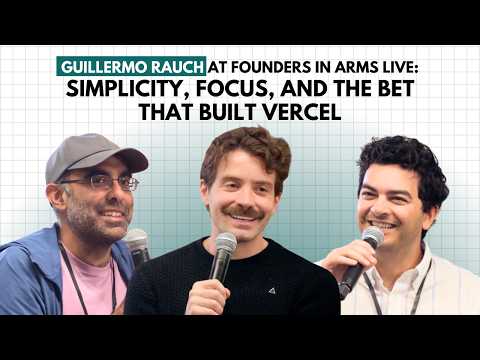
Guillermo Rauch at Founders in Arms Live: Simplicity, Focus, and the Bet That Built Vercel
being a founder can be so lonely. Cuz it's not like you have a whole team of coaches that are helping you not burn out. So, a lot of it is what I think is Ben Horowitz says like managing your own psychology. Cuz in reality, whether you burn out or not, like there is a you could you could totally go off the rails and just burn out, but also you can have be your own coach in the in sense of like, all right, it's time for me to unplug.
It's time for me to go for a run. It's time for me to like invest more in my social life. And I know that it was difficult for me to figure all that out because I was by myself coming from a from an another country. So, like I I appreciate the the concern over those kind of things. But it's also part of what one is to master. >> >> Welcome to the Founders and Arms live event. We do Raj and I have been doing this podcast for I think 3 years now or something.
Almost 3 and 1/2 years. But I guess only recently we started doing live events and they've been working out. So, you know, I'm Immad, founder and CEO of Mercury. >> And I'm Rushi, co-founder of Lemonade Tribe. Welcome everyone. It's great to see such a great turnout yet again and we love doing these events because we get to meet some of our listeners in person and some new people as well who are, you know, get a chance to learn about the podcast for the first time.
We do this podcast because we care about founders and we care about you know, it's it's a big part of our identity and and what we do, you know, you know, I've been a founder for almost 20 years and Immad I think similar. And we spend a lot of time with founders, we invest in founders, you know, and a lot of our friends are founders. So, it's just a big part of our life. And that's why we started the podcast too, you know, found it's in the name, Founders and Arms.
We care about helping each other, you know, through this very very very unique journey that most people don't understand. But um but we know we it's our life, so Thank you all for coming and and we love to interview great guests as well. We're excited to have Guillermo meeting you for the first time. Um but I've heard a lot and I use your product, so thank you for coming. >> I made a lot of customers today, so thank you for putting this group together.
>> Yeah, absolutely. Let's do a quick poll here. How many people use Vercel here? Oh my goodness. Oh my goodness. Wow. >> >> That's product market fit, exactly. Yes. Perfect. Our product market fit. Yeah, yeah, yeah. >> Do you do We should do some promotions together, like sign up to Mercury you get Vercel credits. Have we done that already? I hope so. We should definitely do it. >> You know, I think of Vercel as your kind of the I actually I don't know exact description of it, but like the really speedy like front-end deployment stuff.
How much of the Vercel's business is that versus kind of V Zero and some of this kind of newer stuff? >> Yeah, the way we talk about it is that we have a web stack, which is all of the tools and infrastructure that you need to build for the web, and then you have an agent stack, which is all of the tools and infrastructure you need to build agents. What I've learned over the past year is that you kind of always need both.
So, people really like that Vercel is becoming the everything cloud. You can come in because you're building a site, or you can come in because you're building an agent. You can come in because this is your first time ever building software, which is what we're seeing with V Zero, with our the Vercel plugin for cloud code and code X. A lot of people, some of people might be in this audience, had never even thought about creating software before.
And now they can create and deploy on Vercel. So, what we've seen over the past I'll say probably 6 months is this massive new onslaught of users who are new to software engineering. So, the platform has become the the place where you have an idea and you bring it to reality online. >> Yeah, that's so cool. Tell us the story about like starting with So, is this your first company? Give us a like a little little rundown on like that journey of like you know, where the idea came from and >> Yeah, interestingly it's the second company that is a serious company.
I think I've had you know, for many of us in this room were serial entrepreneurs, right? So, we've been having companies since I probably had my first company was like 10 selling CDs in my school. During Did you get banned? Kind of. The teachers didn't love it. But this is the nature of being an entrepreneur. Like sometimes you rub people the wrong way. But essentially this is my second startup. So, I came to Silicon Valley.
I was initially working for another startup. And one of the things that I noticed is I love building stuff. I don't love working for a boss. So, I want to work for myself again. And I also noticed that in Silicon Valley is really easy to start things. In many ways I think in this day and age is extremely easy to start things, but the journey is also gotten really difficult and competitive. So, I started a startup. Then I sold it to the company behind WordPress.
So, it was my first exit after quite a few years of iterating, pivoting, trying different things. And then when I was at WordPress I realized that the world is going to change because of different big waves. One big wave was the cloud. At WordPress we had our own data centers and I thought man like I don't think that you know, the next billion companies are going to have their own data centers. >> Wait, what what year was this?
>> This is 2013. Um >> Okay, so somewhat early in the cloud. >> Yeah, so um I started Versel in 2015 end of 2015 and I had spent 2 years at WordPress. And by the way, WordPress had to create their own data centers. They were scaling really quickly and they needed to keep up with their scale. And so what the cloud brought to the world was this idea of elastic computing. That you could have a quick idea.
An anecdote that I like to share is in this room you might find the next multi-billion dollar success that everyone's going to be talking about in 10 years. For me it was the case when I went to my first co-working space and I met the Instagram guys that were like my, you know, office mates and they had built on AWS. And what I noticed is that as they kept growing, obviously they AWS able to keep up with their growth.
So they became quickly one of the S3's biggest customers because they just people kept uploading photos and then they would put them into S3. So one that was one of the big things is that the cloud has this ability to scale with you and and I noticed I bet on that wave. I didn't know exactly what I was going to do frankly when I left WordPress but I knew okay, that's going to be a very important wave. Another one was front end.
So when I was at WordPress we'd been really successful with the PHP stack. But it was all this monolithic thing. You had to put all of your eggs in one basket. In the same runtime, in the same code base, with the same sort of limitations and I noticed that the world was going more towards more interactive rich client experiences. So React was happening as well. And so when I left, I didn't know exactly what I was going to do but I I had a bunch of intuitions.
I knew that there was going to be a potential for something like Ruby on Rails but for this new generation. I also knew that the cloud was really powerful but it was insanely hard. So, I think noticing these asymmetries about the world is really important for entrepreneurs. >> So, you just quit and you had like these ideas and then you start >> Yeah, like some of them were like >> What did you go as like what was the next step?
>> What I would do is because I was always obsessed with like starting something new or coming up with new ideas. I would go out to dinner with people and I would like try ideas on them. I remember I was with a couple of friends in Finland and I was like, "What do you think about this framework idea?" How I I go back and was like, "Mhm, that that might have been the first time that I articulated verbally what would become Next.
js, right?" >> This is because you were like kind of thinking out loud or >> Thinking out loud and seeking seeking feedback. I think I've been always pretty outspoken about what I want to build. Which is sometimes hard to do as an entrepreneur because you think everyone's going to steal your ideas. Like I've been there done that but it's really helpful to notice how people react to your ideas. Uh >> Or >> to the things that you're selling them on a Zoom call or whatever.
>> like sometimes it's hard to get good feedback. Do you have like a good process for getting good feedback? Is there a way you phrase things that like you think gets you the best feedback? >> I think everything is feedback. >> Yeah. >> Even when they notice that and by the way I've gotten better at this over the years but even noticing someone is not following your train of thought. >> Yeah.
>> Which when you're in pure like builder locked in mode it may be hard to notice this but like how land how to land a good pitch uh is the reaction or or or lack thereof is feedback. Um Another thing that I do a lot is pain discovery. I kind of upset an engineering manager at Vercel today because I was I was like, "Hey, like I on Friday we're going to have this customer they're going to come to us and they're going to they're going to tell us everything is broken.
And by the way like a lot of what's broken is is relating to your area of work. So, it's like sort of like setting up expectations. It's like, "Don't feel bad. This is how we're going to improve." But, I try to like get out all of the negative stuff out of someone if I can. Because one lesson that I learned is that you know, people sometimes might not volunteer all of the bad things about their prod- their product experience.
Sometimes they might even be a little oblivious about what's painful about their day-to-day. They might tell you like, "Oh, I I love everything about I don't know, like ChatGPT." But, then you start digging in and like, "Oh, yeah, you just, you know, got a bad answer." And like, "Oh, that didn't work. Oh, and that was really slow." And so, you start identifying opportunities, commensurate with your ability to dig. Yeah.
>> I feel like actually that's a really good thing to have a value to have as a CEO is to just be annoyed about everything. >> Yeah. >> Like I try to be really annoyed about everything I'm agree. I'm like, I think you I think you can get used to things and then you just take things for granted, but if you're just very annoyed about the world, >> Yeah. >> uh it's actually like a useful way of like learning and improving.
>> Yeah, and it's and very important that, you know, you kind of set up your team to understand that that's a really positive way of building things. I think it was I heard it I heard about I heard from this about Stripe that the way that they think about it was um short-term pessimism, long-term optimism. Because if you came to my workspace and you saw me like, you know, kind of like tear down all of our websites and applications and saying, "This is wrong.
This is bad." You might think, "Oh, this guy doesn't like anything." But, in reality, like that's kind of my process for extracting greatness over the long haul, uh and over long periods of time. And and and that requires, I think, to your point, a little bit like that short-term annoyance. And I also think, for example, impatience, right? And impatience cannot just be you irrationally ship things into the world that are not ready, that are half-baked, that are terrible.
But so you have you need to balance out, okay, how can we do what you just proposed you would do in 3 months? Is there an intermediate step that we can ship that happens in 2 weeks? And so can I have that sort of impatience around getting value out into the world, but not so much that you actually ship junk? >> Yeah, I think keeping standards high is the job of the CEO and and how do you how do you do that in a productive way where people feel motivated to hit the target without feeling, you know, discouraged?
It's a It's a hard balance. I think it's something that a lot of early CEOs struggle with because you can go too far, right? And you can make the workplace terrible, you know, where people just like, "Emad's annoyed again, you know, what a guy." But like if you do it in a productive way, they know Emad's a nice guy and they know like, you know, this makes the company better. >> There's a yin and yang, I think.
I'm I'm a huge like spiritual believer in that that like I have to set I have to give you enough of what's bad and also I have to celebrate the wins and I have to like bring out the joy of our accomplishments, but not so much that we'll just live in this permanent like >> >> idealized state of oh, everything is perfect. So >> I think it's also like how you give the feedback. I think if you make it very much about like, "Hey, you I don't like this.
Maybe if you did it like this." And like you make it more about like we're creating something together. I don't think people mind that. I think if it's purely critical without like proposing like a solution. Or if it's like someone like, "Hey, why did you do a shitty job of this again?" Like no one likes that. >> One thing that I adopted as a mental model that like changed my perception of everything is Jony Ive has this thing about opinions versus ideas.
So opinion, by the way, and and I I preface by saying all feedback is a gift for me. I've I have enough thick skin that you can tell me an opinion I still kind of value it. But there's a superior form of feedback which is an idea. So the example here would be if there's something you don't like about an app, you can say, "Ah, this app sucks." Screenshot. Or you can say, "This app sucks because so-and-so and here's my idea on how to improve it."
So I think the like final form of feedback and in the most dynamic and productive workplace would be one that is a free exchange of ideas that are high-quality ideas and the more concrete the better. Because then that gets you into this exchange of All right, here's my idea, here's your idea. Ideas can come from everybody in the company. This is another really important thing. Like you hear a lot about the great successes of Silicon Valley in ideas that can come out of anybody in the company.
In fact, the ideas that I celebrate the most have come from customers. And I sometimes correct people when they tell me, "Oh, that's an awesome thing you guys invented." It's like, "No, that was invented by HashiCorp, who was a customer of ours in the early days, or that was invented by TripAdvisor." I actually memorized some of the big wins that we've had that are attributable to customers. >> Yeah, that's cool.
That's a good one. What about bad ideas? How How do you deal with like, you know, someone brings up a bad idea? What's your Because this is something I you know, you have to deal with all the time as a CEO. People Ideas are good. You want to encourage more ideas, but then some ideas are just not good. >> Yeah, one of the ways that we try to suss it out as early as possible is by actually building. So can you ship it as an experiment?
Can you ship it as a V0? Can you actually show me your idea in action? Obviously, as long as the cost is not too dramatic. Uh but actually, you know, giving it shape, people realize pretty quickly that their idea is bad. Uh there's also ideas that we all convince ourselves are good ideas, and we have to, you know, face the real world. And so, I try to always use the voice of the customer or or or data to actually show, contrast the hypothesis with what actually happened.
And I really try to use data, you know, I'm not the the crazy like data science guy, but I try to constantly orient myself around data. So, I have all of these really cool Slack workflows where um now an agent will give me every week a download of metrics and then an analysis of the metrics. And so, those are ways in which like you can be reoriented. And And by the way, sometimes it's not that it's a bad idea. It's that there's this other much much greater idea that you should be feeding your attention.
And so, this is actually what where data can be really helpful. Obviously, I'm speaking about a company now that has like multiple product lines and like we're at a certain scale. Right now, you're probably in the trenches of your zero-to-one idea. And And there's different techniques for that. >> So, yeah, the speaking of getting to scale, one question I have is Tell us walk us through like the 10-plus year 11-year history in terms of what are the key inflection points?
And, you know, and you know, we all know as founders, it's not all linear, right? You You You There's a couple things that have huge leverage. So, what were those points along the way? >> Yeah, I If If I were name If I were to name the chapters of the company, um from your question, I would say like chapter one was finding focus. That's That was the whole arc of the first few years of the company. It wasn't finding ideas.
I think right off the bat, I had some pretty good ideas. So, Nextja is obviously a pretty good idea. Maybe I had too many ideas. I was starting to build a lot of our open-source projects at the same time. Uh like you some might know like we built a terminal called Hyper and we built a microservice framework and a bunch of other things. So, finding focus and narrowing focus. First, identifying that from all the portfolio of open source things that we're working on, Next.
js was like, "Holy [ __ ] like that one is getting adopted by enterprises and individuals alike. That one is going to have a lot of traction." But the other one is on the infrastructure side. Narrowing our focus to do this particular kind of deployment really, really well and focusing more on like the CDN and and and the capabilities of distributing this workloads globally. So, that required focus because I my prerogative, my intuition was, "I'm going to build infrastructure for everything."
Even if this is so crazy cuz like I was I was watching these two movies of, "Wow, Next.js keeps taking off and everybody in the world is using it." And it's like the infrastructure is can can can do Next.js, but it can also do kind of everything. So, it wasn't focused. So, it was a process of trimming the forest and finding the thing that would stick. >> Sounds like you did a bunch of things. Like did you know that Next.
js would be the biggest or was it like you needed to do all those things to find what would work? >> Okay, so in retrospect, the things that have always worked the best and I teach the company still is the things that were uh solving our own pain points. >> Mhm. >> And had been proven before they kind of got out into the market. Uh so, Next.js we built for ourselves. So, when I left WordPress, I realized I'm going to use React for everything.
And yet React was kind of a pain to even just build one page, one website. You had to almost like take a PhD. And so, I built it for myself. And then I started noticing that a lot of other people were running into that same problem. I wasn't It wasn't immediately obvious to me that my problem was relatable. I had almost discovered this gem and by talking to other people and paying attention to it was okay like this thing Someone was asking me earlier, how do you get into a market that's seemingly crowded with a lot of competitors?
And actually don't I try not to think about competitors because I would have never shipped anything if I was motivated by competitors. Like I think of how many ways there were to create a website. There were actually probably 20 React frameworks before we nailed the one that had this like minimalism and zero configuration and server-side rendering and all of the all of this thing. So I I I think focusing on that pain point but then noticing that that pain point was so relatable and it was going to give rise to a gigantic market opportunity.
So that's the other thing I would give advice to people is you really have to play in enormous markets. I think the the the intuition that entrepreneurs sometimes have is that well you know I if I get like 5% of this market, 10% of this market, doesn't matter what the market size is but what do we what I think we really benefited from is that we entered the and you know again from a wedge. Next.js became a wedge into what has now become the entirety of the cloud for us and so we can keep dreaming about >> I think it's tricky though, right?
Like when you started Next.js like you know some people could have said there is no market here. >> Some people said that. >> Like the market >> Some people said that. I still remember that. >> So like how can you say So how would you say like oh actually it was a it was a huge market when like people would have said there's no market here. >> Yeah, it's it's tricky. There were a ton of very skeptical venture capitalists so I I do think by the way and this is potentially like bad news for some, but like what you do cannot fully be consensus.
If it's fully consensus, if it's like you're listening to the idea and like every podcast about agents and AI, by the time you like roll up your sleeves and you're working on it, it might already exist, it might not be a good idea after all. And so, there's a certain amount of a skepticism about the market, about the category. Um and I'll explain why. So, there were appliances that you could buy to do all of these things that Vercel does.
It's a little bit like when I was a kid in Argentina, I assembled my computer by buying all of the parts, and then I put them all together. At the time, it seemed like a good idea. My dad thought that the way to like have a computer at home was like buy a bunch of parts and accessories and toss them all together. And later came along Apple and they said, "Here's a MacBook." And I remember when I got my first MacBook, I was just in disbelief that computing could be so simple.
Um and I think there was a a version of this for the cloud because I think rightfully a lot of VCs would tell me, "But isn't that solved by CDN?" And I would say, "Well, but it's really easy to build and deploy and configure it." Well, isn't that solved by CircleCI that gives you the CI part? And then I would say, "Well, yeah, yeah, but like you also have to host the thing." Well, isn't that solved by Heroku? And so, I I kept getting this like intellectually good objections.
Uh but I was the thing that I guess my North Star was I kept dreaming of that simplicity that I could give to the world. And I do think I do remind people that you know, there's a lot of advice that I may give you that is maybe good, bad, whatever, but I do think that so much of the world is won by the people that bring simplicity and ease of use. It's It's that simple. >> Uh I think the other thing that I So, I agree with your kind of idea that like you want to work on like a contrarian bet that like, you know, people aren't all saying, "Oh, this is obvious."
And, you know, Mercury started in 2017 and to some extent it was it was like that. Like, people weren't thinking, "Wow, neo-banking is going to be huge." Uh I think the thing that I find tricky in these kind of hype cycles like the one we're in is that everyone's working on an AI app idea. And, you know, I'm an investor, but I actually find it hard in the last 6 months to invest that much cuz I'm like, "Okay, this is like the fifth time I'm hearing about legal AI startup."
And it like kind of sounds similar to the other ones. And but it's got some angle, but, you know, the angles are like kind of subtle. Uh So, I guess like, yeah, probably a lot of people I guess put up your hands if you're working on an AI startup here. All right. I think like lower >> Well, there's some people that are not. >> Yeah, that's surprising. Uh but, you know, it's like how in a world where like, you know, investors really want to see you working on AI, we're in a super cycle, like, yeah, how do you find that like contrarian idea?
And like have the confidence to do it? Or do you think you don't need that kind of contrarianism? Like, yeah, how do you think about that? >> It's not necessarily about like, okay, the market is excited about AI, don't do AI. But even that is provocative, right? Uh not AI might not be the solution to every kind of problem. The thing that I try to do when I speak with um entrepreneurs is talk about their customers.
Talk about, especially when they don't understand the idea. Like, I'm always like giving them a freebie. Like, all right, I you just I blacked out for the last 2 minutes. Can we start over, but tell me about it from the point of view of a customer? And I think at the end of the day, there's going to be more and more and more opportunities for legal AI, I'm sure. Not everyone has the clarity of how to do that. And I think that's the problem is that people get excited about the category itself.
Or or they get excited on a surface level. I'm going to use AI and I'm going to bring it to books. I'm going to use AI and I'm going to bring it to drinks. But you're not really you don't have depth to the to the story or to the pitch. >> Yeah, I mean this is where you also have to bet that on the founder to figure you know, to like be the one to like figure it out and and figure out the nuances. I don't think it's possible for investors to understand all the nuances.
It's not possible. They're looking at too many deals. They're looking at too much stuff. But like a a founder a good founder will figure out the nuance. So I think you're mentioning the the stages of a company. The first one was Next.js. What was the next did that story complete? >> Yeah, finding focus is the first arc. The second one was repeatability I would call it. So one of the blessings of you know, when finding product market fit and getting this really really broad distribution through open source was okay, what are the what are the three things?
What are the three use cases that we're going to we're going to really dial in? And so one of them became um everything around e-commerce and storefronts and and sort of anything that has a commercial transaction. And I'm really glad that I was paying attention and I realized like it's going to be really big because it gave us an ROI calculation that I could go to market with that made the case for Vercel really easy to understand to a business buyer.
I've always been really good at creating developer experiences and convincing developers and agents to use a certain technology. It's like in in the DNA of the company. It's happening organically. You might have seen some of the things that Vercel Labs have been putting out like we launch projects and and they get really good adoption. But sometimes it's not obvious to a business buyer. Uh people have asked me and and and not they weren't trolling.
They were like, "Why should I make the lives of my developers better? >> >> CIOs, CTOs have asked me this. To me it's so obvious. If you make the lives of your developers better, you increase productivity, you create higher quality products. Those products make you more money. But they wanted me to spell it out. They wanted to okay, four jumps in logic. Okay, like developers happy, more money. Can you like draw it out for me?
And so e-commerce gave me that. I was like, all right. Next year has cost this much, resell cost this much. Improvement in conversion rates, improvement in obviously development cost, total cost of ownership, and then profits. Like etc. And sometimes we would The most beautiful thing that gave me the repeatability is I started marketing through what I would hear from customers. This is the easiest way to do marketing in the world.
No one wants to hear By the way, I think we all kind of navigate the world with with shields up, with some kind of like [ __ ] detector. For example, I have tell you one of the pet peeves of mine. I go to a website and I see a banner of logos. And I immediately think none of these logos use this this company. Because it's so easy to throw in an SVG. Now Claude can look it up for you. He's like, oh yeah, cool. Nike uses me in this and this and that.
And so you need substance. Okay, sometimes I ask an entrepreneur, just tell me about one happy customer. Just one. Um and let's go from there. And so when I started hearing from our e-com customers, okay, this is what you did. This is what we measured. This was the ROI of the business. I was like, okay, awesome. I'll run with that. So that started giving me repeatability. And then I found a bunch of other use cases and started scaling the company revenue-wise.
Cuz basically what I I describing with the Finding Focus arc was like basically 0 1 million. And then 1 million to 5 million was like the next a lot of it was e-com marketing. We're doing a lot with obviously startups has always been a very good segment for us. Like leaning into like if you have an idea and you need to get it get it to market really really really fast. We became synonymous with that solution for crypto, for agents now, for AI, for a bunch of other things.
Yeah, so that was chapter two. >> And is that where you are right now? You what's what's after >> Well, interestingly, right? Like you realize at some point that there's a couple things in your trajectory. I'm sure you guys are also in a similar journey. So one is that you always have to keep growing, right? If you're in the venture game, you're always growing. So like we went from like we we 5x revenue again.
We went from 5 to 25. We started going into areas that we were less comfortable, I would say, or like we're less natural. So the classic one is enterprise. So we were we've always been a an awesome like product led growth machine where people know about our product. They recommend it to their friends. They invite their friends. And so everything grows bottoms up. Then we layered more top down. Top down is really important.
Top down pushes you into places where you're less comfortable. Adds requirements to the product and things that you normally don't hear cuz like I think we all can get trapped in local maximus. Even with really fast growing businesses, things seem to be going amazing. There was a sense of like, okay, are we getting trapped in like what's what's known what is a known quantity for us. So we layered more of top down sales.
For me like the next chapter, I guess, would be like scaling the company as an organization. I always have loved this idea of turning Vercel into an innovation machine. It's not really about Next, it's not really about AI SDK. Maybe this is the third chapter, right? Which is the product is the company itself. I and it resonates with what I like because the reason that I built Next is I wanted to create a framework that things could use and the framework itself helps you grow.
It has escape hatches, you can break out of the, you know, limitations if you want, but it kind of assures a certain level of success. And that's what I want for the company. You don't want such a rigid framework that, for example, every decision goes through Emad. And he says yes or no and everything happens in the company. Company is going to move very slowly. But he wants to create the framework such that people have a shared set of values.
They have a They They know what the operational best practices are, what the rituals are, what's rewarded, what's punished, like all of those things. And so this is what's given us agility to become a multi-product company. Where, okay, we do front ends, but now we do back ends, and we do agents, and we have the AI gateway, and we have V0. And so we've been able to accelerate our product development while maintaining a high bar of quality.
And And I not having to create one put oneself as a bottleneck of everything that happens. >> Yeah. Being a multi-product company is quite challenging, right? I mean, you know, you you you know, it took you so long to figure out product market fit initially. Then you got to do it again. And in some ways it's harder with a big organization, right? Which is already all kind of focused on one thing. You've had to do it a few times, too, right, at Mercury?
So, yeah, what's your process for figuring that out, I guess? >> I reject that idea that it's hard. And actually, I think thinking that it's hard is what makes it hard for big companies to to it. Big Yeah, when you have a bigger company, you have all the advantages cuz you have distribution. It's much easier to hire talent when you're a little bigger. Uh you just have a lot more people. Uh and I actually think the mindset of thinking it's hard is what makes it hard.
Uh like I'm always like, "Hey, let's do a five-person team. They go do this idea." Um um sometimes a three-person team. Uh and they can go run it and just they just run it as a startup within Mercury, but they have all of the advantages of >> Mercury, right? Like they they can access a lot of customers. They can get access to data and the money, etc. So, I I think the doing I mean, I don't know if you disagree with me, but doing a new product within Mercury is much easier than doing a new startup, I guess.
>> I would agree with that, right? Like it's going zero to one is the hardest. Is that what why Peter Thiel wrote Zero to One? I haven't read the book. >> Oh, it's amazing. It's the hardest thing. >> Yeah. But there's the whole thing about the the innovator's dilemma, right? The innovator's dilemma is like if you're already successful, it's hard to innovate. Like >> Yeah, whole book on this. >> Well, the innovator's dilemma is about disrupting your own business model.
So, it is slightly different conceptually. >> I think Okay, so I think we've established some some consensus. I think it's not as hard as zero to one. That's the hardest thing in the world. Uh and I agree distribution advantages are awesome. Um but you've also probably seen, for example, the company that's so annoying about growing their new product that they advertise and vomit all over their existing successful product.
>> Look at Meta. >> They really wanted to adopt the new product, right? Like So, they they deal with the difficulties around like are we um you know, ruining the existing good product to are we sabotaging it or are we, you know, uh inflicting uh self-damage in in promoting the second product? There's that risk. Although, I don't think it's particularly high risk. Uh another risk that is real is your second product might be might be a mediocre success.
And so that is also unacceptable cuz like if you're looking at like public markets, they're expecting that to your point about distribution advantages, now the bar got higher. So if it took you several years to get your first million ARR, the new product should get it in a day, right? And because you have the distribution advantages. Um I think the cure to this is that I've always believed in companies need to build a very strong core.
And this is why zero to one is really hard cuz it's going to be the the main substance of your company, and then the way to succeed is by building really smart adjacencies to that strong core. Now to make this advice relatable to the people that are just getting started, be careful in not jumping too quickly to that second thing cuz the main thing is so the metaphor that I like to give the team is iPhone and AirPods.
I think we've all heard the sales figures from AirPods is astonishing. Tens of billions of dollars a year is just maybe a lot of that coming from me because I lose them a lot and they break and whatever. I have like 20 pairs. But even excluding me, it's been a such a successful product. Um but it goes like bread and butter with the core product. And that product would have never been successful if the iPhone wasn't this good.
So your goal, your job is to create the iPhone. No big deal. >> Yeah, I think that's a really good point and I think things look cluttered when you add a product that doesn't make sense. Uh I So most of the products at Mercury that have done well, either people have just been asking a lot about it or you know, it's I think it's even better if they're already using your product for that thing that like you haven't quite made it for.
So like they're kind of forcing you into it and then it doesn't tend to be cluttering, but it definitely is cluttering if you just make something up and no one else has >> alpha by the way. I I violently agree with these two things, like you can get I mean, this is I imagine that you're working extremely hard, 20-hour days, and like I'm telling you about you can visualize this amazing future in which you don't even have to innovate anymore.
Your product is so successful that people pull features and products out of you. Like, your main thing is already gotten so much adoption in a critical path that they're inventing on your behalf. They're saying, "Oh, man, all my Bluetooth earbuds are [ __ ] Apple, couldn't you just make one that always works?" And then you invent the AirPods. And so, a lot of subsequent innovation, if you pay attention, can directly come from customers.
And so, I was giving some examples, like TripAdvisor, etc. um where they invented features that have now become, you know, uh you know, hundred-million-dollar revenue businesses for us. Uh and and obviously one remembers that first insight or moment where it was the customer that said, "Yeah, I need that thing." Or "No, no, no, what you just said, can you change it slightly? I need that other thing." Uh and they're both giving you the product and then they're giving you the marketing story.
So, the the example with Hashi was they uh they had grown too big to do static websites. But they really like the snappiness of the static websites. So, they came to me with a conundrum. They were like, "Okay, I don't know how to solve this, but this is what I want. I want every click to be instantaneous, but I want everyone in the team that are you guys go invent." So, that was the dance. It's like, and then I was like, "Okay, if I can come up with a solution, they're going to remove the existing provider, they're going to use more of our sales, so it's highly, highly motivated."
Uh and that's what I get true good design partnership sounds like. >> Yeah, I like that uh framing of a customer-led, you know, innovation. Um you know, makes ensures that the products you're creating makes sense. Yeah, and um solve a real problem. I mean, there's plenty of examples of companies that are not like making the AirPods, right? Like Google tried to make Google Buzz, you know, like a social network because Facebook was being successful, right?
So, like that's like externally driven, you know, like it's like a VC telling you, "Hey, my other company's doing well. You should go do that, right?" >> There's a mental model uh I've heard it from Satya over Microsoft. He calls it brand permission. Sometimes you might have the right team and you might have the technological ability, but you don't have brand permission. And so, I think with Google they fell for this trap quite a few times where people didn't want them to be a social network.
It didn't fit in the conception of how you think about that company. And but you have the best engineers in the world and the best technology and they create development platform. Just because you can doesn't mean you should. And this is advice that I'm finding myself giving to everybody today with AI. Just because you can prompt, and yes, code is seemingly free because you can turn anything any problem with enough tokens into a piece of software, doesn't mean you should.
It doesn't mean you'll be able to afford to maintain it. It doesn't mean you'll be able to market it. It doesn't mean you have to, right? And so, I think saying no to a lot of things, to the right things, and to a lot of things is also part of the job, which is so ironic cuz a lot of people sometimes praise us with, "Oh, you guys ship so fast." But if you saw just how many times every day I'm blocking things or saying no or asking for refinement, you would think that it would never ship anything.
And so, I don't know you know, like the formula for that is, but like you do have to have a fair amount of no in your own head even. Like before you verbalize an idea. Uh and also before you you decide to uh greenlight a product or ship a feature? >> Yeah, absolutely. And that actually speaks to my next question which you know, there was a tweet that went viral over the past few days. You might have saw you commented on it by by DD Das who's talking about, you know, the culture in SF and how there's like, you know, becoming like two different cultures.
One is very AI forward, one is very scared of AI and like you know, there's a lot of anxiety in general about where you know, where the industry is going. I mean where you know, we'll start I've heard this from you know, some really good investors like will startups even be around in two months in two years, right? You know, they're like they they don't know and and there's a lot of anxiety right now. I'd love to get your take.
I mean you're right in this. Where do you think this whole ecosystem is going to evolve? >> I'm curious to hear your take as well. My take is when I first came to Silicon Valley, I remember people saying all kinds of [ __ ] that I just turned off, focused on my product, focused on my customers and I wish I'd done that even more aggressively like this narrative company X will destroy company Y. I think Steve Jobs had a had a thing about like I never read the Wall Street Journal to outsource my opinions on the world, the markets, the tech.
Now that I'm getting closer to all these people that invest in public companies and whatnot like I realized that you are there to provide the substance and every everybody has a shallow cheap opinions, the cheap seats. And so X is this double-edged sword. You can source fog, anxiety, fears, negativity or it's the most wonderful marketing channel and like freedom of speech platform of the entire history of humanity. So every every successful technology has these two sides and I try to I've always been just insanely optimistic and so I've always believed if I create something great, the rest of the world sorts itself out.
I actually remember one of my the co-founder of my previous company used to say uh product market fit solves all kinds of problems. Like just focus relentlessly on getting product market fit. You can have problems, you can have funding problems, you can have margin problems. I'm not advocating for like sell sell dollars for a penny, right? But there's so many problems that are solved once you get to that beautiful feeling of like customers are pulling product out of you.
And uh and I try to turn off the noise of By the way, like sadly, like venture capitalist main job is to be the expert non-expert commentator of the world. Like increasingly they're realizing this as they spend a lot of time in media. Like Andreessen Horowitz is a media company, they're open about it, right? Like media media media media. Like you think about your life, your time should be product product product, customer customer customer, code code code.
Uh not media media media media. Like the media going to be a double-edged sword. >> So I agree with I would say there is something going on that is real, which is like there's almost this like like this new gentrification in San Francisco where like the non-AI people are being gentrified by the AI people cuz we don't build any new housing. So like you know yeah like if you're not doing these hot AI rounds and you're not working Anthropic, OpenAI, or whatever it is, it's just very hard to live in San Francisco.
Uh >> But wasn't that the case? So I'm I'm going back in in my head >> 10 years ago and like I remember the Google bus and the Facebook bus. All of my friends who went to work at Facebook, they were so much richer than I was. We'd actually meet at the same little coffee shop. It's just that my laptop, my coffee, and like they had their [ __ ] seven-figure paying jobs and whatever. And they would go in their little bus and whatever.
And >> that's what I'm saying. I'm saying like this gentrification kind of has happened all the time. It's just like >> I do I will say it's It's more intense now. Yeah. >> social media is way more prevalent. So, everything that is happening is being uh transcribed in real time and narrated in real time to the world, which is a whole other can of worms. Like, it's amazing how many conversations I had with journalists where like they come to me and say, "Can you tell me more about this thing that happened last week in San Francisco?"
It's like and Wall Street Journal story comes out. You know what I mean? So, there's a lot more Eye of Sauron >> Yeah. >> in SF. You just have to make sure it doesn't get into your head and and and you keep safe focus on building. >> So, the thing I was trying to get at with my tweet is I said like, you know, some people saw this post and they're like, "Oh my god, SF sounds awful." But, I think a lot of entrepreneurs that saw this post were like, "Oh my god, I need to move to San Francisco."
>> Right now. >> And like, it kind of reminded me of the the Social Network, the movie, where I think you know, it was supposed to be somewhat of like a look at Zuckerberg, he's evil or whatever. Uh but I think it encouraged a ton of entrepreneurs cuz they're like, "Wow, like, you know, I can come up with ideas and I can do things." And I think to some extent this Yeah, we are in this like crazy time in San Francisco and I think like there are certain people that are attracted to that.
And then there's a certain people who don't want that life. And like that's kind of San Francisco's filter. >> You know, over the years I've become more and more and more interested in the story of the Gold Rush. And it seems like one could say, "Well, 10 15 years ago people were like doing the Gold Rush in San Francisco because of social media networking, Web 2.0, etc." But, another point of view is that this has been going on for a century, right?
And that there are people that come in to the city because they're drawn in by the ability to build, the unique the very unique ability to build that it gives you. And then there's people that are attracted by like, "Oh my god, like, look at the stonks stonks go up" kind of my mindset. Uh so, yeah, to your point, I think there's people that read stuff like that and are like this is the best place in in in the world to build with like-minded people.
And there's other people that are like wow, like there's nothing I would dislike more than a life of just being obsessed about chasing the next big thing and innovation and whatnot. >> Yeah, I think people struggle some people struggle with the amounts of money that they could kind of get or not get if they're in the right place at the right time, right? Like if you happen to be at Anthropic two years ago, you know, it wasn't a big deal two years ago, right?
It was like a normal thing, right? Like you know, or or it was a growing company, right? Mid-stage company. And but like the outcomes there would be so much dramatically different than maybe even if you're at at Facebook, right? Especially Facebook at this point, right? So you know, and people struggle with that. But maybe for founders we're used to it, you know, like our friends you know, you know, we we know people who have a thousand X or you know, 10,000 X.
It's normal, it's part of life. But other people I think struggle with that. And also you can now you can get laid off much easier, right? So you can we all prob we all probably know people who've lost their jobs as well. And and they're struggling. It's In this market if you lose your job sometimes it can be very hard to get it back from a big company, right? So there is like a more of a divide of outcomes, which I guess can be stressful.
But you know, I guess people just have to get used to it. It's part of >> I will say there's always been like an ambient stress in Silicon Valley. I've always perceived that because it's a very competitive place. And people talk a lot about work. And people talk a lot about rounds and people talk a lot about performance. So that I think comes with the territory of like you know, I I always ask myself the question of like how much will entrepreneurship and knowledge work over the fullness of time resemble being an athlete?
Cuz you have to put in the hours, you have to outcompete others, you have you're always you have to be always on and you obviously hear a lot about what Something I've always loved about SF is people are always optimizing. They're optimizing their company, they're optimizing their agents, they're optimizing their life. Like Ryan Johnson and like all like it all comes in this bundle of competition. So sometimes [snorts] it kind of reminds me of uh like being in being in a in a in a some kind of sports competition.
>> Yeah, you got to like it if you're here, though, you know. >> I mean I would say I think this kind of thinking can also likely to burn out, right? So I think like it's important for people to understand like what's healthy Like I love competition, but I like I don't it never like I want to lose. You know why? Because that's how I learn the most. So I I hate I hate winning all the time. I want to be like I want to be struggling, and I want to But like But that's a certain mindset, right?
I think there's a there's negative competition where you're like actually scared of losing. >> Well, and this is the other reality of this game is that I think being a founder can be so lonely. Cuz it's not like you have a whole team of coaches that are helping you not burn out. So a lot of it is what I think is Ben Horowitz says like managing your own psychology. Cuz in reality, whether you burn out or not, like there is a you could you could totally go off the rails and just burn out, but also you can be your own coach in the in sense of like, all right, it's time for me to unplug.
It's time for me to go for a run. It's time for me to like invest more in my social life. And I know that it was difficult for me to figure all that out because I was by myself coming from a from an another country. So like I I appreciate the the concern over those kind of things, but it's also part of what one needs to master. >> I mean I I make one other point. I don't I think as a entrepreneur, sometimes we can think that the point is to be in pain, but I think I think the point should be you should be having fun.
Even if you're working hard, right? Like working hard shouldn't be hard. In my >> Yeah, there's periods of pain. >> Yeah. >> But I think it it get go For me it goes back to like the yin and yang thing. It's like pain pleasure balance system >> Yeah. >> that over time should tip more towards pleasure. But I I truly do think Maybe this is even more so in the early days. It was like I've been in extremely painful situations, right?
Like Um there's [clears throat] so much uncertainty that comes with building a company that puts you in in situations that you're simply not prepared for. >> Like what was the most painful situation? >> >> I feel like I can't let that go. >> Man, there's so many. I I think Well, we talked about like in the early days being misunderstood or being trying to go against the grain and like not getting good results.
I think just like hitting a wall. Um I think the time pressure. Like if you raise money, like you have to like produce results by Like it's it's interesting. I think raising money is such a good example of the pain pleasure balance because everyone celebrates raising money. >> Yeah. >> But it's a little bit like I just I'm celebrating that I was on the treadmill and I just went from 10 to 14. >> Yeah.
>> It's You're really stressed out after you raise money. >> And there's another guy next to me and he's also running and like So >> That is funny. >> Yeah. >> It's funny because we just announced a fund raise and I >> Yeah, yeah. >> And like everyone's like congrats. I'm like Jesus, now this is just like I have to now 10x more. >> Thanks everyone for listening. Please leave us a review on whatever channel you're listening on.
Makes a big difference to the algorithm and to the success of the show and see you all next week.