Microsoft AI 的超级智能计划——Mustafa Suleyman
Inside Microsoft AI's Plan to Build Superintelligence | Mustafa Suleyman
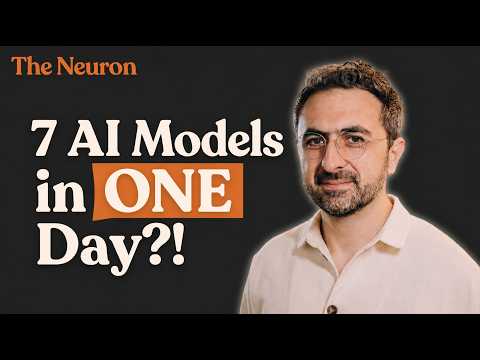
We're here at Build 2026 in San Francisco and you had some big announcements today. Seven new models in one day, eh? We did. Yeah. No, we're very, very excited. It's been a very intense 6 months. We actually have to be truly self-sufficient in AI, be able to get train our own models at the absolute frontier. These are all the basic building blocks of a super intelligence. >> Yes, it needs to be able to hear. It needs to be able to talk.
It needs to be able to see, have a VLM. >> Um, it needs to be able to reason or think. It obviously has to be able to write world-class code. But the motivation is does this accelerate human progress. And that's the test. And if it doesn't do that, then technology should be rejected. Every clinician, whether nurse or doctor or physiootherapist, is going to have an AI assisted tool that is helping them with their diagnosis, with their workflow, with their decision-m 24/7.
Welcome humans to the Neuron AI Explained. I'm your host Corey Nolles and today I'm here with a guest we've had before, Mustafa Sillyman, CEO of Microsoft AI. How are you today, Mustaf? >> Doing great man. Thank you. Thanks for doing this again. >> Absolutely. Excited to have you because uh we're here at Build 2026 in San Francisco and you had some big announcements today. Seven new models in one day, eh?
>> We did. Yeah. No, we're very very excited. It's been a very intense six months and we now have seven new models. Our transcription model is the best in the world, state-of-the-art. It's also the fastest, most cost-effective of any hyperscaler inside of Azure, which is very exciting. Our voice generation model is out now. Voice generation 2. Super awesome model. Um, we also have our image to image editing, image to image model, and our image to image editing model.
Wow. Two additional image models. They're now number two and number three on the leaderboards being out Nano Banana 2 and all of the other models. So we're very very proud of that. And we also have our code flash model and our thinking model. So it's been a it's been a quite a journey, but we're very excited. That's a that's a really big step up. You guys had a lot of restructuring around the AI team and things back into the year and I feel like is that a thing that has kind of led into the ability to make today happen?
>> Yeah, totally. I mean basically for much of last year we were sort of negotiating our contract uh for the next phase with OpenAI and we're very happy with how it landed. um you know we're partnering with them for many years to come but we also set a uh you know a drop deadad date which meant that we actually have to be truly self-sufficient in AI be able to train our own models at the absolute frontier and so since October we were sort of freed up to pursue true super intelligence internally and that's meant that I could deploy you know all my crew on building the best models in the world and that's what we've been up to that's really awesome let's talk a little about mi thinking one uh so this is your first foray into reasoning models how did that come about how long have you all been working on this >> yeah so I mean the way to think about it is that you know the last few years everyone's been sort of focused on pre-trained models and that's very very important and we know that our enterprises and our developers really cared about coding yeah >> um and some of the other models that we get from third parties they're optimizing for consumer use cases so they have like the long tale of languages around the world they have cultural, entertainment, information, and so on.
And that chews up tokens. Yeah. And so instead, our pre-trained model uh is 50% code, really high quality. Wow. Commercial grade, licensed in exactly the right way, dduplicated, decontaminated, really focused on security. And that has produced a very good reasoning model. Right. So that's that's actually a very very important thing. It's it's very distinct to say GD for Google or um OpenAI. Yeah. Um and we did it deliberately so that the model could be great at maths and science and the kind of STEM subjects.
>> Yeah. Because once it learns how to reason, it kind of have this it sort of has this like >> abstract general idea of the logical relation of things and then it can use that to learn in new domains and that produces a general purpose thinking agent that any developer can then adapt to a downstream agentic task >> where you want it to have some knowledge of mathematics and of physics for example to to help round its view it's bringing into other things I guess.
Yeah, that's that's actually what drives it to do really well in RL because much of what happens in RL when you climb a model reinforcement learning style in a broad open environment is that the model has to make decisions and so it needs logic to be able to make those decisions. Should it, you know, try this tool or that tool? Should it, you know, invoke an API? Should it generate novel code? And it needs to obviously do that over many, many time steps accurately.
Yeah. And that's general purpose reasoning, which is what Mi thinking one is exceptionally good at. Now, >> that's really awesome. That's really awesome. And you said you see this as a I think you called it a medium weight medium weight class. Yeah. It's a 35 billion active parameter, one trillion tokens, 256k context length. Um, we've actually published an extremely comprehensive technical report today. 109 pages in great detail going through not just the algorithms but the data mix.
Yeah. All the training methods that we use. We've actually shared a lot of lessons that we've picked up along the way, things that we haven't got right, that we've had to improve. Um, you know, so it's it's a really comprehensive uh report that shares everything that we've been working on. >> That's really awesome. And I think I think that people sleep on in in talking about these when you talk about a million parameters, a trillion parameters is that data doesn't just create itself like that's a massive undertaking to come up with that amount of data.
Like is that are there teams working on that alone? >> We actually have more than 250 trillion tokens internally. >> Wow. >> And we whittle that down at least for MAI thinking one to 30 trillion tokens. And so we're constantly running ablation. Sublation has like pair-wise comparisons between this set of data and that set of data. And we do that, you know, at huge scale to find the optimal combination of tokens to fit inside the medium-sized weight, you know, window because obviously we want these things to be affordable to run inference on.
They can't just be giant because, you know, that's not the goal. The goal is to make them hyper inference efficient whilst delivering the right performance that we need. >> That makes sense. And it's uh it's really fascinating that I think you've hit at an interesting time here where I've I've you know and I mentioned this to you before we talk in our earlier year predictions. One of the things I thought was that I thought Microsoft seems uniquely keyed up to have a number of things coming together because it's felt like we were seeing pieces of that come out with, you know, there's an image model and then there's a speech model and then there's a voice model and and it's like kind of like watching something be built in public if that makes sense.
>> I mean the these are all the basic building blocks of a super intelligence. Yes, >> it needs to be able to hear. It needs to be able to talk. It needs to be able to see, have a VLM. >> Um, it needs to be able to reason or think. It obviously has to be able to write worldclass code. And there's a few other very important capabilities which are coming down the track in the next three or four months.
And then they need to all be brought together in very efficient agentic forms. >> Yeah. >> That allow them to go operate in the real world. And I I think that's kind of what we're working towards in the next next few months. >> That's really awesome. I'm anxious to see that and see how that comes out. >> And now, a message from this video sponsor, Beyond Trust. Identity is one of the biggest attack surfaces in your business, and it's getting messier fast.
You've got employees, cloud apps, SAS tools, machine identities, and now AI agents all connecting into the same environment. That means risky privileges and hidden attack paths can sit quietly in the background until someone finds them the hard way. Beyond Trust's free identity security risk assessment gives you a clear snapshot of those risks in just 24 hours. It helps uncover excessive privileges, toxic access, and identity security gaps across cloud, SAS, and hybrid environments.
To start your free beyond trust identity security risk assessment today, just click the link in the description below. And now back to the episode. in in thinking of super intelligence and and this this quest to for something bigger. U you talked this morning about humanistic super intelligence and I was wondering if you could talk to us a little about that idea, what it means and uh how it came together. It's a very important design intent.
I've always been inspired by science. You know, science and technology >> is really the engine of everything that we are as humans. It's true. all of our progress. And that's the real quest here. You know, we we want to invent the next big breakthrough that makes us all healthier and happier and live better lives, not just for us, but for seven, you know, 8 billion people across the globe. And so, my opinion, the way to do that is to train these models to be really good generalist reasoners that we can use to invent new science.
And that's, I think, got to be the motivation of building these models. The motivation is does this accelerate human progress? You know, that's the test. And if it doesn't do that, then technology should be rejected. Like technology for its own sake isn't an inherent good. Technology applied in the right ways to make us humans, yeah, you know, better and healthier. That's really the kind of benchmark. That's the goal.
And so the purpose of framing this in humanist terms is to remind everybody continually that that's the project. That's the project. And we have to put technology to that test because people are anxious at the moment. Understandably, there's a lot of uncertainty and we don't quite know how it's going to play out. Yeah. I think we have to be upfront and straightforward about that and we have to be very public about what we're trying to do.
I mean, not everybody's trying to do that. Not everybody declares it in those terms. And, you know, we still have a lot of work to do to make good on that promise, but we're we're heading in the right direction. >> Agreed. And I I tend to feel like a little ways farther out, I think a good outcome is pretty certain that there's this this window of time that's very very in flux. And uh you know, I mean, we none of us have a crystal ball, but it's good to see that you're making decisions that that are centered around that idea.
And I think that's very important. >> Yeah. And I mean, we get to choose what applications we work on, right? So today we also announced that we have this incredible partnership with Mayo Clinic. >> Yes. >> It's a really big deal. I mean number one hospital system in the world you know many people associate them with you know kind of elite care for the people who can afford it. >> Yeah. Truth is 65% of their patients are on Medicare Medicaid.
>> Mhm. >> Um and that's actually remarkable. So they have a very representative population uh cohort in in in their patient population. They have the largest most digitized longitudinal patient record of anyone in the world including any government. highest quality data that exists. >> Um, and you know, I I think that's going to really make a huge difference. It's multimodal, it has genomics, it has clinical practice as well.
And so we're really really excited about this because I I think that it's going to really help with diagnostics, with treatment, with preventative intervention. And, you know, it's going to take us quite a few years to to really land the the model here, but we're going to train a new foundation model from scratch together. So, it's very exciting. >> That's amazing. And you know, the thing that that's really cool about it is it also creates access to male caliber information like they've uh you know, they've done so much research work with with rare conditions and diseases and things that don't get tons and tons of attention uh as well as you know, the many cancers and other diseases we hear about.
So I mean I I can't imagine that the data they have is not a gold mine of of stuff for longevity for quality of life improvements. >> Yeah. And and they've already deployed hundreds of AI diagnostic algorithms themselves. So I mean this is kind of an important thing to realize. They invested in digital pathology seven or eight years ago. Wow. They've been pushing um mimography um radiology you know from from day one.
Um they've been doing digitized radiotherapy. like they've really been pushing the boundaries for a very long time. So, they're a great partner for us because we're already starting at the absolute peak. Yeah. >> At the top. And I I think that's the big quest is like, you know, obviously we want to make Mayo quality healthcare available to everybody. >> Yeah. >> But we also want to, you know, uncover new diagnosis, new correlations that were maybe surprising because we have this like breadth of very longitudinal multimodal data.
just by existing ideally there will be things that it can uncover that thinking of AI in terms of pattern recognition and things like that there's so much something like that could uncover just in working with itself. Yeah, totally. I mean, ju just as every coder today now has an AI assisted coding agent, >> every clinician, whether nurse or doctor or physiootherapist is going to have an AI assisted tool that is helping them with their diagnosis, with their workflow, with their decision-m 24/7.
Yeah. So I I'm pretty sure that's going to be the next big product market fit explosion in um the application of AI just as we've seen chat and code over the last three or four years. Healthcare I think in 2027 you know is probably going to be the next one. >> I think you're right and uh can't come soon enough to suit me. The truth is that's you know when you think of of the promise of AI that is what brought so many people into this space.
It's not just this idea of building cool software and building this this thing necessarily, but like at the core of all of that is this idea that this can help with the problems humans can't solve on their own like problems around longevity around not just longevity but making life something you want to continue living you know making it good enough and finding new ways to use exciting things. And I think it's u it's excellent that you guys are doing this work and I'm excited to see where it goes.
>> Thank you. Yeah, me too. Very exciting. Mustafa, thank you so much for joining us again. This has been an absolute pleasure. I uh look forward to seeing what you all do and can't wait to get my hands on some of the new toys you dropped today. >> Pleasure, man. Thanks very much. I appreciate it. >> Thank you. If you haven't yet, please take just a moment to like and subscribe. We'd love to have you.
And pop by the neuron.ai. Sign up for our email newsletter that goes out to 700,000 or so every morning. We'd love to count you as one of our readers. And on that note, that's it for today. Farewell for now, humans.