Google AI 的历史与未来——对话 Sundar Pichai(Cheeky Pint)
The history and future of AI at Google, with Sundar Pichai (Cheeky Pint)
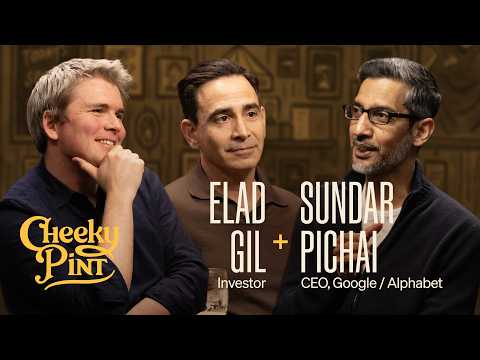
Sundar Pitchai just passed a decade as CEO of Google. Alphabet is now not only one of the world's biggest tech companies, but a leader in the AI race with plans to spend $175 billion in capex in 2026. >> Cheers. >> Thanks for coming. >> Oh, thanks for having me. A bit of history that people talk about a lot in the context of Google and AI is the fact that transformers were invented at Google but then productized outside of Google uh with uh mostly chatg and kind of that style of product.
How do you reflect on that now? >> I think it's actually worth talking about. It's a bit misunderstood. You know transformers was done in the context of a lot of like like TPUs transformers were all done to solve a specific product need to some extent right like the teams thinking about how to make translation better >> in the case of TPUs how do you hey speech wreck works >> but you suddenly have to serve it to two billion people we don't have enough chips for it >> it's like how do you solve inference for it so trans >> I had known that the transformers were specifically >> uh it was from our research teams right But they were guided by solving product problems >> and and transformers were immediately used.
So Bert and mom people underestimate how much because we measured search quality so religiously. Some of the biggest jumps in search quality in that period where search went ahead of everyone else was because of Burton M. We built transformers and used it immediately in search to improve language understanding, understanding web pages, understanding your queries, kept building better models. >> We had also started productizing it internally in the form of there were teams building something called lambda.
>> So obviously we weren't the first to ship that. But I think it's less to do with like it was just research and we weren't applying it in a product direction. That I think is just >> it's like you did this research, you then saw massive ROI from using it the way you intended and then you didn't invent all of the products that were invented with it. But that's to be expected. >> I would go a step further.
We exactly even conceived the product which is like Chad GBD. It was lambda. You know if you would remember there was an engineer inside who thought it was sentient. Right. So think of it as a early version of charg speaking to internally. So we >> we even had the product version of it >> in the multiverse somewhere else. Google probably shipped that >> 9 months later or something like that. Yes, >> maybe the in fact in the Google IO in in we launched something called AI test kitchen and that was lambda but we had constrained it because internally we didn't have an end toend version which was RLHF right so the version I saw was a lot more >> uh you know toxic at a level we couldn't have possibly put it out at that time and also I think as a company which had this search quality bias.
And so, you know, we had a higher bar maybe, right, for what we thought was an acceptable product quality to go out, but it wasn't like it wasn't we were figuring out how to get it out. I would also argue that even when OpenAI shook, they did their deal with Microsoft probably a couple months before. So, like, you know, so you can look back and say it wasn't entirely fully obvious. I think they were lucky to also see it on the coding side.
with GitHub I think maybe there was a signal we were missing >> you know coding side probably you were seeing more of a sequential jump than probably you know just on the language side >> so maybe the jumps between GPD2 and three and later four were more pronounced you know if you were using it for coding too so that you know you can point to things but yeah so but I I think to to answer your original question >> yes >> I think it was less less that research to product >> than a bunch of other factors.
>> I also um I remember talking to some of the people who worked on ChachiPT and I think they launched it the week of Thanksgiving. You know, it was a little of a buried launch. It wasn't like this is a big prominent thing and this is going to be an important part of our future. I think it was a cool >> sort of test case. Yeah, it was really interesting. >> But, you know, the way I internalized these moments is if you're in consumer internet, you're going to have surprises.
>> We were at Google when um El and I made you >> there was something called Google video search. >> Mhm. Yeah, >> YouTube came out, right? Just that we acquired YouTube or think about if you were in Facebook, Instagram came out. >> Nobody sits and says like, you know, you don't look at those moments with that >> drama because Facebook just bought Instagram. >> Yeah. Yeah. >> Right.
And but the way I've internalized is consumer internet people are able to three people are going to be sitting and prototyping and throwing out millions of things. I I'm not trying to diminish anything, but I'm just saying you're always going to have >> these moments. You know, I don't think people like wake up in a garage and ship a better iPhone. Like that's not going to happen, right? But that's not how consumer internet is.
So you you just have to be conscious of that and internalize that. As I think about the AI race in 2026, one thing that strikes me is Google has for so long had speed as the place it tries to differentiate. And so original Google search was really fast and you know famously displayed the uh you know search query time within the results uh sort of showing off and then you know Gmail fast search compared to the competitors of the time or Chrome compared to the competitors of the time and now I mean I use all of the AI services for different things but Gemini on TPUs is just so fast and I'm curious how much this is part of the explicit product strategy and how you think of it or it's much more nuanced than that.
I've always internalized speed. Let's call lat call it as latency for this purpose, right? And and uh as like one of the distinguishing features of a great product and also almost always reflects the technical underpinnings of the product having been done well. There's a different speed which matters too which is the speed of shipping and iteration and release cycles. Uh so both are important but you know you talk about latency there are time you know you it's easy to say you know you want latency but you're constantly adding capabilities so the capability frontier is progressing so there's some sense of how do you balance that so that's where it gets more complicated but to give an example like search you know I was speaking about the teams right like they now have for sub teams like latency budgets like in the milliseconds you get 50% credit if so if you ship something which you know shaves off 3 milliseconds you earn 1.
5 milliseconds for your latency budget and 1.5 milliseconds gets passed on to the user >> right and and depending on what we think you're doing some people may get a latency budget of 30 millconds or 10 milliseconds you can use it so but you have rigorous reviews against that but That's how much we think it matters. So, >> and for context, I guess humans pick it up in the low hundreds of milliseconds. Is that correct?
In terms of where it actually impacts >> field. That's right. Yeah, that's right. I think we've actually, you know, the last checked the dashboards and the metrics, we've actually improved search latency by 30% in the last 5 years. But think about the functionality >> progression that's happened. This is why in Gemini, you know, we deeply think about that parade of frontier >> of making sure, you know, the the the uh the capability to uh speed and and you know, the flash models are at like 90% the capability of the >> pro models >> uh but much faster uh much more effective to serve and and the vertical integration helps and and so on.
How do you think about the future of search actually? Because a lot of people now are talking about chat as a new interface. Obviously, Gemini's incorporated um or search has incorporated Gemini or AI results in in the context of Google, but a lot of people are now talking about agentic flows and everybody's going to have a personal agent who >> uh instead of typing in a query, it'll go and do something for you.
You know, instead of asking about trips, it'll go and plan a trip for you. >> Uh what do you view as a feature of search? Is it a distribution mechanism? Is it a future product? Is it one of n ways people are going to interact with the world? >> I feel like in search with every shift you're able to do more with it >> and you know we have to absorb those new capabilities and keep evolving the product frontier.
>> You know if it's mobile your product evolve pretty quickly. You're getting out of a New York subway you're looking for web pages. You want to go somewhere how do you find it? So you're constantly shifting the you know people's expectations shift >> and you're moving along. >> Yeah. If I fast forward you know lot of what are just information seeking queries >> mh >> will be agentic in search you'll be completing tasks you have many threads running >> mhm well search exists in 10 years >> well you know you may >> or just evolves into >> it keeps evolves like you know search would be an agent manager >> right in which you're doing a lot of things >> I think in some ways I use anti-gravity today and you know you have a bunch of agents doing stuff.
>> Mhm. >> And you know, I can see search doing versions of those things and you're getting a bunch of stuff done. >> But I think the root of your question is if you think of search as a prompt that is not longer than one line returning a bunch of different ranked results >> as opposed to just telling you the right answer or something. I think your question is does that modality >> but today in AI mode in search people do deep research queries, >> right?
So that doesn't quite fit the definition of what you're saying, right? So but kind of people adapted to that, >> right? So I think people will do longunning tasks. >> Sure. >> We all started or the the you know life started as unicellular organisms and now we have this complex life. And so the question is almost like does that former version or paradigm eventually go away and really what was search becomes an agent and your future interface is an agent and the the search box in in 10 years or n years is is no longer >> I mean the form factor of devices are going to change IO is going to radically change and so you know so >> it's tough to I think you can paralyze yourself thinking 10 years ahead >> but we fortunate to be in a moment where you can think a year ahead and the curve is so steep >> it's exciting to just do that year ahead right whereas in the past you may need to sit and like >> envision 5 years out >> I'm like you know the models are going to be dramatically different in a year's time and so pro you know so I think riding the curve itself is exciting and uh so I think it'll evolve but it's an expansionary moment I think what a lot of people underestimate in these moments is >> it feels so far from a zero sum game to me >> right like the the value of what people are going to be able to do is also on some crazy curve, right?
So, >> so once you view it that way, you know, like people would ask all these questions, right? Like I mean, YouTube has done well since Tik Tok and Instagram has, you know, so you can I can give many examples. >> I think you know the more you view it as a zero sum game, it looks >> difficult. It become it can become a zero sum game if you're innovating or the product is not evolving or you know but but as long as you are at the cutting edge of doing those things >> and we doing both search and Gemini and right and like you know and so they will overlap in certain ways they will profoundly diverge in certain ways >> right so and and so I think I think I think it's good to have both and uh embrace it >> when we talk about kind of searching where it's going and things like this I'm reminded of the fact that basically a year ago kind of spring summer 25 sentiment was very negative on Google uh the prevailing view was that you know search is cooked and you know going to have a really hard time the core business model is under attack blah blah blah you know uh Google was trading for $150ish dollars a share and now people have realized that's silly you know Google has up and down the stack whether it be applications or models or TPUs or whatever um turns out as well as you know Whimo and YouTube and all the cool bats.
What do you think investors as a proxy for kind of informed sentiment um misunderstood this time last year? Cuz clearly there was some big misunderstanding. You know, I was obviously kind of very inward focused in that moment. So, you know, to me it was very clear in that moment. Hey, the Overton window shifted. We have like I felt like the company was built for that moment. >> Um, you know, the vertical thing.
It's it's it's not an accident or something. It was a very intentful. We were in the seventh version of TPUs. >> Yes. >> I remember it might have been 2016 Google IO where we announced the TPUs and you know spoke about we building AI data centers. >> This is 2016. We were thinking about you know uh you know the company was operating in AI first way. So we had deeply internalized the shift. So to me we were behind in terms of frontier LLM models but we had all the capabilities internally and we had to execute to meet the moment.
But we had the exciting part was when I look at it from full stack. We had the research teams, we had the infrastructure teams, we had all the platforms and we had been investing in intentfully in many businesses, right? And to me it suddenly felt like wow, we have this one common technology which can accelerate all those businesses. surge to YouTube to cloud to Whimo all relies on progress in this uh so it was a very leveraged way to uh make progress >> so I understood it and to the earlier point of the discussion I didn't view it as a zero sum moment at all >> right and I felt like everything is going to scale up 10x >> right and there's going to be room for other people right and you go back you know, Amazon has done well since Google came into the picture and Facebook.
So, we underestimate the growth scenario of how all these things work, right? So, but we had to execute better as a company. So, that's what I mean meant by I was more focused on that. >> Mhm. >> Was there something that demonstrated to the outside world that oh, they got this? Was it Gemini 3 that changed people's lives or like I didn't follow all the timelines? I think I think the real model uh probably where people uh saw it was maybe Gemini 2.
5. >> Mh. >> Um and you know and getting to the frontier on multi particularly around multimodality we made a bunch of I mean credit to the Google DeepMind teams right uh they we I think we paid a bit more of a fixed cost up front but we designed the Gemini models to be very multimodal from day one. Mhm. >> And so there were there were areas uh I think I think um we started the strength started showing Nana Banana was an example of it, >> right?
So you were able to see it all together. But look, it's an amazing >> amazingly dynamic frontier. I think there are two to three labs who are pushing each other pretty vigorously. >> Mh. >> You know at any given month we feel like oh great we've done this well. Oh there's like a couple things we're behind. Right. But I think the picture will again be dynamic in a few months. >> So the I think the frontier is intense as you would expect it to be.
>> Uh so that's how I >> it's been interesting because when I talk to researchers not at Google >> or at the other labs um one of the things that they commonly bring up is that they feel like the difference between the the you know two or three other labs in in uh the Google team is that Google is not as uh they call it AGI >> pill. In other words, there's less of a belief in AGI being right around the corner and the acceleration through it and obviously the folks at Google are thinking deeply about that.
A do you think that's true? And B, do you think that at all impacts some notion of what the future actually looks like and therefore how what people are building against? >> Look, I think you know we probably have scaled our capex from 30 billion to approximately 180 billion. >> It's like real money now. uh you know you you don't do it if you don't think you know you know about the about the curve a certain way >> I view it as largely semantics maybe because >> we are a larger company >> with a lot of products that touches so many people at so many levels >> maybe the language of how we uh uh uh uh uh talk about it might be different I think the founders were AGI built Yeah, >> probably you know my earliest convers I think this notion that >> at Google we haven't understood what AGI is or or >> Deis and team or Jeff Dean and team like you know I mean >> at one point >> I don't know Deis Jeff Ilia Dario were all there so we can this so you know >> I like that retort it's like uh hello have you paying attention for the past 20 years >> yeah so that doesn't make sense to me I I think some of it is, you know, if you're a younger company, uh, you know, or you you're more a pure research lab, uh, you know, >> you're maybe headquartered in San Francisco.
>> You know, there are a lot of small attributes which can probably make a difference, >> but I don't think >> at a foundational level there is a difference in outlook on what the curve is. >> Yeah. >> Right. Or how we internalize the technology. Look, I think even within the company, there's a set of us living on the bleeding edge, firing agents, seeing what these things can do. >> Uh see the agents pick up skills, do stuff, and also look back 3 months ago what they could do now >> and we are living that exponential internally, >> right?
>> I think you're both right where I I agree. You can kind of point at um history of Google. I think what a lot's getting at is like a a feeling uh where uh I saw a tweet go by that someone was saying what you have to realize to explain what's currently going on in the valley is that every tech executive has severe AI psychosis right now and is spending you know a huge amount of time writing code and talk to AI and things like that was a funny take and not without any truth to it and I'm curious what were your feeling the AGI moments along the way of the recent or you know to what extent do you have AI psychosis these is >> my first feeling the AGI moment was uh 2012 when Jeff Dean demoed the earliest version of Google brain.
This is the when the neural networks recognized a cat, right? So >> that was 2012. >> Um I went with Larry to the DARPA challenge. Uh might have been 2014 I think. I need to be exact about when when we went there. seeing the cars drive there uh demoing the earliest versions of the models having what we would call as imagination. So there have been many moments like that. So it was obvious the technology is progressing in terms of living now and kind of having a visceral feel for it.
I think the closest I would say is if you're coding and you give it a complex task and you never open the IDE >> and you're in some agent manager world and you see it kind of do it. >> Mhm. >> You know and how powerful it is. So you know if you you can you know call it feel AGI. So there are moments like that. Yeah. >> Yes. Yes. I did a little hobby project recently and after a while I was like oh I wonder what language it's using.
But that was like a detail that I needed to ask it about after everything was up and running. >> Yeah. Feels like magic. >> Yeah. So, you know, moments like that for sure. Yeah. >> And but but the but the slope of the curve is what surprises you. >> Yeah. >> Right. And and you're improving it on so many paradigms. It feels clear that there's going to be progress ahead. Right. So >> when you talk about the visceral feel, I feel like one thing that's important at tech companies and every CEO thinks about this differently is how you stay connected to the product experience and everyday users because tech products are so abstract that it's easy to you know you cannot just manage through reports from teams and slide decks and spreadsheets and so you know Tony Shu is talking about um how he still works as a door dasher you know to stay very connected to that experience we do at our like little weekly all hands.
We have a recurring segment of just walk the store where we like click around in the dashboard together and we're tripping over like why is that modal there and that's a bit confusing or whatever just so we're like collectively using the product. I'm curious how it works for you and how at Google you ensure that >> you're staying connected to the experience of using the products other than you use like Gmail and everything every day.
Oh yeah, you know like you know dog footing uh like literally internal versions. >> I do block time like to kind of use it intensely. So like kind of focus time to do it and so that helps. Like even just two weeks ago I was stretching in the gym and I had the phone with Gemini live and so I'm like I'm going to talk to it for like the entire 30 minutes on like one topic. Mhm. >> So you you do those things and it's it's some of it works, some of it is frustrating, but you kind of learn a lot, right?
Like so I force myself to use it in those power user mode ways and and stay in touch that way. X helps because sometimes you get the raw feedback. >> Thank you for fixing the Google calendar thing. That was so good. >> Well, the few more we have to fix, but >> no, it's awesome. >> Thanks for flagging it. Yeah. >> So, yeah, X helps because you you kind of get the raw raw comments and I try to follow it directly.
>> Mhm. >> But I'll tell you what what has helped internally like I would go fire to our earlier part like I would query in anti-gravity just our internal version of anti-gravity. >> Hey, we launched this thing >> like what did people think about this? Tell me like the worst five things people are talking about. the best five things people are talking about >> and I type that. >> So now that brings it back.
So has my life gotten easier? Yes. >> So in the past I would have to spend a lot more time trying to get a sense for it. >> Mhm. >> Now an AI agent is helping me in that journey. So you can get you know well how much should I be spending firsthand to get that feel versus >> actually leveraging these tools. So even I'm going through a journey there right? So I'm trying to adapt to this future.
I guess there's um you mentioned a that it's not zero sum b there's all these productivity gains people are seeing and if you look at a lot of prior technology cycles it took a while for the internet or for mobile or for SAS to show up in actual GDP numbers >> right in the context of AI we're seeing it from a data center buildup perspective right that's driving part of GDP growth how do you think ahead in terms of three four years do you think the US economy is bigger because of AI and if so how much bigger >> look for these returns to make sense somewhere where it has to um you know how long was it before I think it was maybe from Sequa someone wrote and saying >> okay >> people are investing this much >> yeah they're comparing the capex to the uh >> and this might two and a half years ago it was a talk and like saying it doesn't make sense because you would need to return at that level >> you probably 10x the >> investment [snorts] >> since that moment I need to go look at the numbers again right so >> at some point uh you know it has to reconcile uh to be very clear >> you know we are see we are supply constrained we are seeing the demand across all the surface areas we offer >> I actually don't have any doubt that this is a massive market and outcome so my my question and I I think there's a lot of things that people misunderestimate so for example >> people often talk about software engineering budgets and then what proportion of that is token versus salary and to some extent I think that market has been so demand constrained for great software engineers that suddenly adding supply can 10x that market, right?
In other words, I think the market for software engineering and coding is dramatically bigger than anybody thinks and it's the wrong metric to say, you know, token budget versus engineers. So, I actually think it should grow a lot of things. >> Yeah. >> I was just sort of curious of your view of like how much growth do we think is likely actually to come of this. I actually wasn't doubting at all sort of capex versus outcomes or you know, I see.
>> Yeah. >> Look, I mean going back at the internet and looking at GDP growth, uh you know, it doesn't quite capture what we all feel with the internet, right? And so maybe you would have had negative GDP growth without the international. So you know it's it's tough to look ahead. >> I do think there are natural dampening mech mechanisms in uh in society at various levels. >> Um and the obvious ones being you know the compute buildout is a different curve than the rate at which we can improve the models >> right?
So you're already dealing with a more constrained curve there. Um then how do you diffuse it into society right we doing this with way more >> right and you you can make way more safer than human drivers but you know but you have to be careful at like the pace at which we are rolling out etc. So sometimes you know how do you diffuse it through society responsibly? There are constraints in all these layers right.
So but I think the US economy is so much larger than it was 10 years ago. So to grow that >> even at a half a percentage point higher than you know that that's a massive contribution. >> So I expect it to play out that way. Listening to Sundar is a powerful reminder of what it means to operate at true internet scale. When it comes to commerce though, most businesses are forced to make critical decisions in a vacuum.
They view the internet economy through only their own lens using only the data that exists within their four walls. This is where Stripe comes in because we process $1.9 trillion a year in global payments. We have a panoramic view. When you build on Stripe, you're plugging in to that network intelligence. From verifying a user's identity to stopping fraud before it starts to streamlining how businesses connect and knowing what payment methods work best locally, we built a system that puts 1.
6% of global GDP to work to protect and grow your revenue. So, if you want to use the power of Stripe's network intelligence, come see what you can build here. You referenced the supply con constraints and I think that's a really interesting defining aspect of twin 26 basically where you said 150 billion in capex 180 >> we have said it's it'll be between 175 and 185 >> okay so 180ish uh billion of capex and what's interesting to me is that Google could not spend $400 billion in capex if it wanted to because the memory isn't there and you know the power isn't there and all these components So can you just take through >> we can find a number of electricians we would need >> exactly.
So I'd love to hear just your overview of the various bottlenecks. look at some level you have to work back to actual wafer capacity or something like that right so there are like deeper ground truths right >> I think so wafer starts it's kind of a fundamental constraint >> I think power and energy are more solvable >> permitting and actually working through a regulatory environment might might be a constraint right so the the the pace at which you can do things >> even though there's lots of land in progrowth, you know, Texas or Nevada or Montana, just maybe not enough.
>> I think we we're making tremendous progress. I think for the US, I think it's a particularly important thing. You know, it's you're in awe of like how the pace, you know, in China, how fast they can build things. >> So, I really think we need to learn to build things much faster. like you you almost have to shift your mentality to think about what would it take to do things 10x faster right in the physical world construct 10x faster >> but I would worry about that as a constraint >> right I think >> you know there could be growing resistance so you know it's not as simple as like a few people deciding we want to build faster >> the data center >> moratorium yeah so I would say wafer starts the ability to permit and do things and I do I think there's a lot of good work being done from the government on.
>> I think people realize you need to do these things better. >> Then comes critical components in the supply chain. Um memory is a good one. We we are constrained in those things in the short term. >> Everyone will respond to it. >> Yes. >> But I think all of us running companies regardless of how AGI pill you are. >> Mhm. Then comes this error bands of like you know how bullish can you be what's the margins you can afford because there are extraneous factors which can go wrong in the world right which are outside your control >> so everyone is making those adjustments those are all constraints >> right and constraints >> so I think but that's where I see the constraints >> is memory the biggest component that you think about >> memory is definitely one of the most critical continents now.
Yes. >> And you said in the short term, do you think just people ramp up supply and so high prices will take care of it? >> There is no way that the leading memory companies are going to dramatically improve their capacity. So you have those constraints in the short term, but they get they get more relaxed as you go out. >> Yes. >> But I do expect all of this to constraint. By the way, I think it'll push a lot of innovations on >> we will make these things 30x more efficient.
>> Yes. >> Like so all that is happening simultaneously as well >> works. >> Does that enforce a igopoly market? So if you actually look on the model side because if you look at um a lot of the views of models and how they're going to improve a lot of it is going to be both self-improvement. So the models will start writing more and more pieces of themselves do more data labeling for themselves etc.
>> So there's a musical chairs game of who has compute right now. Basically you're saying >> exactly who has who has compute right now and how much can you actually scale relative to overall industry capacity and if everybody is roughly parata up to some number you've effectively put a ceiling on how much far ahead somebody can pull versus everybody else. Do you think that's a correct statement or an incorrect statement?
I think it's a reasonable framework to think about it uh that way but there are things which are you know I'm coming here as we just shipped Gemma 4 >> right and um it's a really good open source model I mean the Chinese models are very good you but I think outside of China you know it's a very good open source model you know the frontier to Gemma 4 is both >> huge and not so huge in terms of time like of uh Gemma 4 is based on Gemini 3 architecture Right.
You know, it's a very weird thing, right? You're talking about a set of weights which can fit on a USB stick. >> Yeah. Yeah. >> So, so it's like a really >> um you know, crazy. It's not like a SpaceX rocket, you know, like it's like >> I'm always shocked that you run a data center for months and months and months and then your output is a flat file. >> Literally, it's like having a word doc or something and that's your model.
It's amazing. So there are these unique attributes about this. So which when which makes me challenge those frameworks and say >> you know how should we think about this >> but I think it's a reasonable at least on the inference side what you're saying is a very reasonable way to think about it. >> Uh think about it but I do think I do think everyone is trying to figure out how to blow through and the capitalist incentive >> to break through these constraints.
>> Yeah. You know it's immense >> but as you say there's only so much memory in the world. So like no capitalist incentive will really solve 26 or 27 memory supply. >> That may be the era where you see more divergence you know and and remember >> that has to balance with >> wafer capacity increasing you being able to permit those data centers. >> So this constraint may be less severe than it appears right.
So you have to kind of >> you have to envision the total square set of like all the things that you need. M >> and then and and think it through, right? >> Are you creating capital? >> Yes. Yes. But but again, what's interesting to me is that plausibly people would invest beyond the current capex, but we're now just running against 26 and 27 real world constraint. It's a little about the straight of hormuse.
You can have whatever price of oil you want. Ultimately, if you take 20 million barrels a day out of the system, you need to like destroy 20 million barrels a day of demand. And it's kind of similar with memory where like ultimately some people have to not get the memory they want. >> But there are other constraints rightly which you you know take security as a constraint. >> Mhm. >> And these models are definitely like really going to break pretty much all software out there.
Maybe already we don't know as we sit here and speak. >> Do you think all software there? Cuz like SSH people have been trying to break for a long Do you think I'm >> I'm talking about just think software large platforms >> right how many zero days >> you know so there are constraints here in the system right you just can't wish away right >> somebody was telling me the black market price of zero days is dropping because the supply is growing due to AI which I thought was a really interesting >> market metric yeah >> not at all surprised right and uh not at all surprised so >> so but when it how does it practically diffuse through society what are the implications of it right like you know and so and so there are parallels I think so I think there could be hidden constraints >> yes >> and there could be shocks to the system if you will uh but having said that like you know uh I I genuinely think there's a lot of upside ahead some of the constraints maybe are helpful >> yes >> right I think constraint inspires creativity >> forces a compaction cycle where we get more efficient >> forces maybe important conversations to be had which otherwise wouldn't wouldn't Mhm.
>> Right. I think um you know just on my security point alone like I thought about we are going to need more coordination >> which is not happening today will be a moment of you know it could be a sharp moment right and like you know and so all those things I I I don't think you can wish them away. >> Yes. Yes. >> Right. Yeah. >> Actually related to that Google does have an amazing portfolio of things is both built and bought into from a ownership perspective.
you know, you own a reasonable amount of SpaceX. I think I I don't know the exact amount, but I think it was 10ish% way back when anthropic tennis percent, the majority of Whimo, which is like an amazing thing. And then, um, internally, obviously, there's this enormous swath of amazing technology that's been developed. We talked about AI and transformers, there's TPUs, obviously. Whimo was another one of these things.
There's quantum, you know, you just released a very interesting result there. Mhm. >> Are there other hidden gems that people should know about or that are especially interesting or that may have very big impact in the future? >> People may underestimate. >> Look, we're constantly trying to take these long-term projects which when you first announce them slightly marginally looks ridiculous. Um you know like we're in the earlier stages of thinking about data centers in space u right but to your earlier point discussion around constraint inspires creativity.
Mhm. >> But if you take a 20-year outlook, right, where are you going to put most of these data centers? >> Mhm. >> Really hard problems to solve. >> But those are examples of projects we think about today which are way more in 201 like 10. >> Mhm. >> Uh quantum itself is one of the one of these projects. >> Uh we are like in a deeply committed way making progress there. >> Mhm.
and I'm excited about it. >> Where do you think quantum will have the biggest impact? Because mainly people talk about molecular modeling, they talk about cryptography. Um there's quantum proof sort of cryptography that people have been developing over time. On the molecular modeling side, it actually looks like the the deep learning models tend to be very good at that in certain circumstances. I mean, you all pioneered that with AlphaFold.
Do you think quantum will actually matter? And if so, where where do where do you think it'll have the biggest impact? Look at abstract level to me it feels like to simulate nature more and more >> like you know like given it's inherently quantum you would need quantum systems to better simulate it. We may get there with classical computing techniques in a surprising way or get at it with enough compression enough uh you know uh abstraction it may work but I fundamentally felt like quantum would have an edge there >> and I don't know we still don't understand the behavior process for fertiliz like there are many complex I mean you know it's probably your background going back to what you did in college >> more so my you My instinct tells me they'll be you know >> simulating weather simulating you know reality >> all that I think quantum will have an advantage I think the way history of technology is you get something to a scale where it works >> and then you use it and people's creativity on the top finds the applications so >> you know I mean I always give this example of >> mobile phones plus GPS enabled Uber Yeah, >> like like >> there's nobody who was working on for phones who would predict that as an outcome of this platform shift.
>> So, you know, I'm confident quantum will have many many many applications >> if you can actually make it work. >> Yeah. >> So, that's how I I think about it. >> Sorry, we interrupt you. You were talking about kind of your favorite of the Google further field. I think we're making um uh you know the GM team is deeply thinking through robotics >> right and uh you know robotics is an area where we were too early as a company before it turned out AI was the missing ingredient for a lot of ideas maybe 15 years ago or 10 years ago but you know the Gemini robotics models are sort of on spatial reasoning etc so we definitely have state-of-the-art models here and we are partnering uh back in an ironic way with Boston Dynamics and and Agile and a few other companies and and in a determined way making progress and there are uh extraordinary startups out there as well.
>> Mhm. But so we are investing in you know I spoke about quantum data centers in space drone delivery with wing >> you know I think we are scaling up wing where in some reasonable time period like 40 million Americans will have access to a wing >> delivery service right and I'm not talking years out or something like that but again these are all like methodical compounding >> when you take these long-term projects so you know we we are committed Isomorphic.
>> Mhm. Isomeorphic is very exciting. In fact, >> you know, think about uh uh you know, think about being focused on these models in a targeted way, improving all the possible steps in drug discovery. >> Mh. >> And even though you have long polls like phase three trials, etc. getting there with a much higher probability of success. Yeah, I think it's definitely the smartest approach I've seen in terms of the different biom models and really thinking about the broader swath beyond just the molecular design which is I think where most of them are stuck.
>> It seems very smart. Can can I ask I'm curious how capital allocation actually works at Google and what I mean by that is you know the idea good capital allocation is about internalizing that the opportunity cost uh for capital and putting the cash that a business generates towards its highest and best use and in the toy example in a business school book you know maybe you're Boeing and we can either you know we have this cash that our business generates and we either go bid on the next defense contract and we'll invest this much in R&D dollars and we model this much revenue from the contract or we go develop a clean sheet commercial airliner and we'll put in this money and we model this kind of thing.
It's like a 16% IR versus a 19% IRRa. Okay, I prefer the 19%. In Google's case, the projects are extremely heterogeneous where it's like, okay, we can give the YouTube team more funding so they can go, you know, improve the recommener algorithm and therefore time on site increases and so does monetization or we can give the Whimo team more funding so that they can actually get to market faster or scale up faster or we can invest in this new AI approach that might, you know, pay off in five years time.
And so I'm curious if you are trying to put capital towards the highest and best use and you're ultimately comparing, how do you compare initiatives that are so different in nature and so different in payoff curve shape? >> This is the most John question ever. >> I need to know you need to throw an >> It's a good question. Look, I feel it today more than ever ironically because of TPU allocation. M >> so in some ways I feel even way more HDPUs right then so you know computers made the question ironically much more front of mind >> by the way of all the things I do I'm really looking forward to how AI as a companion at least gives inputs to this task um you know and I think >> once we can actually get all the data connected and flowing through the models are already capable it's more uh you know getting all the data unlocked I think will be helpful.
So I feel it there. Historically I think at Google one of the advantages we have had is sometimes we make these decisions very early in the cycle. So it's almost like going back to that roots is a a deep technology orientation and you know we actually think about the question you were asking a bit ago about like what are those longer term things >> and so I think thinking at that stage it's easier because your initial funding amounts can be smaller but then like you know you stay committed for the long term but you're making sure you like making progress in a deep way.
So as long as you're seeing that underlying techn like take quantum for example >> how do we judge it like we're judging the underlying >> like you know so you have goals around >> you know what logical cubit error corrected log stable logical cubit threshold by when you're going to get to and is the team able to do that >> right so I think I think you assess it that way so one of the I won't say advant I think one of the ways we have thought about it and we've been disciplined about or at least to me matters a lot is to make those early technology bets in in kind of a deep Okay.
And and so that's helped. But on a on a constant basis, look, I I always view it as you have to assess the long-term value of these things, right? So it's almost like in some intuitive way, you're thinking about the option value and the TAM of something 5 to 10 years down the line >> and and you assume like a crazy growth, right? And and and think through whether those decisions make sense. So the TPU investments have been great that way, right?
And u you know we've steadily invested in that. Whimo was a great example where I think we increased our investment two to three years ago when the rest of the world got pessimistic on it. >> Mhm. >> When others some of the people were backing off >> it's very magical. It's such a magical experience. I take Whimo now every day to work when I can and it's >> I think Whimo is a good example of this like this question I have which is >> Google does cut projects and there's various things you've tried where you said you know we're actually not going to fund you know this part of X all the way or you know we're not going to you know we're going to retire this product it's not working but Whimo despite the fact that it was a long road from a compelling demo to commercial service in market you guys didn't lose the faith and so >> what was that you were seeing.
Is that a qualitative decision or a quantitative decision? How do you decide that we're going to cut Lon but keep Whimo? >> I think it's to do with that some kind of quantified you look at the Whimo driver. That's underlying technology which you know how does the software drive the car >> and the progress in terms of safety and reliability. So it's a longunning task. how safe and how well will you do it >> and you follow that curve >> and you predict or you set goals where you want to be and how you perform against those curves.
>> I think the team has been phenomenal. There have been maybe phases where they it didn't progress. >> But those are the times you need to kind of like you know you have confidence in the quality of the team >> to break through those phases. But I think the more you're able to evaluate things at that deeper technology level, >> I think you tend to make those decisions better. >> Or at least that's how I have tried to do it.
One um argument I've heard uh or one discussion I've heard made about Whimo is that a lot of the huge gains that have been seen recently because it used to be this handmapped huristics of like how do you deal with edge cases of driving or something happens how do you respond and a subset of those were almost like uh handdrawn out for the cars to follow and so it had kind of a narrow set of things that it could do and then really the breakthrough was moving to end to end deep learning a couple years ago as this big transformer wave was happening in general.
Do you think if Whimo had been started 5 years ago, it'd be at the same place as it is relative to having been started 15 plus years ago just given that that's the breakthrough that's kind of propelled it forward. >> Look, I think you know we spoke earlier about robotics. You can think about Whimo as a robot, right? I think people who are starting robotics in the last 3 years by definition >> would be making faster progress maybe >> but I think Whimo is such an integrated system.
There are aspects of it >> not quite like but you know like you know you take something complex like TSMC or SpaceX launching things >> you are talking about system integration in these things in a very complex way. >> Mh. >> I think Whimo has hidden aspects of that which the time of how how you do it the craft of it matters. Mhm. >> But having said that, I do think the end to end approaches are going to be an accident in these >> because just having a team arguably was a huge benefit to to Alphabet and Google, right?
I mean, just the fact that you kept investing in it and then it hit a moment in time where there's technology liftoff was more than worth it and was very smart and forward thinking. Um, I just think it's an interesting thing to ask how does that apply to other domains because to your point on robotics it seems like with robotics we'll potentially have a different history where you can move very quickly now. Um, do you folks think about re internalizing hardware again or is it largely going to be a partner-driven model to bringing this stuff to the world?
>> I think we keep a very open mind. Um, my my lesson from Whimo and on the AI side with TPUs etc. I think to really push the curve well >> particularly in areas where you have safety regulatory everything >> you want the firstand experience of the product feedback cycle >> so I think having first party hardware will end up being very important is how I would say uh right at this stage >> mhm makes sense >> so I have two more capital allocation questions can you make the case that Google has historically been underleveraged where Google's historically carried a strong net cash position and given that both Google has more ideas than it knows what to do with like it's just brimming with good ideas and just the core business grows very durably and I think Google clearly has a very good understanding of that core business and it has you know grown at a higher rate than Google's cost of capital as you look back on it should Google have been more leaned in and said okay we will be willing to have a leverage position that's slightly more aggressive than you know strongly net cash and we will put that towards new initiatives or just buy more of this core Google business for Google shareholders or do more more minority investing which again Google seems to have been best-in-class at >> it's a great question for example if reached this point earlier I think I would have invested the capital earlier so to some extent >> I think you were judging it by like you want to be good stewards of capital um So the to the extent you're bullish on ROIC, you want to invest every last dollar you can there.
Um but to the extent you know you have excess value where you don't think I mean this is why we've invested in other companies too right even if not then but we've always thought about it with a lens of being good stewards of it. Yes, >> we we felt our investment in Stripe was being a good steward of our capital, >> SpaceX, right? You know, SpaceX and and and anthropic and so on. So, >> I think I think now with the AI shift, there are more opportunities on which we can deploy capital.
>> Yes. >> In a good way. And so, we're doing that. >> Yes. Yes. >> But I think we always had that mindset. >> Yes. >> But I would have been glad to invest more capital in way more earlier. But we weren't that the level of maturity needed to do that. >> There was a point in Whimo from a safety standpoint, you know, we did approach way more safety first. >> Yeah. >> And you just it wasn't the right thing to do.
>> So you feel like you cannot point to projects where they would have gone faster had they gone more capital sooner. They just needed a they had a natural ramp. Uh I I wouldn't say that but I think in generally at least we might have gotten the decision wrong but our approach at least was like to say if we got excited about something and had the conviction >> we were willing to commit the capital to see through.
Then my other capital allocation question was historically at tech companies the large majority of the R&D expense was the people walking around the building and [snorts] uh you know headcount was managed through a very tightly controlled process and indeed as you thought about uh kind of allocating R&D effort it was really allocating kind of highly paid people to go work on the uh on the challenge and the tech costs were unless you were doing something very computationally expensive which obviously Google did in place you know Google books or something um But broadly speaking, the the tech uh was an afterthought compared to the cost of the people.
We're now going to a world where as you say that's not the case with uh you know TPUs and how you allocate that just at a very concrete budgeting level. How does that work inside of Google? like are you do you have an overall TPU budget for the company and then when you are giving a project resourcing previously you gave it you know a certain headcount budget and now you give it a headcount and a TPU budget are they the same budget just how does that work when you're doing a quarterly review or an annual review >> uh look we've always had a comput >> asking for a friend now but we've always had a compute budget right you know even in classic compute >> um I would say with ML But we use both TPUs and GPUs by the way extensively.
But ML compute planning is we are super thoughtful about headcount planning too. But we've always had to plan that and >> ML compute we've gone through phases where they've been easy and then there have been phases where we've been constrained as a company >> but now it is really acutely constrained right so you spend a lot more time >> I at least spend a dedicated hour a week thinking about that question at a pretty granular level.
>> Mhm. So I will know by projects and by teams the compute units they are using >> right and you know or or at least I have that information and I'm looking at it >> and assessing it and and in some ways it it's a really important uh thing to be doing right now I feel >> so the scarce resource is compute in a lot of cases and so you're ensuring that Google's precious compute resources are being spent on the most worthwhile.
>> That's right. >> Initiative. >> Yeah. >> How do you think about that in the context of uh GCP and Google Cloud? Because there you're actually allocating the compute to others instead of for your own >> purposes and given the constraints in the system. How do you think through that differential allocation? >> Look Amy, plan ahead, right? So when we do the forward planning, you know, the cloud team >> uh is forward planning and they're putting a plan in place and you know and so you're funding that and you're doing that for our internal needs.
>> Mhm. >> You forward plan and and and as part of that you're also signing long-term commitments to customers. Anything we commit to a customer is sacrosan, right? So these are >> uh contractual commitments. So, so you solve a lot of it with planning and and so there are when you plan, we are all in a constrained world. So, I think the cloud team would say they don't have the compute they want, >> etc.
, etc., but you you solve it with planning ahead. >> Speaking of Google Cloud, um I have my uh product request that I've been saving up for this uh this section that I know you're looking forward to. >> You're going to have posted. Exactly. Yeah. Yeah. We're taking care of But no, I'll say one thing that works really well is the GCP MCP is awesome where your AI can just interact programmatically with Google Cloud and I guess you guys have exposed almost everything except like the core you know permissioning stuff and I feel like in a way part of the curse of Google Cloud has been there is so much functionality there that I'm sure you occasionally hear from people it was like a little hard to navigate that you log in you have to create an organization a project and whatever and find the right services whatever and now all that doesn't matter.
And so you just say, you know, hey, go uh, you know, add this Google Cloud functionality. And so that is something that actually it feels like Google Cloud is really benefiting from like the it is so broad and there's so much functionality there. I mean, we have a little bit of this problem with Stripe where as we add more functionality to it, just the right way to navigate this big product surface area is an AI that's read all the API docs for you.
So that's working really well. I mean the the promise of AI being this orchestration layer like for anything you think about to my earlier question even internally within the enterprise as a CEO >> it's not like you don't have all the data >> yes >> but how do you get it in one place and you see it in the past that would have meant one more big ERPish project >> to go connect all the data sources etc >> again like you know AI being this orchestration layer in a way that makes sense for the end user I think it's been delightful to see so >> and the bigger the product surface area, the more that benefit, you know, hits you.
And again, we've seen that to some extent with Stripe, but I feel like with GCP, it must be just a massive effect because >> I think I think I think we could do a lot better. So, but you're right. It's an immense opportunity. I think Yeah, >> I've been really happy with it. Okay. And then that gets to my product. Did you bring product suggestions for a second? >> Uh, you go first. Yeah, I have one or two.
But >> what's interesting to me about kind of open claw and the product market fit of things like that is they're allowing stateful AI for consumers. And if you want to say, you know, the classic um, you know, round up the daily news that I'm interested and send it to me each morning or just something that involves persistence that none of the popular, you know, or like mainstream AI apps allow persistence. Is that common?
>> I think directionally, look, I think you want to give users capability where you have >> persistent longunning tasks. >> Yes. >> In a in a reliable, secure way. um you know you have to think through things like identity access etc. >> But I think that's the future that's the agentic future. >> Mhm. >> And bringing that for consumers is like a bit of a exciting frontier >> we are looking at.
>> Yeah this is one of mine too. This is um dreamer which was uh the former CTO of stripes company they just got by bought by Meta I think did a very good version of this. There's a very early kind of view of >> Yeah. They were making custom software including persistence but also you know you could kind of spec out >> kind of make your own little app. >> Yeah. Yeah. And they made that very easy to use.
But I feel like when people have this experience there's a surprise and delight moment. And it's just interesting to me that >> look I think effectively the consumer interfaces are going to have full coding models underneath right and and the right harnesses and like the right skills >> and the ability to persist and run somewhere securely in the cloud locally and in the cloud. So all those primitives are coming together and so what developers are like today I feel like there's 1% of the world >> maybe not 1%.
1% of the world who's kind of living this future >> right >> they are building stuff for themselves you know but bringing that to mass adoption >> yes >> is a very exciting frontier I think >> okay my other product suggestion is sorry you have to endure this part of the uh the interview Right. >> Exactly. My other product idea is for some reason, I don't know if this is your lived experience, but certainly my lived experience that search in Google Docs is so much harder than say search and Gmail.
And obviously like they're both equally good search engines, but I think what's going on is keyword search works reasonably well for email because you can probably remember a unique set of keywords for that email. Whereas what always happens, at least to me, is like I want to go back and look at the 2026 budget. It turns out if I search, you know, Google slides for 2026 budget, neither of those words is like particularly unique in the context of words that exist in, you know, powerpoints at uh Stripe.
And so I can never find the exact right one. And I'm curious, does Sund Pachai also have this problem? >> Somehow I haven't felt it as acutely as you're describing it, but when you describe it, it resonates well with my experience. I'm literally playing through the person to whom I'm going to play this segment of the conversation. I know exactly who I'm going to go talk to the the people are working on it. I think we can make it a lot better.
I think look the AI integration into these services including Google Docs. I think you will see sharp improvements in the coming months ahead. I think we all did the first versions of it where you just >> put it in somewhere. >> But I think you know over time what all can you keep in context? what can you cash and what can you really bring to bear I think we can make a lot of progress on so I think we can do a lot better >> okay great we have a good >> putting up with this a lot of companies that I'm involved with even ones that were started reasonably recently have had dramat dramatically shift their workflows relative to product development engineering practices who they even think of it should be on the design team and the capabilities of that are you revisiting all that at Google are you rethinking it has there been big shifts in workflow or other aspects >> the The way I would say it is um you can think of it as concentric circles.
There are some groups within Google who are shifting more profoundly >> and so for me a big task is how do you diffuse that to more and more groups particularly in 2026. >> Some of it we couldn't do it early because it breaks so often that like you know almost like you see this promising new world but it's kind of semi-broken. Uh but this year I feel like >> the curve is shifting pretty dramatically.
So I can see groups you know particularly I would say GDM and some of the sweet groups really change their workflows right and you know they are using we call this for some strange reason we have a different name internally than externally of the same product but it's jet ski internally uh which is anti-gravity and and you're living on it you're living in agent manager world you have workflows and you're kind of working in this new way >> right >> but just Last week we kind of rolled it out to the search team, >> right?
So we're constantly pushing that you know in a large organization I think change management is is is a hard aspect of this technology diffusing which may be easy for a small company right you know you can quickly switch over. Can I lay out a few um problems I see when it comes to actual diffusion of AI in industry and I'm curious how and when you think we'll solve them because I see we have a big intelligence overhang like the AIS are now amazing in terms of what they can do in the abstract and if you look at how AI native uh company is or just kind of how much it uses that intelligence there'll probably be a shortfall and the problems that I see are something like one it actually takes a while to get good as an engineer at prompting your AI well and you can prompt an AI better or worse to write code then there's a lot of say stripe specific prompting in our case to know which tools to use and and so there's kind of the general being good at prompting and then there's the stripe being good at prompting and then of course you have the fact that it's hard to share an AI generated codebase because you are you have a blast radius and you're just changing so much and the turnover of the code is high enough where maybe you're rewriting it several times before ship that it's kind of hard for many people to collaborate on the codebase versus before when the code velocity was slower.
And then as you go outside of engineering, the big one I see is access to data where you'd like to have your agent go, how many times a day do people at companies around the world say, hey, what's the status of this deal? And that is like information that the company knows and should be agentically answerable. And we actually um have some cool stuff at Stripe where I was seeing where you can actually answer that pretty well.
But with both habits and access to data and you know as you get into a bigger company you know the the permissions engine of who can actually get access to this data that all needs to be rewritten. And then you get into role definition where kind of like um you were saying PM design kind of stems a little bit from a prior year and you may want to at least in some cases merge those roles a little bit as AI gets better at all those and you've got a product tour.
Anyway, that's kind of my characterization of in 2026 the models are capable of you know this but we're only doing we're only using them so much. What do you think that adoption of the intelligence looks like? >> Look, a lot of us are working on like you know literally what the Gemini teams, the Gemini enterprise teams and the anti-gravity teams, they're precisely working on these problems. This is the road map you're talking about, right?
like you know and and and that's literally we are using it internally running into these barriers kind of working past it. So that's the products that are shipping. We are still diffusing it because what you do is people as part of using it like if you're the S sur team at Google, you suddenly find portions which you can create an automated workflow and so that's happening in like these parts. >> Mhm. >> Right.
But doing it more systematically when you develop skills, how does it get centralized? How is it available to the models and for everyone to use? Identity access controls are like real hard problems and so we are working through those things but those are the key things which are limiting diffusion to us too. Mhm. >> Right. And we take security a lot more seriously and so we have to Right. So that is another layer on top of all these things.
>> Uh the cost of mistakes when you're running these services and so we have to work through it. But I think because of it when we solve it, I think we will bring it in a more robust way which will help. So I feel like we're going through that fixed cost right now. But you will see this jumps of what people are able to do when we bring it outside and other others are doing it too. Mhm. >> And and in a more robust way the models are improving.
>> Google um reforcasts its business a few times a year formally I at least we do at Stripe where we you know we set a budget for the year and then three times a year we produce a formal reforcast. And when you think about it a reforcast is a moment in time function where you take the state of the business some of which is in people's heads but most of which is written down everywhere where it's like how is this product doing?
How is that product doing? Will this deal close? Will that happen? Whatever. So there's like the moment in time state of the business. We put it into a you know function and out comes the updated numbers for the year. You can imagine a an AI doing a fully no human in the loop um uh forecast. What quarter do you think Google's first fully agentic forecastes? >> I definitely expect in some of these areas 27 to be a important inflection point for certain things.
Even the people doing it, that is the workflow through which they would produce it. And you know maybe for a while you would check it in the conventional way but you kind of switch over crossover >> but I expect 27 to be a big year in which some of those shifts happen pretty profoundly. It's >> okay. I think that was lad's question was edge is an early adopter but kind of outside of edge and okay it sounds like you think 27 a lot of these non-enge processes really start >> I do think your question earlier on like you know I think you were asking in the context of way more robotics like companies I do think companies which are that's one advantage startups are going to have >> more AI native teams >> mh >> and and you know you can probably get at it through your interview processes etc whereas for us we would have like retraining change transformation >> etc.
And I think that that's maybe an advantage like the younger companies are going to have >> and we have to you know kind of like drive the transformation. >> Mhm. Last question. We're talking a lot about initiatives that started small at Google like the transformer which are not Google's main priority you know when that um initiative started. What's a small thing inside Google that you're excited about these days?
It probably would surprise people like you know when we decided to do data centers in space like you know we started as a very small team right so it's literally a few people with a small budget to go to the first milestone so I think it's important to start small even if it's a big idea uh so that is an example of a small thing look I literally spent time yesterday who was explaining some improvement in post training like which is like one person talking through the improvement they are doing listening to it I'm like ah that's gonna like really show us like a like a nice jump >> right so that's the constant power of this moment um and so all of that I can't I don't want to be specific about the second one but >> we'll publish it one day I'm sure uh uh you know so but those are uh those are some of the small gems I'm excited about >> so data science in space and new ML techniques >> yeah great answer thank All right.
Real pleasure. Thanks. Take care.