🎙️AI 访谈库
Google chief architect Koray Kavukcuoglu says AI goal is to solve problems humans cannot yet understand
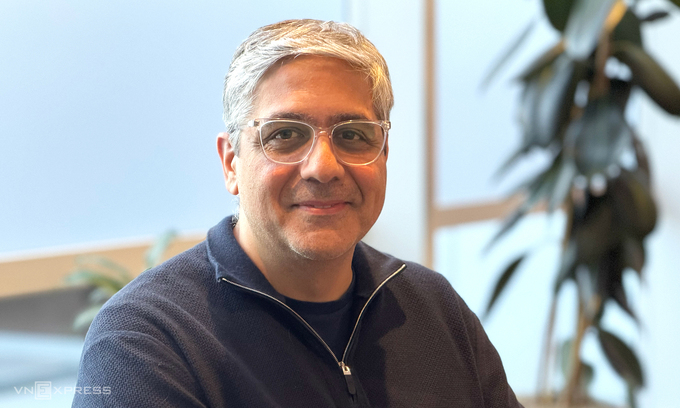
Koray Kavukcuoglu · Google DeepMind

Google chief architect Koray Kavukcuoglu says AI goal is to solve problems humans cannot yet understand

2026-05-26 · VnExpress · 约 13 分钟读完 · 原文
Google I/O 2026 场边问答实录:AGI 愿景、如何把实验室研究带给数十亿用户、年轻人如何为 AI 时代做准备。

News Politics Education Environment Traffic Crime Brainteaser Business DataSpeaks Property Billionaires Markets Companies Economy Money Quiz Tech Tech news Enterprises Personalities Vietnam innovation Challenge hub Travel Places Food Guide Visa Puzzle Life Trend Arts Celebrities Vogue Love Wellness Sports Football Boxing Marathon Tennis Golf Other sports Trivia World Perspectives Readers' Views VnE-GO All sections News Politics Education Environment Traffic Crime Brainteaser Business DataSpeaks Property Billionaires Markets Companies Economy Money Quiz Tech Tech news Enterprises Personalities Vietnam innovation Challenge hub Travel Places Food Guide Visa Puzzle Life Trend Arts Celebrities Vogue Love Wellness Sports Football Boxing Marathon Tennis Golf Other sports Trivia World Perspectives Readers' Views VnE-GO Tech Tech news Enterprises Personalities Vietnam innovation Challenge hub Copy link Most Read 1.

Australian engineer wins $28,000 as firing over 17-minute Singapore Airlines flight delay ruled unfair 2. Asia's 'most beautiful island' sees foreign arrivals jump 82% in July 3. Thailand no longer Southeast Asia's second largest aviation market 4. World's second most visited country welcomes 46.6 million tourists in first half 5. New US visa rules create fresh hurdles for international students pursuing higher study or careers 6.

LeBron James to use helicopter for training and games with Philadelphia 76ers 7. Ho Chi Minh City beats Bangkok, Singapore to claim world's best street food city 8. Which country is Southeast Asia's biggest lumber producer? 9. Vietnam's largest island Phu Quoc launches English training for locals ahead of APEC 2027 10. Indonesia naturalized player goes viral with sarcastic comments at Vietnam after heavy ASEAN Cup defeat --> Google chief architect Koray Kavukcuoglu says AI goal is to solve problems humans cannot yet understand By Luu Quy &nbspMay 26, 2026 | 01:11 am PT Get VnExpress first in Google Search See more of the news you trust.

Make VnExpress a preferred source to prioritise our updates in your Google search results Koray Kavukcuoglu, chief AI architect at Google, said the company’s long-term goal is to develop AI capable of learning and adapting independently to solve problems humans do not yet understand. Kavukcuoglu currently serves as chief technology officer of Google DeepMind. Last year, he became the first person appointed chief AI architect at Google, with the task of integrating the company’s most advanced AI models across its products.

Speaking to VnExpress at Google I/O 2026, held in the U.S. in mid-May, Kavukcuoglu shared his views on Artificial General Intelligence (AGI), how Google is bringing AI research from laboratories to billions of users, and how young people should prepare for the AI era.

Koray Kavukcuoglu, chief technology officer of Google DeepMind, speaks to VnExpress on the sidelines of Google I/O 2026 in May 2026. Photo by VnExpress/Luu Quy

- Google was once best known for its search engine, but AI is now becoming a foundational layer across nearly all its products. How do you see this transformation unfolding inside the company?

- I think that Google's mission is about making information available to our users, right? And information available to our users, right? And it is important that we always try to do it.

I think Liz (Elizabeth Reid leads the Search organization at Google) said it really well, like people always want to get the information in the best way possible and AI is now opening up new opportunities with the developments that we have, as we are talking about here, like Gemini 3.5 Flash, with reasoning and agentic capabilities it brings, it opens up new ways to achieve that.

And then when you think about from a technological development perspective, I think it is important for us to, while we develop the technology, to be always in touch with real world because we evolved from the times when it was more of an academic research into where it is actually something that is useful and applicable in real world.

And with that applicability, we are actually in a position to get what is the next steps we should take in that technological development path from the real world through our users through our products and combine that with deploying that in a in a responsible way as well and that transformation you can see Gemini being used in many of the Google products and that is enabling those products to be more helpful and provide a better service to our users.

- Google DeepMind first gained global attention through research breakthroughs like AlphaGo before its technologies reached billions of users. In your view, what is the biggest challenge in bringing AI models from research into real-world applications?

- I think this transformation, as I mentioned, which was like going from that academic research, as you say, into a place where it is more applicable and operating in the real world is the natural course that any technological development takes. And that transformation, I think, is something that you have to think consciously. So as an organization, we have been, of course, with the goal of developing AI, our goal is to make it available to people and make it useful, to use it for making our users' lives better. So with that, this is a natural transformation point that comes, and I think it's an exciting opportunity in itself.

The hard part in that research, I think. I think for every different idea it's a little bit different but there's always generally about there's the technological development where you have the technology, where you have the capability. And then there's the issue about how will users actually use this? Is this actually going to solve something for them? What is the best way for them to experience this technology? And those two things,, when they come together, bringing that connection point is very critical. And I think that's a very important point. And I would say that's important.

- As Gemini advances rapidly in multimodal AI and AI agents, what technical breakthroughs do you believe are still needed for AI to become a truly reliable assistant rather than simply a tool for answering questions?

- I think it's all about what we expect from the technology. For many purposes the technology is helping us a lot in our lives. But what we are after is something that is general, something that can be helpful in not just one, but many different areas of our lives. And what we want to do is not do something that just solves the problem that we have right now, not help with things that we see as them right now.

What we want to build is a technology that is forward-looking, that can learn by itself, and that can be helpful on things that we don't know yet, that technology can learn and adapt by itself. So there are many, many capabilities that I think we can hypothesize that will enable that, but that's part of the research of pushing the technology frontier. And then, as I said, the goal is to bring that together for users.

- What will determine the outcome of the AI race over the next five years?

- I think the underlying thing is it's always about the model. It's always about the ideas that go into it. It's always about the research that goes into it. That's where the real technological development comes from. But you cannot isolate it from, of course, data.

You cannot isolate it from of course data, you cannot isolate it from the user experience, you cannot isolate it from how users interact with it. I think one of the important things is we develop the technology where we are and where we are going into the future, how is that interaction going to happen and what are the critical decision points or the critical enabling points during that technological development. Right now, a lot of the progress is on agentic workflows, and we can see that.

You can see that with our 3.5 flash model, that that agentic capability increase already shows up itself in many different products all at the same time. Why? Because these are some of the core capabilities that you would imagine that as the technology develops that the models will have more and more. That's why 3.5 Flash, yes we are sharing it with developers and it will make it is making an impact there but also like it's in search, it's in AI mode. Every search user can use that. It's in Gemini app. Every Gemini app user can use that.

When you have this kind of core technology that it goes everywhere, that in search you have new ways of interacting with information, in Gemini app as well, I think these are the kind of core capabilities generalizing into being helpful in people's lives.

- Do you think we are still far from achieving AGI?

- I think, as I said, AGI is, we have been in this journey, like building intelligence, and I think there has been significant development in this aspect. I think like when you look at the progress in the field you can see that and more over I think more importantly when a technological development is real you have to see it in real life and you can see AI being used a lot more and being dependent on a lot more in real life as well. But as I mentioned, there are critical elements of what we want to build.

When we talk about AI, AGI is the generality that is important and it's the capability of not just being able to solve today's problems that we as humans know how to do it and teach the AI to do it, but actually have a system which can figure out solutions of new problems and even be partners to us in that creative process. And there I think there is more to do.

- In the future, can smaller countries still build meaningful AI ecosystems, or will AI increasingly become dependent on a few global technology companies?

- I think what is important for every technology is for it to be widely available. For people across the world to be able to have access to that technology and benefit from that technology. And I think this is something that we think about a lot. This is something that we invest in a lot. I think in the press conference, there was a question about multilinguality.

From the beginning, we thought about building a technology that everyone in the world can use to our capability. So a very important way of, of course, ensuring that is making sure that the model can interact in many, many languages. And that is one of the biggest priorities that we have. And also when you look at the products that we have and also when you look at the products that we have as Google and their availability across the world I think like these go hand in hand for us to understand what is the right way to enable the product in different parts of the world and making sure that we can do that so that that technological progress shows up for everyone.

I think research is universal and creativity, human creativity is universal and research and human creativity are hand in hand. Right. And we see AI research being a lot more universal. We see like researchers and people from everywhere and like being part of that development path. And then also having AI available in many different parts of the world.

I think that is what we are working on as part of Google. I think what I can say is as we develop AI as a technology more, what we try to invest in Google is while we push that technology, make sure that we invest the necessary elements so that AI can be helpful to as many people as possible around the world and continue to invest in that and continue to enable that is what our goal is. And that is why, again, that comes from our product surface and user surface area.

- If you were a student today, what would you focus on learning to prepare for the AI era?

- I think what is important is for students who are thinking about what to do or what field to get into, and I have my own daughters, I'm giving them the same advice, it's important to do something that you like. It's important to do something that you love. Because like at the end of the day whatever that job is, whatever that work is, you are going to be the one doing that. You are going to be working with your colleagues.

You are going to be like day to day thinking about that job. And today there are like today like you can think about many jobs and then there will be there will be different jobs or there will be like many different things that people can do. But what is important is for students to always think about what they love to do and always think that AI is available to hopefully make it better to help them to be more creative in what they do and then to enable them to be more productive or to enable them to be more faster or more effective at what they do. But it's always you who's doing that and that's how we should think about it.

License number: 71/GP-CBC, Ministry of Information andCommunications, September 22, 2021

Email: evne@vnexpress.netTel: 028 7300 9999 - Ext 8556

10th floor, Block A FPT Tower, 10 Pham Van Bach, Cau Giay Ward, Hanoi

© Copyright 1997-2026 VnExpress.net. All rights reserved.