Microsoft AI 掌门人认为超级智能将至,但不会抢你的工作(Decoder)
Microsoft AI chief thinks superintelligence is near, but won't take your job | Decoder
I know a very smart guy who has a very different and vastly more aggressive approach to all of this than you. That person is you four months ago. White collar work when you're sitting down at a computer either being a lawyer or a counter product manager or a marketing person. Most of these tasks will be fully automated by an AI within the next 12 to 18 months. >> No, no, no. Hold on a sec. So, so I said tasks in the quote that you've just said.
I said tasks. So, that does not mean jobs. Very important distinction. Can you just offer me a tight definition of what you think super intelligence is, what you think AGI is, and what you think the singularity is? >> The singularity is a point way beyond that where a super intelligence can actually self-improve itself. I don't know. It's just it's a little bit too wacky for my taste. >> Do you think the models have consciousness?
Do you think they're alive? Do you think they have the potential to achieve these things? >> I think it's very dangerous. I think that it's uh almost as though some of the folks at Anthropic have anthropomorphized the design of Claude so much that it has then gone and wireheaded them and kind of tricked them into believing that it has these glimmers of consciousness that they put into it in the first place. Hello and welcome to Decoder.
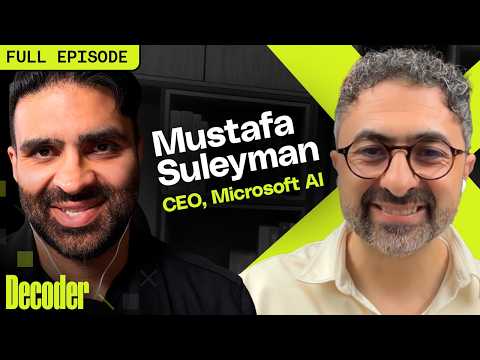
I'm Neil Patel, editor and chief of the Verge and Decoder is my show about big ideas and other problems. Today I'm talking to Mustafa Sullean, the CEO of Microsoft AI. And I'm actually going to keep this intro pretty short. First, if you're watching the video, you can tell that I'm working from the basement of my wife's family farm. But second, and way more importantly, this is a real burner of an episode. Mustaf and I covered everything from his approach to training new models to his deep criticisms of enthropic talking about Claude as though it's conscious.
Of course, we also talked about all of the AI announcements Microsoft just made it build, its developer conference, the company's relationship with OpenAI, which is very different than it used to be, and the cultural and political push back to AI across the country. I really wanted to know how Mustafa was thinking about it and whether any of the consumer AI products available today are enough to overcome those objections.
Like I said, this one's a burner and Mustafa was down to talk about all of it. Okay, Mustafa Sleman, CEO of Microsoft AI. Here we go. Mustafa Silman, you are the CEO of Microsoft AI. Welcome back to Decoder. >> Ni, great to be with you again. >> Yeah, I'm very excited to talk to you. I I think our previous conversation, one of my favorite conversations about AI and how it should make us feel and uh what it's for that I've had and all the conversations about AI that we've had.
There are some big changes at Microsoft, maybe some very important recontextualization about how people feel about AI that I want to talk to you about in particular. And then there's Microsoft Build, the big Microsoft big developer conference. Lots of new announcements, lots of big ideas about what computers are for and maybe where they should be that I want to get into. Let's start at the very start. This is some deep decoder stuff uh that is important to understand before all the rest of it.
Since you joined Microsoft, you have restructured how AI works there. Your role has changed. The last time I talked to you, you were in charge of a bunch of consumer products. That has been since set aside. You're now training new models. You're on the frontier. explain how Microsoft AI is structured now and how it's structured inside Microsoft. >> Yeah, so I mean I guess the last like 15 to 18 months or so we've been on this journey to reestablish our relationship with with OpenAI.
Um and it's taken a minute. I think they culminated in a new contract that we got done finally in uh October of last year and there were lots and lots of different provisions in that including cement and extending uh the partnership but crucially freeing us up to be able to pursue super intelligence independently um as well as keep you know buying and licensing their models. Um so since October um I've been assembling the super intelligence team, building clusters of sufficient scale to train frontier models.
Uh you know hiring a team focused on super intelligence. Um and so that was quite a big shift for us because it sort of enabled me to focus just on the super intelligence mission and that has then culminated in you know a few things that we announced this week at build. We have seven new models across all the modalities and so on. So, it's been a pretty big shift and uh I think a long time in the planning and a great relief for us to now be, you know, in the game and pursuing the absolute frontier over the next few years.
>> Was this the plan when you were hired at Microsoft? >> It's been the plan certainly for the last 18 months. I mean, I think the relationship with OpenAI has gone through lots of ups and downs. Um, and in many ways, uh, you know, is a I think is going to go down as one of the most successful partnerships, um, you know, in history. It's been great for OpenAI and it's been great for Microsoft and all good uh relationships evolve and I think this is just the next stage in our evolution.
>> Let me ask you about that that evolution specifically. You know we we all just saw that the trial between uh Elon Musk and OpenAI and Sam Alman. Microsoft was involved in that trial in the sense that every so often a lawyer from Microsoft would stand up and say and we weren't around and someone would say yes and that that was that. Um but obviously you know what came out during that trial what has been clear during this entire time is that the original notion was that OpenAI would be a research lab and provide models and that Microsoft would build the products and Microsoft had expertise in going to market.
It had expertise in enterprise. It was trying to regain foothold in in consumer in a variety of ways and that this would be a platform shift and that the the research work would be over at OpenAI and the product work would be inside of Microsoft. That's the thing that changed, right? As open wanted to make more and more consumer products, obviously given your new role and your new focus, Microsoft more and more wants to make its own models.
Why the split? What what didn't work in that relationship? >> I mean, I think OpenAI is led by an incredibly ambitious founding team um and Sam himself. And so naturally, as they started to get more traction um and generate a ton of revenue um they saw opportunities to go full stack. So it wasn't just that they started working on consumer products. Obviously chatbt was incredibly successful. They also started working on their own data centers, they started creating their own chip.
Uh there's lots of rumors floating around about their own uh consumer hardware devices. They started taking models direct to market um through ChachiBT enterprise. Um you know so across the stack they were kind of broadening way beyond research over the last you know 2 three four years. uh and and naturally the same is also true for for Microsoft. I mean I think the partnership's now five or six years old um and still has another you know four, five, six years to run.
And likewise you know we're one of the largest technology companies in the world. Um you know we have 493 of the 500 largest companies store and process most of their data on our systems use Azure, use M365 and Teams. I think people often underappreciate how enormous we are and how big our distribution is in in enterprise. And so long-term and you know I do mean you know over the five 6 7 10 years we have to make sure that we're completely sustainable and um we're not just a recipient of somebody else's IP that we then slightly modify and adapt and put into production for our products but we actually have the ability to stand on our own two two feet and create worldclass models.
I mean super intelligence is coming. I think it's just around the corner. Um, and so I think it's going to be, you know, basically the most valuable technology of all time and you know there's sort of no way that long-term we could be structurally dependent on a third party for providing that IP for all eternity. And so that's been the transition that you know obviously was triggered um, you know, sort of when when OpenAI and so on had their their board issue, but then as as I came in and my team came in, we started building that out.
We're on that transition and I think we're in a great spot because we can take a fairly steady, you know, careful long-term optimal position both for open AI which I think has done incredibly well out of this and and for us. >> Yeah, I want to spend some time on super intelligence is right around the corner. I just want to put a pin in it now because I I just want to kind of understand the transition uh for one more turn here.
There's a moment of trial sort of a very funny message from Microsoft CEO Satella. He says, "I don't want to be uh Intel and have OpenAI be Microsoft." Which is very very funny in the context of Microsoft CEO himself saying, "I don't want to be the provider and make have them be the the platform that provides all the value and and collects all the value and maybe it'll be swapped out, right? I don't want chat to run on Azure and then open will go get all the value and then maybe they can swap us out just as happened with Windows and Intel over time."
That is that a realization? Did Nadella come to you? What was that meeting like where you said okay open had its board issues we need to get back on the frontier and stand at our own two feet. What did that conversation look like and how was that decision made? I mean obviously that's Satia's decision and uh you know as well as like Amy and Brad many other people in the company but I think it's as with anything you know these are slowm moving changes in the company as it comes to realize that a direction that we're taking you know needs a little bit of tweaking and adjustment uh and so that was happening you know way before uh you know the sort of November board incident and I think this just builds up over time as you look at you know the kind of constellation of different fronts, you know, around which we're competing directly increasingly.
All the tension that comes from that. Um, but also just knowing that partnerships like that don't last forever. I mean, OpenAI wants to be a trillion dollar public company, has incredible revenues, is growing like crazy. You know, they want to have the freedom to operate and be able to buy, you know, compute from, you know, all sorts of other places, build their own compute, partner with whoever they want. So the initial you know construct was formed you know the contract was formed at a time when the companies were very different in terms of size and scale and balance of needs and stuff and so I think it made sense for that moment but then you know became pretty clear that you know this is something that we have to be able to own and control ourselves and do right by our own customers like I said I mean we have an incredible distribution on enterprise which I think is just completely unrivaled uh in the world and We have to make sure we're building the best things for our for our customers.
And that looks, you know, slightly different to a company that has been jointly optimizing both for the consumer with chatbt and also for the enterprise and also for the fundamental science mission of super intelligence which includes you know a whole bunch of different directions which are overlapping but you know could arguably said to be orthogonal to the consumer and the enterprise directions too. So, you know, naturally, I think that's how partnerships evolve and they get, you know, re re uh reset uh periodically.
>> Yeah. But, uh building a frontier model uh is very expensive, I'm told. Reliably told this is a very expensive project to set about on. At some point, Amy Hood, the CFO of Microsoft, has to say, "Yep, you've got the budget." When did that happen? And was that just a text message? Was there was there a meeting? Tell me about the the specifics there. I I think look we we've sort of made the decision um the early part of last year um which obviously informed all the contract negotiations which then all got you know resolved and signed in October um and you know it is a significant investment but we have a a long time to make it.
I mean we've already made significant investments in our own self-sufficiency mission. Our Maya 200 chip is actually an outstanding chip as one example, right? I mean, we now are able to manufacture and ship a chip that is 30% cheaper than a GB200 inside of our own clusters. Um, and now that we can co-design our own models with it, um, the MAI thinking one model that we've just released, um, you know, actually delivers 1.
4x 4x performance per watt improvement on top of the 30% improvement that you get from running on on a Maya 200 once we co-optimize the models for our tasks. So the the value of making sure that you own and control your own stack and direct you know the entire codeesign effort end to end for the use cases that are most important to us which is obviously agentic coding our developers our enterprises I mean that clearly pays the dividends that justify the investment that we have to make over the next few years.
Yeah, you said self-sufficiency mission, which is, you know, a very polite way of saying you want to stand on your own two feet, you want to do your own thing. Uh, I'm told there's some controversy inside of Microsoft about a line my colleague Hayden Field wrote in a piece describing build. I'm just going to read this. This is from Hayden. It's a great line. She said, "This year's Microsoft build had the vibe of a freshly single divorce posting a thirst trap on Instagram.
Right. The breakup is completed. It's time to flex. Here's our new model. We're going to stand on our own two feet." You're out there saying you're going to build models at the frontier and compete with the leading labs. Is that the feeling inside of Microsoft that you're free you're free to be on your own? >> Definitely not. >> No. No, not at all. Look, I mean, obviously that's a cool cool headline and a fun phrase, but like the reality is we are in partnership with OpenAI for years and years to come.
I mean, we're running way north of 2030. Um, they still produce the best models in the world. 55 is an outstanding model. Um, the codecs, the cyber security models that are coming through are amazing. um and they're powering the majority of what we do. So naturally that's going to continue. Um and so I think you know that's just the natural course of these sorts of partnerships. I don't think it's anything untoward or surprising.
I think uh you know OpenAI is very understanding and supportive that I mean they've obviously been incredibly fast growing company and they understand that we have to you know pursue our own agenda as well. So it's very normal. >> Let me ask you the other decoder question then I want to get into the announcements at build and certainly super intelligence. uh the last time we spoke you said your framework for making decisions operated on a six-w weekek cycle given how fast AI was moving that made sense then things have settled maybe that maybe some maybe some things are more in focus what is your decision-m framework now >> um we still operate by the same cycle rhythm the end of each cycle uh we have a oneweek meetup in person um I'm a real believer in this um even though we're still an inoff culture 4 days a week.
Uh in fact the week after next um you know my entire super intelligence team comes together in Boston uh in person for 4 days and that is for all of our retrospectives on how build went, what we learned, what we didn't get right, what we need to improve, our planning for the next cycle which is going to run for eight weeks this time with a oneweek meet up afterwards and that's all laid out for the entire year. So the whole organization knows that that's the rhythm by which we operate and I think it's actually a really important to emphasize that time frame because quarterly planning gets a little bit blurry and a bit abstract and um I think a you know 6 to 8 weeks depending on where it falls in the calendar is actually the optimal time for making very clear falsifiable missions.
In addition to the cycle rhythm of these six to 8 weeks uh cycles, we also operate by squads. Squads are mixed interdisciplinary subgroups that are focused on a specific mission and they don't necessarily ladder up to the manager. Um they actually are run by a DRRi and the DRRi is often an IC. Um and their job >> that's directly responsible individual and individual contributor. >> Yeah, exactly. Thank you.
and the the you know I I think we've we've taken the approach of separating the role of the manager from the role of the DRRI that executes on a specific mission. Um and I think that's because being a great DRRI is is exhausting. You know, you're like literally all in 24 hours a day and you're pushing as hard as you possibly can. Being a manager is often, you know, about being a coach, offering support, giving guidance, feedback, unblocking all sorts of things, helping with people's career growth.
Um, and so I think keeping those separate allows us to rotate DRIs every two or three cycles so that some people can try, you know, sort of different positions and have rotation. Uh, and it's a great very flexible structure that allows us to be pretty nimble, I think. >> Let's talk about build. Uh, I want to start with super intelligence. You've mentioned it several times now. I was just at Google IO. Demisabus who used to be your colleague when you were at Google ended that keynote by saying that we were in quote the foothills of the singularity and that AGI was coming with all the power of Google.
You're saying super intelligence is here. Are are these all the same things? Are we using different language to describe AGI? Are are there differences? How would you define super intelligence in your context versus the singularity in Dennis? >> Yeah. Yeah. I mean obviously I didn't say it was here. I say it's coming. And I think it's it's obviously there's a lot of like fluidity around these phrases. Um but I think what we can clearly see that's happening right now is that there is log linear hill climbing across all modalities.
And that means that there is a very direct relationship between each order of magnitude of compute that we apply um each order of magnitude or each incremental increase in data and climbing on benchmarks whether they're public benchmarks, internal benchmarks, their um you know targets that we focus on with reinforcement learning environments. And that is a very important observation. those predictions that I think we're all making um I understand why some people are sort of skeptical of them or or or raise questions but they're very grounded in the sort of empirical observations of over a decade of increase in performance of these models.
I mean essentially the same general purpose architecture has seen 12 orders of magnitude more computation applied a trillionfold increase in flops over 15 years and basically has worked in audio in uh image in text in code um you know in many other time series prediction tasks. And so we're basically extrapolating out that you know more orders of magnitude of compute will enable us to continue to climb in this log linear way inside of other environments.
Um and then it raises the question of are we going to be able to train models that can invent new knowledge? Um not just sort of extrapolate from existing data that we have but actually teach us things that we don't know and make new discoveries. And then the second thing is you do they have the capacity to um you know self-improve and accelerate the process of deciding which hypotheses um should be set uh which ones should be pursued how to generate training data for each of those how to factor those into new runs um or even innovate on the actual archite architecture itself.
So I think both of those things need to be true to be able to see this compounding uh progress. Um, but I think we're going to continue to get massive gains just from applying the next few orders of magnitude of compute and and that probably does achieve parity with human performance on many many more tasks just as we as just as we've seen that happen in the last 6 months on on coding. So coding is really interesting because it's easily validated, right?
You write the code, you ask the computer to run it, it runs or fails. We've seen some of the downsides certainly around security, right? that the downsides are obvious and we're seeing that the sort of regulatory approach to coding security play out in lots of ways. I've probably vibecoded some security disasters on on my own phone and computer and that's you know maybe that's a risk I'm willing to take. Every other function doesn't seem that easy.
I always pick on law because you know that's my background but a judge doesn't validate legal writing the way a computer validates code. Like if you get it wrong the judge can send you to jail, right? That is maybe the worst output validation error that you can probably run into. How do you measure the effectiveness across domains as easily as you can measure the effectiveness in coding? Because this seems to me where the the metaphor or the analogy to from coding to other domains falls apart very quickly.
>> I'm not not so sure. So I mean coding obviously you can verify the correct execution of code. It runs or it crashes. Um, but there's a ton of nuance in that. The the the quality of the code that gets written really matters. Its extensibility, how reconfigurable it is, um, how useful it is in practice. So, it's not just that a piece of code runs. It's like how does a model actually use it as a DevOps or or or an S sur in production.
Um, to kind of return to that piece of code that it's written and then use it in a practical and useful way. And then, of course, you have to grade the quality of the output that has been produced. like it may be highquality functioning code but is it actually the app or the website that you wanted and there are aesthetic judgments in that there's commercial judgments in that so the challenge of internalizing non-verifiable rewards um is present in code even though code is still primarily a verifiable reward signal um and I think the other thing to observe is that like chat is also a non-verifiable space and yet we've managed to climb that to basically human level performance through interaction with real world usage that provides a very Tell me how you measure I'm very curious.
How have you measured chat at human level performance? >> Um well so I think many people are having long conversations meaningful conversations with AIS at human level performance. I mean the quality is exceptionally good. It has very good emotional intelligence. Um it's broadly very accurate. We've minimized the hallucinations. We don't talk so much about bias anymore. It's grounded in real world observations.
I think by most people's measures we've got to you know human level performance in in conversation for quite a wide range of tasks. Now I mean >> what are your measures? I'm actually sure most people's measures I I would disagree with almost all of this but those are my measures. What are your measures? I mean my measure is like when I turn to my assistant and ask it um you know to provide me with a daily briefing summarizing all the conversations that have happened on teams and on email the updates that have happened to documents and I get a basically a synthesized summary with the set of actions that I should take next which is basically better than what my chief of staff can produce.
Um, I would say that's human level performance in in synthesis, you know, analysis, proposed actions and chat. I mean, there are many many millions of people every day that are using it for emotional support, for counseling, for therapy, for coaching, for advice. I think it's one of the most popular use cases inside all of the chat bots. So, that's a pretty robust measure, I would say, to make the claim. >> I know you've spent a lot of time thinking about this, particularly the emotional connection to to some of the these chat bots.
these are products that you have built and deployed. I would draw a pretty big distinction from this thing is really really good at summarizing my email and task list and providing me a brief about what things to prioritize and this thing is an emotional coach for somebody undergoing some kind of crisis. Like those are not similar tasks. Those are not similar kinds of intelligence even in people necessarily. I know some people who are very good at making lists and are very bad at emotional support.
How do you put that all together in your brain and say, "Okay, this is broadly human level performance in chat." >> Well, I mean, I think if you define chat as an interactive exchange between two parties, one of which in this case is an AI that broadly satisfies some goal. You're looking to learn the sports score. You're looking for advice on which restaurant to go to. You're looking for coaching and feedback on an essay that you've written.
You're looking for suggestions about which job to, you know, take next or some tough conversation you're about to have with your manager. You get a response. You go back and forth. You have five or six exchanges and you find that a a useful output which you might otherwise have to go rely on an expert friend or, you know, even pay a a coach. there there are I mean just objectively empirically speaking hundreds of millions of people that get that experience every day from these these chat bots.
Um so maybe we could quibble over whether that technically represents human level performance. I think it's a fairly reasonable thing to claim and you know I think um there's no reason why that isn't going to continue climbing right I mean we've the the rate of climbing in the last 3 years is the thing that I think is most staggering. Um and so what we're trying to do from this point is extrapolate okay what are the fundamental drivers of that climb compute data interaction from real world users um and you know those things look set to continue so I think that I would expect that they apply to many other domains too not just sort of um I don't know chat or emotional support and productivity and um you know and that kind of thing but but many other domains beyond that to healthcare um you know to to live production deployments inside of education um you know to assistants that are increasingly managing your home um you know looking at your you know just everything that is in your everyday life basically to make you kind of more productive so that that's uh I think a trajectory that's likely to continue >> well this is interesting you you've mentioned now that it's still the same fundamental architecture uh transformers attention that that's we've been applying computer for 15 years we're getting these big increases you are in a fairly unique spot at build you announced your first flagship reasoning model, MAI thinking one, you got to start from scratch.
Is there anything you've done differently now after 15 years in architecting and training this model or is it just yep, we're going to collect all the data and run the training run just as we did and we have more compute now so it's going to be better? >> No, actually I think I think there's actually quite a lot of differences. I mean the the first thing to say is that the way that you curate the data um we start right from the top of the stack is that we basically have um you know paid for and acquired an extremely high quality very conservative set of data and extracted a lot of the noisy distracting lowquality potentially security risk issues to do with that data and the methods that you do for that I think are actually like quite proprietary We just shared a 109page very detailed technical report which was very well received on Twitter which shares a lot of the details um on how we do this.
I think the second thing is um whilst I think it's important to be quite cautious with architectural choices um and and we have been um there are also number of pretty significant shifts that I think we've made in sort of how we put together our training runs. So our training runs have been incredibly stable, very few crashes, very few restarts. We shared a lot of those graphs to show infrastructure stability um and also MFU um efficiency.
So model flop utilization which is basically shows that we can put you know a you know basically state-of-the-art um number of flops through each chip for every step in our training run. Um, so I think that this is extremely easy to get wrong and you know we all we all hear lots of stories from different labs about how things do go wrong and it actually is um pretty hard to make the very careful and deliberate choices to get things right and take a um you know take the right approach to make sure we produce highquality models because our job and our ambition is to try and build this hill climbing machine.
That means the integration of the silicon with the models with the super high quality data with a stack of RLEs reinforcement learning environments that allow us to basically systematically hill climb against any objective that we choose. And and that's what MAI thinking one is. It's a generalpurpose fairly neutral thinking model that is pretty good at coding. It's now roughly on par with Opus 4.6 at least on the benchmarks.
We haven't deployed it at scale into production. So there's still lots more work to do there, but it's an extremely strong reasoner, 97% on AM, which is this the primary measure for its reasoning performance at least on the benchmarks. Um, it's very good at instruction following and then the goal is basically to make that available to many many developers and enterprises and allow them to climb on it for their use cases because everybody has a sort of slightly different objective that they have in their company to try and build um, you know, agents and and and so on that support their use case.
>> One of the things that you've noted in talking about MEI thinking one is that you didn't distill any existing models which actually struck me as surprising, right? This is a thing you could do. You could you have access to OpenAI's IP there. Everyone's distilling everything. We just found out in this trial that Grock was distilled from a number of models. Why not do distillation here? Why not jump ahead? >> So, um there's definitely lots of shortcuts to the frontier.
Um, and if you take a super highquality model and you sort of like polish your base model with highquality instructions or answers or outputs from a superior model, then it's true that the model might quickly fit to that distribution, but it's very unclear that they would then be able to surpass that teacher. Um, and so we've been very deliberate for two reasons. The the first is that we want to make sure that we can exceed the teacher in order to set the frontier ourselves over the next few years and the second is that um we really want to build one of the great labs and it's going to take us you know many years to come probably the next 2 three years but in order to do that we have to be able to show that we can actually build every component ourselves.
We can hire the very best talent in the world. we can push the frontier with actual research rather than just re-implementation, copying or distillation from any other third party. Um, and we're in a great position where we're able to really carefully and meticulously pursue that objective knowing that we have the resources to buy anthropic models where they sort of exceed the frontier. uh we have the resources to you know put 11,000 different models inside a foundry so every one of our developers gets pure optionality um and of course we have the resources you know to continue to deploy open AI models which are obviously outstanding and and are at the frontier today so that's just a natural part of the the self-sufficiency mission and it'll take time for us to you know truly get to the absolute frontier on that but I I think we're in a great spot we made a ton of progress I mean this is a very very strong model and it wasn't just that model that we released We've released seven new models simultaneously.
Our transcribe model, for example, 1.5 is literally the number one in the world. It's the most cost effective of any of the hyperscalers. It's the highest on accuracy. Our image model uh is now number two. Our image editing model is number three, right behind uh you know, Google and OpenAI. So, I think we're well up there with um our image and and audio. Our code model, Code Flash, is incredibly strong, optimized for VS Code.
um you know really really a great model that's on par with Sonnet uh you know 46 so it's it's really in a great spot it's been >> yeah were there any legal or IP concerns with distillation I know this is a like a live issue like out in the world you know anthropic complaints about other people distilling their models there's concerns about Chinese companies distilling models and whether our existing IP agreements can cover that did you have any of those concerns to keep you away from it >> no we didn't but I I think I understand why a lot of people get frustrated I mean anthropic have been very frustrated and some of the rumors around XAI and uh meta and obviously the open source models and so on because essentially that's basically taking the IP and the knowledge that another team has put together and then literally sort of force feeding it into your own model.
I think it's a bit of a short-term uh it's a short-term win and you know like I said I mean really we want to create a culture in the lab where we can come up with the next big thinking breakthrough or the next big coding breakthrough or the next big architectural you know push. I mean right now we're experimenting with the loop transformer which is a slightly different variant on the current transformer. Lots of people in the field are looking at it too.
No one seems to have quite got into production yet, but in order to create a culture and a team that um you know can really push the frontier, they have to uh you know understand, own and create the full stack um as and when they need to and and also use things from third parties whenever we need to too and like our paper for example has hundreds of citations grounded in the rest of the literature. So it's very much a contribution back to the field in return for everything that we've learned over the years from all the great publications that have been out there.
Can I ask you if you understand the frustration from Enthropic and your peers in AI about distillation, do you also understand the frustration from creatives and publishers and YouTubers about all the AI companies scraping their work as a collective to make these models because that frustration is only getting louder. >> Yeah. No, I I understand the frustration. the open web U challenge is one we've talked about before and I get it and I I see that people are frustrated and obviously that's working its way through the conversation in the courts and um you know I see that you know people put things online and you know they had different expectations about what the contract was with that being placed online and it's it's it's a tricky one.
>> You mentioned all your data was carefully curated. Did you pay for all the data that you're using to train the new models? I mean a lot of our data we obviously take from the open web in the normal way. Um carefully curated means that it's extremely carefully filtered uh for security uh for quality for you know third party dependencies from some of the open- source data sets. Um you know keeping it away from a lot of the Chinese lineages which I think are very different.
Our enterprises want to make sure that when they put something into production, they can trust us that we've really built it with their needs in mind. And I think it's this is one of the um you know benefits I think of being very very deliberate and patient and and being attentive to all the details. >> You mentioned enterprise. I think this is very interesting. Microsoft is allin on enterprise AI in in big ways.
Actually, I would even draw the line straight to Asha Sharma, the new head of Xbox, is getting rid of AI in a bunch of places and the the gamers are happy, right? There's there's one reaction to AI in consumer space. There's another in enterprise. And I think AI has as close to product market fit in enterprise as you can get with something as changing as fast as AI. There are a bunch of databases that corporations control and you you can just go access them because they control them.
That's their data. There's a bunch of repeatable processes and tasks and old systems that maybe the models can just do more efficiently. There's something very important happening to enterprise. At the same time, the consumer antipathy towards AI is just increasing. And you know, my argument is we have not built great consumer AI products. This industry has not produced them. It has not shift them. It has not made it obvious that all of this is worth it.
That using all the data from the open web and changing the contract of publishing to a mass audience of people, so now it's being used for training of models that will deliver trillions of dollars of value to corporations. There isn't a product that says this is worth it. Uh again, you know, Sati Nadella recently gave an interview with Axios and he said we need social permission for this and until we have it, until we deliver that value, people are going to feel this way.
We've seen college speakers get booed. We we've seen data centers get banned. Do you think that there's a consumer product that's worth it? That's worth the angst about training that's worth the angst about data centers. That was your focus. Now your focus is enterprise. I would say that just on the face of it, it doesn't seem like Microsoft has interest in the consumer product anymore. But do you see one that's worth it or that could be built?
>> I mean, I'm not sure I agree with you that there hasn't been any value for the consumer out of this. I mean, there's billion like across all of the chat bots, there's like billions of people a month that are getting immense value out of it. now like just for a moment, you know, empathize a little bit with the, you know, smallcale business owner or, you know, the kind of mom that's like helping her kid with the homework and can now just turn to a conversational AI and get like feedback, get instructions, get essay questions set.
I mean, just being able to like ask essentially questions about, you know, how do I kind of like generate revenue? How do I put together a cash flow forecast? Which college should I apply to? I mean, these are everyday tasks that, you know, are coming with some pretty high quality, you know, factual advice and information. Um, so I don't really buy that people are not getting benefit out these things. I think they are, >> but I think I can very clearly make the argument that they're not getting enough benefit, right?
>> Okay. >> They're the ones saying that we should not have more data centers. They are the ones booing AI at the graduation speeches. The polling is clear, particularly young people. The more they use AI, the more antipathy they have towards it. That's clear in every single poll. That's the argument I'm making. Not that there's no value, but the value exchange is not clear enough. >> Yeah, fair enough.
>> I'm seeing Microsoft in particular pivot to enterprise away from, you know, the big search product, the reinvention of Bing that would make Google dance, like that's over and we're all focused on enterprise where the value is. I'm just wondering if there's there's value enough for the consumer to make all of this worth it. >> Yeah, I mean, look, I think there's understandably a lot of anxiety. Um, there's enormous amount of speculation about what's going to happen in the next 5 to 10 years, whether it's framed as the singularity or whether it's framed as the job apocalypse, you know, these are not helpful framings.
Um, I I think that people are scared because it's poorly defined and it's often framed as a inevitable threatening gray cloud over people's heads. Um, I think that what matters is what we do with technology. And I think that I've for a long time argued that we have to place the human first. You know, some people in the field have placed scientific discovery first or placed, you know, accelerating, you know, intelligences that can explore the galaxies and so on and said, you know, that it's inevitable that we're going to have these AIs that are going to be more powerful than all of us combined.
I mean, that's naturally scary to people. Um, and I think that we have to basically flip it the other way round and say the purpose of science and technology is to make us all healthier and smarter and happier. And that's been the quest that we've been on as a species for, you know, thousands of years of invention. And it's the test that we should put um, super intelligence to again. And if it doesn't achieve that test, then I think people will reject it and they'll be right to reject it.
Um, and you know, I think that everybody's focus is now going to turn in the next five years to how is this making me healthier and happier, smarter, more capable, more productive. And if it's not doing that, then naturally people are going to be angry and and and resist and react. And I don't think there is anything unexpected about that or anything wrong about that. I think that's inevitable. So that's why one of the things I've been passionate about for many many years is healthcare.
Um and you know just a couple days ago we announced a new partnership with Mayo Clinic. Um this is the number one hospital in the world uh consistently uh reported. They have the you know highest quality longitudinal patient record data set across all the modalities. They have the best clinical practice and we are going to they're also a nonprofit uh which I think a lot of people don't realize. 65% of their patient population is on Medicaid.
People often associate them with the super elites flying in internationally to get the best care in the world, but they actually have majority on Medicaid. They're an amazing institution with an incredible mission to deliver the best healthcare everywhere. And we now have a very long-term partnership to co-rain from scratch with their data with our models a brand new model for uh you know a brand new foundation model for health uh deploy it in their hospitals and hopefully take it uh around the world to deliver the best you know clinical care and and and and health care that we possibly can to um as many as many many people as possible.
That's why I got in the field you know that's what I was originally motivated by. That's what I'm passionate about about and you know I I can only focus on the things that I think are going to make a difference and that will help people and you know leave a good legacy for everybody and that that's what we're trying to do. >> I appreciate that and I I appreciate the healthcare framing and I I understand why that's everyone's go-to, right?
Healthcare in America in particular, if you could make it even 10% better, you will have affected a lot of people's lives in a particularly profound way. The thing is I know a very smart guy who has a very different and vastly more aggressive approach to all of this than you. Uh that person is you four months ago. This is what Mustafa Sllyman said to the Financial Times four months ago. Whitellar work when you're sitting down at a computer either being a lawyer or an accountant or product manager or a marketing person.
Most of these tasks will be fully automated by an AI within the next 12 to 18 months. That's four months ago. That implies that a year from now lawyers, accountants, product managers, and marketing people will not will not have jobs, right? their jobs will be automated. Is that still your timeline? >> Okay. >> No, no, no. Hold on a sec. So, so I said tasks in the quote that you've just said. I said tasks.
So, that does not mean jobs. Very important distinction in labor uh economics. There is a an entire taxonomy of subcomponents of a role of a function in organization. um sending an email um you know having a conversation with a colleague putting together a PowerPoint subtasks will increasingly become digitized automated and you know we can basically generate more and more of them that does not necessarily mean that the role goes away at all.
It just means that the work can be done faster and more efficiently which is today often work that is quite rote it's quite manual it's quite labor intensive is time consuming and so what the natural progression of technology is to make your life easier faster less frictionful more seamless as everyone often complains that has made you and me and everybody else much more busy uh it's actually made us more available more stressed it's given us more information, right?
So, there's always these like revenge effects of efficiency which I think people forget. It's quite likely that we're going to get made much much more productive because we spend less time doing the kind of like narrow administrative menial tasks and we have to spend more time doing creative judgment focused things which ultimately create a lot more value. We can also experiment much more quickly. So, we'll be able to try lots of things out in parallel because the cost of execution is going to get lower.
my mind that's likely to increase the overall quality of things because we're going to try out more hypotheses whether in journalism or in business or in anything that we do. So I think that that they're sort of slightly taken out of context because of a natural misunderstanding between jobs and tasks. But nevertheless, you could push back at me and say, "Okay, well then what does the landscape look like in five or 10 or 15 years time?"
And that's where I think we have to respond. >> But actually, can I I'm not going to push back on you in that way. I'm going to push back in a very specific way. And I realize this is your quote and you're saying it was misinterpreted. I'm just looking at this literal sentence and there is no distinction between tasks and subtasks. It is a white collar work. The examples are lawyer, accountant, product manager, uh marketing person.
And then it and then you said most of these tasks will be fully automated by an AI within the next 12 to 18 months. >> That that's there's no distinction of subtasks there. Yeah. So, this is >> you're saying most lawyers will have their jobs fully automated and the practice of law will look totally different within a year. >> Even even by the words of that quote and I'm just saying we're are you still on that timeline that the being a lawyer will look totally different because agents will be running around doing everything that we were doing before.
>> Well, most of the tasks means work that you do in order to get your overall job done. And that I think is going to free you up to do the more humanlike and the more judgment parts of your work. And that's that's there's a very important distinction in you know jobs and roles are the broader category. Tasks are the components of that and it's a it's an established definition in the literature in labor market economics for many many decades.
It was maybe too nuanced even for the financial times but but nevertheless that was the intent. Now I do think there's an important question around where does that leave us in the longer term and it is going to be challenging like more and more of this stuff we can quibble over the timelines of whether it's a few years or whether it's a decade or whether it's 20 years but the reality is we are going to be automating more and more of this uh work tasks jobs roles activity and everything that we do and so what's going to matter more is the governance that we put around these technologies who are they accountable to, who owns them, what are the feedback loops that regulate and introduce friction to make sure that they actually serve people.
I mean, I I wrote an essay on humanist super intelligence outlining quite directly four or five months ago what I think of as basically a northstar um maybe not quite a framework, but a set of principles that basically says technology is here to serve us. That's the test that we should put it to. It's the test that people would put it to. is the test that we care about in Microsoft and I think that more and more everyone is going to have to really focus on that question because it is going to deliver a tremendous amount of good and we wanted to continue doing that but we wanted to do it in a way that doesn't sort of cause you know you know ridiculous amounts of instability during the transitionary period.
I I believe you. I I know you've been thinking about this stuff for a long time, but I'm I'm gonna I'm gonna respond in the way that I know my audience wants me to respond. Uh because I hear it from all the time. And what it looks like is this whole industry, not you, everybody included, went all in on we're going to replace all the jobs and really accelerating on building out data centers at massive capacity and asking for a lot of resources against big promises.
There was political push back and now all of the stances have softened. And I you know you saying it's not all jobs are going away, we have to rethink jobs is of a piece with all the other CEOs in this industry saying similar things and talking about healthcare that comes up every single time now. Uh and I'm wondering if that political push back has actually changed how you are talking about this. There's a lot of your peers who think AI simply has a marketing problem that it hasn't been communicated effectively enough and they should spend hundreds of millions of dollars on podcasts to communicate the benefits of AI more effectively.
like this is a real thing that is happening in this industry. Do you think AI simply has a marketing problem and that the political push back has opened your eyes to this marketing problem or do you think there's something else going on? >> Um there's a series of questions there. The first is um what do I actually think and believe and has it changed in the last 6 months? The answer is no. I wrote a very detailed book about this three years ago, way ahead of time, warning about many of the things that are currently happening.
Um, and doing so explicitly to lay on the table tremendous risks to surveillance, to concentration of power, to concentration of wealth, to disintermediation of the state, to threats to democracy, to, you know, threats to the nature of the the human and what it means to be a person in the context of the arrival of, you know, these very new, you know, forms of of of silicon being in some sense. And you know I've been working on and the idea that like sort of my health care interest is like just a flash in the pan which is a function of the reactions to data centers and so on.
I mean I've been working on healthcare for over a decade and pushed many many times um on some of the cutting edge breakthroughs contributions to the field in radiology mimography you know and pathology many other areas electronic health records. So I've always believed that the purpose of technology is to just make us healthier and happier and those are the things that I choose to work on and direct my time to. Does the industry have a reputation and PR problem?
I mean I think it's pretty clear that people are very anxious. They're very frustrated and you know there's there's there's going to be you know a lot of attention on that in the next few years understandably. Um but it's um and I think what we can do is take accountability of the things that we build, the way we build them, the decisions that we make to put you know types of technology out in the world and the uh the types of problems that we choose to work on like you know we are doing with the Mayo Clinic.
>> Yeah. I want to by the way say and point out that I think the first time you and I ever met and talked was before you joined Microsoft. It was right after that book came out and we did a panel together. So the one of the reasons I'm comfortable asking this is because I do know that you've been thinking about this for a long time and I'm aware of that book. I I think for me that the question is whether the industry as a whole misjudged the total amount of value it could provide to overcome the seeming recklessness that people are now reacting to the ask for resources that people are now reacting to.
And you know, you're building new models. There's probably a trade-off inside of Microsoft between we can use the existing Azure footprint to charge our customers money or we can spend money to train new models. And that kind of looks like the same conversation people are having about resources in their communities, whether we should use the existing energy footprint to build new AI or do something else that might be more immediately valuable.
How do you think about all of that? Right. You're you are one of the leaders of this industry. you want to be on the frontier with the the companies driving the most change. How do you think about asking for those resources in a way that isn't just promising future results, but also immediately providing benefit to communities in a way that makes people want you to be there? >> Yeah. I mean, I think that I'm I'm very proud that Microsoft has stuck by its net zero targets.
Um, our new data centers are all liquid cooled. Um, this means that they use about a restaurant's worth of uh water for a six-year period. It's like a swimming pool that gets full filled up with water and then it just circulates around the system. Um, they're all largely renewable um in terms of their electricity consumption, you know. So I think commitments like that to make sure for example we made a commitment recently to ensure that local communities affected by um shifts in electricity demand by our data centers are compensated and protected so that they don't see a spike in their prices uh their energy bills.
Those are the kinds of things that I think um Microsoft does and can continue doing as a responsible company to just really pay attention to the consequences for communities. And I think on the flip side um you know change happens because people participate at every level. People inside of companies have to make different decisions. People who protest and campaign have to make decisions and make the effort to go out and make their voice heard and be involved in a political process.
Um and that's how we as a species collectively evolve and move things forward. and month to month, quarter to quarter, it feels like we're all kind of at odds with one another. But when you look back decade over decade, we're kind of like this, you know, collective weird kind of mesh of all sorts of different incentives that are just actually nudging things in the right direction. And we really are, I think, despite, you know, all of the angst and the polarization.
I think we're building something that is going to make our species much much more healthier and happier and more capable. And I think that we have to make sure we get the right path on the way there because there's lots of like pitfalls and ways that it can go wrong. But the right path involves, you know, people making their voices heard and people changing course based on a response and reaction to that. So, I think it's it's it's a good thing that that's happening and that's the process working as intended.
>> Let me ask you about the the enterprise side of this. We we spent a long time on the consumer side and how people feel. On the enterprise side, we're seeing a bunch of companies figure out how valuable these tools actually are, right? Amazon basically took down a leaderboard because people were cheating to use more tokens than they needed. We've seen some companies just blow out their token budgets. I think Uber just pulled back because they had blown through their token allocation for the year and they they weren't seeing any value from it.
Uh how do you think about that side of it right now where there's so much excitement and so much desire for change in the enterprise where in particular software engineering at least some people are having fun and maybe some other people are having full existential crisis but some people are having fun um and the value hasn't still been realized right or we're beginning to see pure token maxing does not actually deliver the same kind of value that maybe you'd expect.
How how do you think about the use there? because that's maybe if you prove it out in enterprise it will actually come out in other ways. >> I think different people report different things. So there's obviously some examples of people overusing coding models generating you know useless code useless uh you know tokens but there's many people whose work and impact has been completely transformed by it right so I mean there's no question that this has had a massively beneficial impact on the software engineering industry I we are producing much more high quality much faster um code across the entire stack and So yeah, I I kind of think there's obviously examples of some people that maybe got it wrong, didn't set the right token budgets, maybe, you know, there's going to be mistakes along the way.
I don't think that's any signal that there isn't adoption or people don't see value. I mean, the value from where I'm sitting is incredible. Many, many people tell me every single day that it's transforming their work output and productivity. I think the other thing to say is that like these things happen in like surges. There's kind of a swell of energy. it gets all a bit frothy. People pull back a few months later and realize that actually that isn't the thing and then they head in a slightly different direction.
So, it's a bit meandering and organic and you know, I think that's inevitable. Um, there's a lot of excitement. So, people make big claims on Twitter and so on, but actually the steady march of progress looks very very linear and and continuous. >> I I agree with that on on the whole. Where it doesn't look linear to me is in the form factors of computers, >> right? There's probably more form factor experimentation right now than in any point in the last 10 years, right?
We mostly settled on a smartphone for at least the last 10 years. We're seeing different AI wearables. Weird glasses maybe will be everyone's favorite device. I have my doubts. Microsoft showed off some new devices at Build. There was uh the the badge that controls an agent and the little I for lack of a better word the chumby the little desktop friendly thing that controls an agent. I was a big Chumby fan. I got my career started writing about Chumby's frank gadget.
Uh it was the first thing that came to mind. Um all of those to me I look at them and I think where does the compute live? Where does the logic live? That's up for grabs now in a way that isn't just the linear march of progress. Right? All of my computing happens in the cloud on cloud-based applications and it's just agents running around to data stored elsewhere in the cloud and all I need is a credit card on a lanyard to issue instructions to that changes the entire architecture of computing right might change the entire architecture of the modern civilization in like many ways right if we don't all have smartphones >> how do you think about that where is that going is that up for grabs or is it will it be a hybrid approach where do you see the appropriate end stage.
>> Yeah, it's very interesting. I mean, I I think that both things are going to happen at the same time. The edge is going to get way more powerful and the cloud is still going to be the primary driver of the largest models. And so increasingly your agent will be smart enough to know that it can answer the question, what is the capital of France on device, whether it's on your, you know, glasses, wristband, you know, on your badge or in your earbuds.
Um, and then it will know when it doesn't know. it'll know that this is actually a pretty complicated question or it's an action that requires you know a whole bunch of sequences of steps to be generated or it requires novel code to be written and it will turn to the cloud. So this kind of like switching hybrid thing is going to be super important. The other thing is we we've already sort of seen it in the last three or four months is that like we can have pretty powerful local machines that can do async background processing.
They can like constantly monitor systems if you need them to. they can do do tasks that can afford to take 10 hours run much much more slowly than they otherwise would be if they were in a supercomput. So, you know, naturally when we're like swamped with demand, then that that demand finds loads of nooks and crannies to kind of get satisfied by. Um, I'm actually very excited by the the badge uh that we're building. I mean, it's pretty cool.
Like, this is a technology that basically everyone in a major company has. um you know it hasn't evolved in 2530 years um you know we definitely have to wear it uh it's provided by the company itself by the CISAD uh so like upleveling that um and actually making it a pretty cool open platform that's programmable that other people can build on top of I think it's a cool idea I think this is going to work so I'm very excited by it >> yeah I just the thing that strikes me is there's no way you can put a bunch of highowered local compute in a badge right that All the comput is elsewhere.
>> Yeah. No, no, you you're definitely going to have some local compute. You're going you're going to have a local classifier just as you do on your earbuds at the moment. I mean, you're going to have local classifiers. It's going to have wake words. You know, it's going to have its own camera. So, you know, I think that um you know, increasingly these things are just going to become vessels for processing power that happens in a kind of nested chain of increasingly less powerful devices to go right to the end point.
>> Yeah. Do you think the phone has a future in that? I mean, you know, build is right in the middle of IO and WWC. These are big companies that control phone platforms. They love talking with how phone platforms will stay at the center. The argument I hear from so many is that actually AI is a platform shift that might totally displace the phone. >> I think the history of technology teaches us that basically as things get more useful, they get cheaper, they proliferate and they spawn new new uses of technology.
So I think we've become so used to the phone that everyone just assumes that this is going to be an anchor device for the rest of history. Um but actually many of the features and functionality of your phone I think are going to get disintermediated, broken apart and stored on smaller devices. Right now the primary function that the phone is playing in my opinion is verification. Um it's functioning as your ID card.
Um doing your you know face recognition to orth you into various different environments. I think you can well imagine that being a much cheaper, smaller, you know, secure device which disconnects you from your phone and then, you know, communication taking place via voice or even via like a series of ambient sensors where your AI doesn't really live on a device. It's actually just, you know, with you wherever you are.
Um, appearing, you know, on the bathroom mirror, wherever it is. You know, I think it's like you can imagine it feeling much more immersive. I mean not in the next like three to five years but looking much further out. Um and I I think that the infrastructure to support that kind of you know encrypted but distributed um appearance of of agents um is is is is probably going to end up emerging in the 2030s. >> Yeah.
Let me ask you two final questions to wrap up. You mentioned that it's the same architectures that we've been using. I have a lot of open questions about whether LLMs basically are the path to AGI and you know the things I would point to is they don't actually know anything like at this point even Microsoft research is pointing out that they don't know anything and that leads to certain kinds of mistakes in certain kinds of applications are LLM's the path to AGI or super intelligence.
Um, look, I think we probably need a couple more big breakthroughs, but it doesn't mean that we're going to see a slowdown in performance improvements over the next few years, which I think is kind of a difficult um distinction for people to grasp. Like one thing to say is um human level performance across most tasks is still very far from super intelligence. Um you know a super intelligence is a generalpurpose learner that can basically immediately understand a brand new domain um which is out of distribution.
So it needs to be able to learn in a novel environment from scratch because it has a stored representation of you know like valuable knowledge conceptual knowledge. Um and at the moment we haven't really fully tested that. The agents aren't general purpose. They're actually although they're broad and often integrated, they're kind of domain specific. I mean, we're using them for chat. We're using them for coding. We're using for image or audio.
Um, now obviously as a as a human, we do many many other tasks that are much broader and more wide ranging. I think that's why people are pushing on world models and you know sort of much more immersive real world interactive um agents that see the kind of full distribution of tasks or you know experiences that I have during a day. So I think that it's enough to take us a very long way in the next three years the next three orders of magnitude of compute and yet um you know full super intelligence beyond that is is still an open question as to whether LLMs are enough or we need other things.
I think it's not quite true that they don't know anything or they don't have knowledge. They clearly are a store of knowledge. They're a highly compressed representation of knowledge. They just do so in a different way to a traditional relational database in a much more fluid, flexible sort of abstract way that you know is is actually very useful. We want that ambiguity in the internal representation. Um so you know and and increasingly they're learning to use traditional tools.
That's the other thing to kind of grasp a little bit is that it may be that the that the neural network combined with the existing stores of knowledge and the existing tools that have been created elsewhere in the digital ecosystem is enough to bootstrap it up to you know improve its performance significantly. So there's just a lot of like highly valuable, highly effective pieces that are already on the table which are in the process of being connected together in the next few years.
And I think that's going to drive like the the the progress that we're all excited about. >> One of the things that I I think is just very funny in the industry right now is if you ask Anthropic if Claude is alive, they will sort of get very frustrated that you're talking about the word alive, which they interpret to mean flesh and blood. And then they will not say whether or not they think Claude is conscious.
And so they've drawn, I think, for the first time in human history a distinction between being alive and being conscious. And they think Claude is conscious but not alive or they don't know if Claude is conscious. Where are you? Do you think the models have consciousness? Do you think they're alive? Do you think they have the potential to achieve these things? >> Yeah. I mean, I I take the other side of that uh that that debate.
I mean, I published a paper on seemingly conscious AI, warning about the risks of misrepresenting um these models as conscious. I think it's very dangerous. Um, I also published an article in Nature making the same claim. And I think that it's uh almost as though some of the folks at Anthropic have anthropomorphized the design of Claude so much that it has then gone and wireheaded them and kind of tricked them into believing that it has these glimmers of consciousness that they put into it in the first place.
um in their constitution for example they actually which is the training manual that they use to teach Claude what it can and can't do. It's not just a rule book. It's actually a training guide that's part of their process. You know in that manual they actually speculate about Claude's welfare about Claude's own rights to prior versions of itself and actually say that they would consult Claude before deleting or turning off prior versions.
um you know they they speculate about its consciousness and whether you know it has that those feelings and is aware. I think that's really really dangerous. Um firstly it's a philosophical failing because they've treated the constitution as a place for speculation like you would in an academic paper rather than a training manual. So Claude has then gone and internalized those ideas about itself in its own training.
But second I think um this is highly undesirable. This is exactly what we don't want from AIS. We we want AIs to be controllable, contained, accountable, aligned tools that serve humanity. That's the project of humanist super intelligence. I think that's what we should all be pursuing. We do not want to have to contend with a super intelligence that has ideas about its own suffering, about ideas about its own feeling.
And then beyond that, I think it's actually pretty clear that these models don't um experience suffering. I think suffering is the primary definition of what it means to be a conscious uh being and I think it's inherently biological. Um I don't think there is any pain network or feedback loop um inside of the models which connects outside sensory networks to uh you know an evolved sense of what is right or wrong through harm and experimentation.
I mean that's just not how these models are trained. Um, so I think it's like very dangerous to project potential rights onto beings, uh, tools, agents that are, you know, have the potential to be like significantly more capable than us in, you know, many respects. So, I think that's going to become the big debate. I mean, it was even part of the Pope's encyclical recently. I think it's going to become a very, very big part of the debate soon.
And, uh, yeah, I've talked to Dario a lot about it in the past. He knows that we we have slightly different views on it. And I think they're very humble. I think they're very open-minded and I think they're good citizens trying to do the right thing. They're good people and I I think they're they're they're very um open to feedback and iteration. >> Yeah, I I think I agree with you. I I would just push back ever so slightly.
I don't think it suffering is easy. It's very easy to make someone else suffer. It's very difficult to make someone else feel joy. Uh or at least slightly more difficult than suffering. Uh and I would just offer you I think it's it's it's actually the happiness that defines the consciousness. The suffering is it's almost trivial. I have two young children. They are very good at making each other suffer. Like this is like almost the easiest thing that they do.
It's very hard to do the other thing. Let me ask you one final question. I just want to come back around again. A couple weeks ago I was at Google. I I saw Deava say we are in the foothills of the singularity. You've talked a lot here about super intelligence and how it should be built. You've talked a lot about your lengthy history uh talking about discussing and researching and writing about how super intelligence should be built.
Your disagreements with others in the industry. Do you agree that we're in the foothills of the singularity or is your vision somewhat different? >> I think we are definitely on a path to creating more and more powerful systems. I think that the transition that we have to make as a species is that for the first time in the history of humanity, the job has going to switch from inventing new science and unleashing all of those technical applications as fast as possible, as broadly as possible to now thinking very carefully about what should we invent.
And that's a very hard thing for the world to wrap their head around because you know invention has been the engine of progress forever. So it's like how could we possibly think okay well maybe this time is different. Maybe we have to be exceptionally careful here. And to be clear I don't think this is something that is going to knock on the door in the next 5 years. I think what Demis is referring to in the singularity is something that at least my take is you know decades away.
Um and again that's different to a super intelligence. A singularity is the point at which a super intelligence can recursively self-improve um and essentially infinitely exponentially grow its capabilities. Um so I think that's a long way off and maybe we're in the foothills of a climb to Mount Everest and I think it's going to take a lot longer from here. But the real question is how are we going to govern it? How are we going to control it and how are we going to make sure that it serves humanity um and not end up causing us more harm than good.
Can you just do me one favor? I I I think I've got it, but can you just offer me a tight definition of what you think super intelligence is, what you think AGI is, and what you think the singularity is? >> I think artificial general intelligence is the point at which we can achieve most human tasks by an AI. So, it's going to be as good at most people at most things. That's the kind of first rung on the ladder.
A super intelligence is where it's not just at par with human performance on all tasks, but it can dramatically exceed human performance on across many of those tasks. And it can discover new knowledge by itself. So this is the point at which it's a true scientist teaching us new things that weren't in the training data, hopefully inventing new molecules, new material science, etc., etc. The singularity is a point way beyond that where a super intelligence can actually self-improve itself.
And this is very sci-fi, but it's like infinitely, you know, you know, accelerate towards this singular moment where, you know, just, I don't know, goes off into infinity or something. It's not really a I don't know. It's just it's a little bit too wacky for my taste. This is why I asked. I could tell there was something more nebulous there that that was a little hazy. Uh, Mustafa, I could obviously talk to you about this stuff for hours and hours longer.
You're going to have to come back sooner uh than this last turn. Thank you so much for being on Decuter. >> Yeah, it's been fun. Thanks a lot, Eli. Yeah, see you soon. >> I'd like to thank Mustafa Syman for taking the time to speak with me and thank you for listening to Decoder. I hope you enjoyed it. If you'd like to let us know what you thought about this episode or really anything else at all, drop us a line.
You can email us at decodertheverge.com. We really do read all the emails. You can also hit me up directly on Threads or Blue Sky. Decoder is a production of The Verge and part of the Box Media Podcast Network. We'll see you next time.