Kevin Weil(OpenAI):立刻加速科学(EP 15)
EP 15: Kevin Weil (OpenAI) — Accelerate Science Now
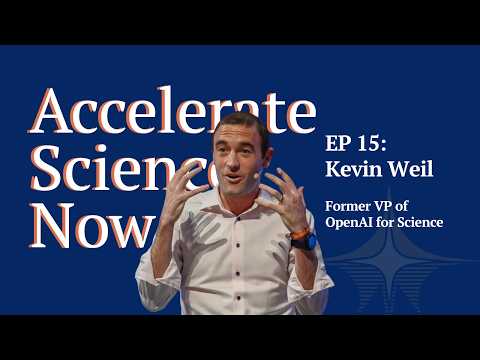
Welcome to Accelerate Science Now, where we sit down with innovators shaping policy, research, and industry to ask one big question. How do we make science move faster and work better for everyone? In this episode, CDI director of policy Josh New sits down with Kevin While who at the time of this recording was VP of Open AI for science. Kevin and Josh dig into how OpenAI's science team is hiring practicing mathematicians, physicists, and biologists to push frontier models past the edge of human knowledge and how AI is being built directly into the day-to-day workflows of working scientists.
Kevin discusses OpenAI's role in the Department of Energy's Genesis mission and what it could mean for fields like fusion. The conversation also covers the barriers still slowing adoption across the scientific community and why peer review and human expertise remain essential even as AI takes on a larger role at the bench. This conversation was recorded on March 10th before Kevin's departure from open AI. Enjoy the show.
>> Hello. Welcome to the Accelerate Science Now podcast. My name is Joshua New. I'm director of policy at seedai. On today's episode, we are very happy to be joined by Kevin Wheel. Kevin is VP of open AI for science focused on building the next great scientific instrument an AI powered platform that accelerates scientific discovery. Previously Kevin served as a chief product officer at OpenAI where he led the teams turning frontier models into products like chat GBT codeex and the open AI API and before joining OpenAI Kevin was the president for product and business at Planet Labs.
Before that, he was co-founder of the Libra cryptocurrency and VP of product for Novi at Facebook, VP of product at Instagram and VP of product at Instagram and SVP of product at Twitter. Earlier in his career, Kevin held software and engineering and data science roles at Cooleris, Tropos Networks, Microsoft Research, and the Stanford linear accelerator center. Kevin graduated Sumakum in physics and mathematics from Harvard University and has an MS in physics from Stanford University.
He's a term member. He's a term member of the Council on Foreign Relations and serves on the boards of Cisco and the Nature Conservancy. And in his spare time, he's an average ultramarathon runner racing distances up to 100 miles and he's also a lieutenant colonel in the Army Reserves. So Kevin, thank you for being here today. >> Thank you so much for having me. >> Um, so starting a bit about your early life and scientific background, sort of come full circle.
Um you originally trained as a physicist at Harvard and Stanford and were on a path towards academia and there seems to be like a very robust pipeline of people who study physics and then become AI people. Um what first drew you to physics and why do you think that through line exists? >> Uh so when I came to college I thought I was going to be a math major. Uh I wanted to study math. I wanted to be a math professor.
Uh I had grown up my dad was an engineer at Microsoft for many many years. And so I'd grown up going to work with him and been like programming as a hobby and things like that, but had just totally fallen in love with math. >> Then I took this class uh taught by a guy named Howard Georgi who's known to be an incredible science communicator, you know, almost won a Nobel Prize, like incredible uh incredible physicist, but also great science communicator and teacher.
And it was just like, wait, this is this is like math except it also tells you how the universe works. And so got uh just just fell in love. Um and so from then on I wanted to be uh a physicist. Came out to grad school, wanted to be a physicist. Um, and you know, I think at some point in there I was like, "Oh man, I I I actually if you're I was doing theoretical physics, theoretical particle physics, and if you're lucky in theoretical particle physics, you make a contribution over the course of your career.
Um, at least, you know, obviously some people are incredibly prolific. I was like, "Oh man, am I, you know, what if I'm that person that works for 40 years and doesn't actually change anything about the world? We don't discover something or my theories are interesting, but they're wrong." Um, and the the timeline to discovery to to to validation in the real world is very long in particle physics, right? You're waiting for the world to build a particle collider, which are literally the biggest science experiments that humanity has ever created.
You know like the the LHC is a 100 kometer ring beneath the city of Geneva that was like a 190 country many thousands of people collaboration over 20 years to make it exist. So you're waiting for one of those to learn if your stuff is right. Um and so anyways I I ended up meeting my now wife who uh at Stanford who had uh kind of gone the opposite direction through school. She spent her entire time working at startups and in the venture industry.
Um, basically paid her way through college working at these startup companies. I had no idea these things existed. I just had like math and physics blinders on. >> But she uh she kind of opened my eyes to it and I was like, "Oh man, you mean I could ship something, you know, write some code, ship something to a bunch of people today and touch, you know, a million people's lives tomorrow? That feels so much more tangible."
Uh and so I ended up dropping out of my PhD going and working at startups and uh you know I've I've missed physics and math. I've always tried to stay close to it. So that's why this role is such a such a fun and you know what a privilege to be able to kind of come full circle back to it. But but yeah, that's how I that's how I left physics. >> So I think it's interesting that you you and your wife said inverted past.
Um, so the the almost kind of like a common trope or a meme, right, where like someone who's really interested in in the academic career like then leaves for the private sector and that is like happening a lot almost like at unsustainable rate at some schools and so like could academia have done anything to keep you um or was it just like something fundamentally alignment related where it's like the private sector was calling?
>> I don't know. I'm a I'm a very pragmatic person. I like feeling the impact in that I have in the world. I've been really lucky to work on big products like Twitter and Instagram that billions of people use. There's something really powerful about feeling like you are hopefully changing people's lives in a positive way. It's one of the reasons I came to OpenAI as well. So that's just it's a harder thing to do in academia.
So I don't know whether I had the right temperament for it at the end of the day, but I've stayed a physics and math nerd. I still try and read a bunch of papers. uh now thankfully with the help of chatgpt because it's a lot easier when I can say hey what does this mean how does that work >> um but uh I don't know I and you asked about the the like physics in particular seems to be a source for a lot of AI people I think there is you you go into you go into physics generally because you're very pragmatic you know it's a it's using a lot of other sciences but you're trying to describe the world and physics is willing uh um uh you know sort of you use whatever mathematics you need to use you use whatever other fields you need to use to try and figure out the world in physics and uh I think it just draws people who are interested in figuring things out and it turns out there's lots of things in the world to go figure out and uh right now AI is one of the most interesting things to figure out and so you see a lot of physics people going huh I wonder if I could contribute to that is there some sort of like natural selection issue where like a lot of the skills that you learn in a physics academic track are also the things that make you a good AI researcher engineer like some transfer or is it just the kind of brain that is attracted to it?
probably more it's the kind of brain it it but physics teaches you teaches you valuable skills it teaches you how to think and how to solve problems it also teaches you know there there are things that I use that even though I don't do physics at all dayto-day I mean a little bit more now than than say a year ago when I was in my old role but um it's not like I'm solving physics problems as part of my daily job but it's still physics teaches you for example when you have a solution to a problem how do you check whether whether your answer is right.
There are probably three or four different ways that you can uh quickly get a gut check for whether you're on the right track. You know, you take limiting cases of your answer. You take some parameters to zero. Does it still make sense? Check your units, things like that. And that general tactic of okay, we're trying to do something that we haven't done before, which is kind of every day at OpenAI. >> Um, and we have some ideas.
Now, how do we know if those things are right? How do we know if we're working on the most important problems? Physics also teaches you to like simplify equations and solve the most important parts of equations rather than trying to solve the complete equation in every case. >> Um, and like those kind of instincts tend to be really valuable in business and and in my work at OpenAI even though it's, you know, not directly a physics application.
They're just things that you learn as a physicist to do. >> Sure. Sometimes I regret my political science major. I'm sure you I bet if I asked you the same question in reverse, you'd find a bunch of uh examples that you were, you know, >> Yeah. but hard skills are nice. I think hard hard going quantifies. Um um so you went from academia into the private sector. Um you're at Planet, right? Um you were focused a lot on consumer platforms and then satellite imagery.
Yeah. Um I have like a soft spot for open data and open science and like earth observation data is sort of like the um example of like why open science matters so useful so many different domains of science so many different like domains of economically relevant activity um like wildlife conversation uh uh wildfire prevention e like weather modeling >> uh to like economic planning national security all these things that matter so much um wondering if you could talk a bit about um like obviously now AI is like a really setting place to be, but how that maybe the through line of like a focus on open science or open data is relevant to your work now or how you think open AI could be supporting it in the future.
>> Yeah. Planet um was one of the most fascinating places that I've ever worked. Um one of the things people don't typically think about San Francisco is outside of LA where SpaceX is building tons and tons of uh communication satellites for Starlink. Outside of that one example, >> San Francisco is the satellite building capital of the world because of Planet. Planet operates, you know, 200 plus satellites that they built in the basement of their building in San Francisco.
Um, and they collectively image the entire planet once a day. They've been doing it for eight plus years. So there's like 2500 data points over every single point on Earth showing daily change. It's such a cool data set. And you gave a bunch of great examples, huge numbers of different, you know, economic uh validators, uh not to mention national security implications, economic climate implications, things like that.
Um just one of the most interesting data sets in the world, by the way, extremely amidable to AI as well. Um because one of the things that's happening and I think this is true of maybe open data in general is there's so much data being produced all over the world. You've got more than humans know what to do with have the bandwidth to process themselves. But if you have AI especially if you have a regular data set of you know everyday daily imagery uh then what you want is to understand anomalies what what's happening in the world that you don't expect to be happening for a variety of reasons.
And you know again theme with AI this doesn't put humans out of a job. It helps humans do a more interesting higher leverage job which is not to just be you know imagery analysts trying to understand where change is. It's more about explaining the change. What does this change mean? Why did it happen? And what should we do about it? >> Um and so it it empowers people which I think is a general theme of AI today.
>> Yep. Um um I we could go on all day about like the role of like open federal data and why it needs to be supported and researched um uh appropriately, but um that's fantastic. Can you talk a bit more on maybe what you've learned from like the consumer technology space as it relates to now like science-driven applications of technology? Are there things like lessons learned that consumer tech like really really gets right that like in a science focused mission we could learn a thing from thing or learn a thing or two from?
Yeah. I mean, one of the interesting things about building a consumer business is it is you you sort of daily have to prove your value. You you have to build something that matters to people because people are very busy. They've got their lives to lead and if you're building a consumer product and it's not directly relevant to them, they're not going to use it. Um and so you you learn very quickly how to find problems and un try to you know put yourself in the the shoes of a user.
Understand what matters to them and figure out how you can build uh a product that solves problems for them and solves not just like problems they might have or they have occasionally but problems that they have on a daily basis. Um that's that's a skill that is relevant to building anything that matters. We're definitely as we think about how we build products for scientists with an opening act for science bringing that lens.
It's not just, you know, hey, we'll build a really good science model and it can it'll it'll give them superpowers in all these different ways. That's all true, but it's also how do you then integrate that amazing scientific AI model into the workflows of scientists on a day-to-day basis. >> And so when you think about it from a science perspective, you still need to be solving problems. You're talking about building products for scientists.
You need to be solving the problems that they encounter on a daily basis. So it isn't just building an incredible AI model for scientists. It's also that that's obviously a huge component of of what we can do and how we can accelerate scientific discovery around the world. But I think it's also how you build that model into the workflows of scientists on a day-to-day basis. So we built this product for example called Prism that is uh a product that brings AI into the scientific writing and collaboration flow.
So when you're writing up one of your ideas, you're going to publish, you know, a paper, for example, you're collaborating with other scientists. You're writing this language called Latte that uh ultimately gets compiled into a PDF, but anytime you see a PDF that has tons of formulas and other things that originally came from this source language called Latte, um, and AI can help you do that faster, better, more completely.
And so we took this amazing science model that we have and we built it into that workflow. And there's an opportunity, I think, to do that in more places. Um, because in general, scientific tools are are not super well supported. It's not a massive industry. Um, and we're really excited to try and bring scientific to bring great scientific tools to scientists. You take that sort of consumer lens, uh, when you think about understanding the problems they face day-to-day, how you can solve them, how you can make their life easier with AI and and new products.
So can you I guess explain a bit more then about like what the AI for science team actually is because it sounds like it's in parts a product team right like you develop prism you develop tools for scientists and like collaboration with scientists but do you have people that are like actually doing scientific research themselves on these teams as sort of like beta testers for this or just for the pursuit of like discovery itself?
What what's going on under the hood there? >> Yeah, it it's it's an exciting thing because we have a variety of different skill sets coming to play. First and foremost, we're an AI research team and we're helping to make the AI models better. One of the ways that we and better for scientists in particular. One of the ways that we do that though, I mean, the models now are incredible. They're they we've gone from 3 years ago when my mind was blown because GPT4 could get a 700 on the math SAT to models that are regularly solving open problems in math and physics and other scientific fields, problems that humans have not solved before.
you see an AI model beginning to solve them. So it's not just really good at understanding, you know, all the things that humans understand. It's actually models are now our models, our open AI models are beginning to push past the frontier and solve new open problems. >> That's amazing. given that they're that good. If you want them to get better at certain fields like math or physics or biology, one of the ways that we do that is actually by hiring uh practicing mathematicians, physicists, biologists who can help teach the models to be even stronger at these fields.
It takes, you know, I am not I'm not even a physicist, let alone a biologist, right? You know, I have more background in physics than most people, but I can't make the models do what one of the physicists on our team can make the models do when it comes to trying to solve hard physics problems. And so when you're at the frontier, you need people who know how to operate at the frontier to help the models get better in these areas.
So we also have been hiring subject matter experts, you know, prominent physicists, mathematicians, etc. to the team. Uh and all of that is in service to making the models really incredible collaborators for scientists all over the world. Our our mission is not to win a Nobel Prize ourselves. It's to see a 100 scientists win a 100 Nobel prizes using our technology. Now in the fields that we think about math, physics, biology, material science, we also will probably take kind of moonshots of our own because it will actually help us, you know, a we can potentially move the world forward.
If we can really solve something important and impactful, that's awesome. But also, it will teach us since we're using our own product the way that other scientists use our product, it'll teach us how to build a better product for them. M so or a better model really. So that's the work that we do on the model side and then I talked a little bit about Prism and the work that we do on the product side and it's really all of those coming together.
Uh it's it's not just an amazing model for scientists, it's also integrating that model into the way that they do their work on a daily basis. Both of those things will help accelerate scientists doing what they do every day. I you you mentioned hiring mathematicians to like help improve the models and I imagine like reinforcement learning with mathematician feedback should be like a right quite literally. Yeah. >> So you you you mentioned u this has come up a lot in conversations you've had people about like where AI and science are natural pairings.
You mentioned a couple different like disciplines like math, physics, material science. Um those are the usual suspects and I've also heard you know quantum chemistry y um high energy physics spec specifically is like they're all domains that are like really really data intensive require a lot of computation to like even do any kind of basic science um and uh that's kind of the obvious fit for AI but what are the and then there's like environmental modeling um u a handful of other ones what are the other kind of domains that people maybe aren't as aware of as like being really really ripe for AI by moving the frontier forward or being like the the obvious like collard you'd want there.
I >> I don't I would challenge you to come up with a domain of science that isn't really ripe to be in terms of for being accelerated by AI. So I was talking to uh a guy named uh Gasper who's a a linguist at Berkeley. >> He studies uh sperm whale language, >> right? Turns out >> we're going to get to talk about like talking to animals. This has been one of the things in the back of my brain, but sorry.
This is where we're going. >> Yeah. Okay. >> Uh for two reasons. One, because what he does is so cool. He studies sperm whale language and it turns out sperm whales have a regular language that they speak to each other. It has some grammatical structure. In particular, it has vowels and he uses AI to understand and decode the speech. Um which is amazing. It's so cool. And you know, if we do if we can do it for sperm whales, why can't we do it for dogs?
>> Sure. >> Um >> second though, the he said something that's really stuck with me. He said, "AI is a metal detector for hypothesis. So, you've got more ideas than than you know what to do with, certainly more than you can experiment with. AI, if you have this collaborator in a frontier AI model like GPT 5.4, it has read substantially every paper across every field of science that have been published in the last, you know, n decades.
It's infinitely patient. It's there whenever you want it. So, you get inspiration at 2 a.m. You can talk to the model. It's also you can just have it explore any particular idea that you have. Write pros and cons. Think for an hour about your idea and explore every possible subtlety. You can do that with 10 ideas in parallel, right? You can't do those things with a normal collaborator. And taken together, you end up being to evaluate ideas across way more axes than you could, you know, as a human alone.
So it's a metal detector for hypothesis. He's a linguist which is not math, physics, chemistry, computer science, you know, but I mean you could be studying the evolutionary biology of snails and the idea that uh that AI is a metal detector for hypothesis is still holds true. >> Um it's been sort of a running joke where we're talking to a lot of uh like policy people about like what are your predictions for AI in 2026?
I think AI will like meaningfully unlock animal communication. Maybe not like language, but a meaningful step change. And this is great to hear that we're on the right track. >> Yeah. I mean, we don't teach the models Spanish or Chinese or English, right? We don't It stands they learn them. It stands to reason that that models could understand other languages from other species as well. >> Um, so the I was thinking you said you were telling me to think of a domain where AI wouldn't be good for science or wouldn't be the obvious fit.
And the thing I was going to say was social sciences, but like I remember reading pretty recently a lot of interesting research around like agentic modeling of humans. You can basically run virtual social science studies and like are they is it good enough yet? Like no, but they will be eventually, right? Like and so you know measuring like human behavior at scale or something to predict like economic impact or something things that are like really messy, really expensive to do require a lot of like human input.
We might get to like dramatically accelerate. Yeah, >> I assume. >> Not not to mention AI is superhuman at a bunch of more basic research uh things like literature search. >> Sure. >> You have an idea, you want to understand who has studied this before. Sometimes you by default you would do a normal search using language, but what if they wrote in a different language? What if they use different wording for the concept?
And AI has an ability to search in sort of concept space across languages that is by itself superhuman. So there are all these other ways that uh scientists are already using AI today to accelerate their work. >> I I keep I want to keep like going back to things you said there. So um open has announced recent partnerships um with with a whole lot of different folks but um one with GKO bioworks um with it's also an accelerated science now coalition member um and I think the headline was you know you GBT5 helped them autonomously design over 36,000 experiments for protein synthesis with the 40% cost reduction.
>> Yes. Um, the idea of AI being like a metal detector hypothesis, I can imagine there's a certain point of diminishing returns where like volume of experiments or volume hypothesis doesn't really matter. It's about knowing like what are the right ones to run. Obviously, if you're screening like a million different molecules, you're gonna have the volume is a necessary element of this, but how can you talk a little bit more about how we actually hone in on the right things to be doing or the right, you know, flashlight to be shining to to to find the way forward because there's like this um it's like this meme where uh where when AI is superhuman everything, like the one human skill that matters is taste.
And so like the difference between like the AI slot for science versus like science that is like meaningful and profound and advancing the human condition uh that is done by AI will require some sort of like human level taste in the the scientific driver's seat. What does that actually mean or how are you guys thinking about that? Yeah, it's because when you look at um if you look at a scientist actually going back and forth with AI and trying to solve some hard problem, it is really a back and forth.
It's not um you know just type the right question into the box and the AI does all the work for you and out comes this this thing that you just like yolo into a paper and publish without looking. It's it's a back and forth. You're exploring a new concept together. Sometimes AI can solve it in one one go. But if that's true, then that just is a an opening for you to go try harder problems. >> Um and so when you're really at the frontier, it's a lot of back and forth.
And if you take I have a colleague named Alex Lubsa who's a physicist, black hole physicist, right? And I have enough of a background to be able to have conversations with him, but I don't have nearly enough background to do the kind of research that he can do. So me with GPT 5.4 cannot do anywhere near the kind of physics research that Alex with GPT 5.4 can do. expertise still matters because at the end of the day, this is you going back and forth with a model, understanding the right questions to ask, pushing back on some of the answers.
No, that doesn't seem quite right, but there's something interesting in what you said here. Let's explore that. Go deeper here. Um, so like that is actually the process of of going back and forth with with these models. And it's why it it does require taste and an understanding of how to write, you know, what what the right questions are to ask. Um, and if the model can just do stuff for you, then that just means you can go deeper and do more.
>> Yep. Um, so on that, like there's been a lot said or sometimes fredded or people are upset about it or confused about it about like the relationship between scientists themselves and the tools that they're using and sort of the history of like scientific machines, right? Have been to you mostly passive, right? Like they they make us more productive, they make us more efficient, they make us more reliable. where we can do things like on a massive scale like a like a particle accelerator or something that we just like can't really do the oldfashioned manual way.
But AI really seems like a step change where it's it's not just it's it's doing all these things. It's doing all that process speed up but also is like fundamentally a different way of engaging with a tool to do science. Um is this just like a natural progression up a curve or is this like some sort of new step change? And I guess maybe as a follow-up to that, like what has surprised you about how people are using, you know, the GPT models for science in ways that you didn't necessarily envision?
>> Uh, it's it's a really good question. I think I mean, it's probably a it is a it's a tool. It's a tool that gives you superpowers. It is probably different in character than most other tools. You can't exactly compare it to a calculator or even to, you know, I I used a lot of Mathematica when I was uh in grad school and it's an incredible tool, but having something that can think for itself is is it opens new vistas, >> right?
>> Um one of the things that we've seen over the course of the last few months, uh uh there's this class of problems called uh the airish problems in mathematics. Paulish was this incredibly productive uh combinatorist number theorist and he left behind like 1,200 open problems. >> I'm gonna I'm gonna be very brave and admit that I've I didn't know how to pronounce his name out loud, but I've seen it written quite a bit.
So, thank you for for getting it on tape of how to pronounce it correctly. >> I mean, you know, fingers crossed. I'm pretty sure that's right. But, uh >> uh so he he left behind, 1200 open problems of like massively varying difficulties, right? Some are some like 400 of them or 500 of them are solved now. Um others are sort of they're unsolved but maybe they're just a little bit beyond the frontier of of what people have done before.
Others are very important unresolved problems that would be major news were someone to solve them. Um so we put out this paper four or five months ago trying to basically just benchmark for people where what AI could do for science at this point. So it gave a bunch of different examples with 10 of 10 outside authors from a bunch of different fields showing how they used AI solving some open problems as as sort of an existence proof.
You really can solve open problems with AI. One of them was one of these air dish problems. And in the space of the next I don't know 30 days there were like 10 or 15 more airish problems solved by a variety of different people. And one of them was uh an account on Twitter. He's solved a bunch of them. He was a very prolific in this in this uh this subculture uh of solving airish problems. And he was sort of an anonymous Twitter account.
Didn't have a name and his profile picture was like an animal. Um and so I reached out to him. I was like, you know, I wanted to get to know him a little bit. Turns out he's a 20-year-old kid. this college student solving a bunch of open math problems with AI and it blew my mind especially as I talked to him more and I realized the sheer amount of mathematics that this kid knows and then you get into it deeper and he like turns out he knows a bunch of AI too.
>> Sure. >> Um and I was blown away. I was just like how did you learn so much? How do you like as a 20-year-old I was happy that I was like you know taking topology or something and thinking I was advanced. kid is doing research level mathematics, knows more about AI than I do. I mean, it's just And he said, "Look, I've I've spent the last three or four years of my life having access to this incredible AI model that is a personalized teacher for anything that I want to learn."
>> And so, I've been able to learn way faster on my own than I could have learned any other way. So, that was uh was pretty eye opening for me. >> Cool. Um, do you make the guy a job offer or is he still out there on Twitter anonymously solving math problems? Yeah, just wait for the summer. >> Yeah. Okay, nice. Um, um, want to pivot a bit to like how you're engaging with the broader ecosystem. Um, um, OpenAI has a lot of resources.
You get to like build these amazing things. You get to test them out internally. You get to like work directly with like some of the leading experts in the field. But science is like a big messy world, right? It's like a federal research ecosystem. It's um universities. It's universities of like varying amounts of of money. It's other companies. It's startups. It's it's private research labs. How should they be spending their attention, their their resources, their their expertise if they actually want to take advantage of this of this opportunity?
Um and what do they need that they don't really have? Like is it a a data bottleneck, a compute bottleneck? Is it just they can't afford the licenses? What is um stopping everyone from taking this and running with it? What you said is exactly right. Science is a massive ecosystem. The surface area is huge. It's it's the reason that our first and most fundamental goal with OpenAI for science is to empower scientists all over the world with amazing AI models and tools cuz we will never do even a fraction of all the science ourselves.
We need to get in people's hands and help accelerate their their process. Um, as far as what, you know, I think a lot of there's a lot more available than people even realize. I mean, you can start using chat GPT for free and for $20 a month, you have access to our incredibly advanced reasoning models that are able to go off and do a bunch of science like, you know, everything that we've been talking about so far. that there's a huge gap today between the people that are really leaning into it, looking at this as an opportunity, getting excited, and saying, "Wow, I could do what I'm trying to do.
I can discover more. I can discover more quickly. I can educate myself about adjacencies that I may have said, you know, that's not exactly my area of specialty. I I'll I'll wait for someone else to solve that." Now, you don't need to wait for somebody else because you have a collaborator in in GPT 5.4 before that can help you kind of go into any adjacency that you want and and do new things. And then you have others who uh are more hesitant or cautious or afraid and aren't taking advantage of these tools.
So honestly, I think the number one thing is just just get in and try these things. um just start using AI models in your research and and I think people will very quickly realize that they are an accelerator to discovery that it's not something to be afraid of. It's actually something to be really excited about because they help you do what you're trying to do whether you're at an FFRDC or uh uh whether you're in industry or whether you're faculty or a postoc or a grad student.
They just help you do more and get more done and learn more things. But adoption is still uneven and that is the number one thing I wish I could change. >> How would you change it? Right? So like the adoption is a big barrier, right? Just like trust or or willingness to experiment with the technology. There's like institutional barriers of um you know maybe a university just doesn't let you do it. Um there's maybe oh I have all this data but I don't really know how to like bring it to an AI system that can make use of it.
um or you know I'm doing sensitive scientific research and need like uh uh secure compute and it has to be on premises or something. Um >> there's a whole bunch of barriers. Um what would you want to see policy makers or like the broader scientific community do to help overcome these? Um is there a magic wand here that we could talk about? >> Yeah. Uh, well, honestly, I think a lot of it is just jumping in and trying, you know, like at at 20 bucks a month to to put in enough effort to show yourself that this stuff really works, everybody can do it.
Um, but then when you really start using it, you know, we have uh we have if you're using our most advanced model that you can sort of use commercially, which is our pro model. So, you're using GPT 5.4 4 Pro uh it will if you give it a really hard question it'll think for maybe 90 minutes sometimes right that uses a lot of compute um which is not cheap and that's that's why in order to use that you're on a subscription that charges that cost $200 a month that is definiting thing and that was like a generation ago so >> oh you got to ask harder questions >> I know I'm not doing science I think that maybe yeah >> um but you can get these models to think for 90 minutes but just like there are questions that you know you could give me a question that I I couldn't answer in 30 minutes but I could in 3 hours or maybe I couldn't in 3 hours but I could in 3 days.
>> When you have models that think for longer they are able to do more. They're able to discover more. They're able to have ideas that they couldn't have uh in a shorter period of time. Um so you really want models that can go beyond 90 minutes of thinking and do 90 hours of thinking or 90 days of thinking in the future. uh and that will require a huge amount of compute. The people that we want to have that compute are the scientists who are going to do the most amazing things with it.
But those are sometimes the people who have the least ability to pay for that kind of compute. And so that I think is a problem that we're going to want to solve as a as a community, as a you know, as the US. Like we're going to want our scientists in order to accelerate discovery. We're going to want our scientists to have access to huge amounts of compute >> and that won't be cheap. >> Um that's a problem we need to figure out.
>> Sure. Do a plug for the National AI research resource which a lot of the coalition members have been involved with which is designed to do just that, right? Like provide um the this kind of deep pool of federated compute that individual research teams can can bid on or startups can bid on. And this can do everything from scientific research to like validating like AI alignment techniques or or or bias testing or or all these things that if but for a lack of compute we wish we could do with AI.
Yeah. >> Um >> we curious to know how that scales. Yeah. Um >> wanted to ask too and I know there's probably a lot you can't talk about yet. Um uh OpenAI is a collaborator for the Genesis mission at the Department of Energy. Um this is I think probably the most exciting like AI for science effort happening. >> It's awesome. I love this project. Yeah. Um uh you also have a history open history of working with national labs in the past too, right?
You guys did the um uh scientists jam and national labs about a year ago. We were quite jealous that we we didn't get to go, but um could you tell me a bit about what the nature of this work with Genesis mission entails? Um uh what does this relationship look like? What are you hoping to like see five years from now a result of this? I I think the Genesis mission is one of the most exciting uh projects happening right now.
Uh it's got a lot of different focus areas, but one of them is saying look the the national labs there are I think 17 of them. Many of them have operated for you know decades and decades doing fascinating science important science. They have a huge amount of scientific data that is currently mostly unused. >> And if you could teach us AI models that kind of that that science, it would make them better at science, which would confer advantage on on the US and and US industry in general.
That would be an amazing thing. So, how can we take this data, which is probably mostly sitting inert, and actually use it to make AI models even better at science? What a cool idea. >> Sure. >> Um, and I think there are many other things that that um that are that are part of this program, but that that's one of the ones that I'm most excited about. What kinds of obviously a lot, right? But like is it data from national lab instruments that just no one else has that have been sitting in the proverbial basement for like 20 years?
Is it like specific domains that are are really poised to be disrupted by this? >> So one area that I'm really excited about is fusion. >> So look at uh Lawrence Livermore, which was they they run the um the fusion instrument. They were one of the first, I think the first in the world to demonstrate positive energy fusion. This is like what 2022 or something. Um, fusion is a massively multi- uh disciplinary thing.
You've got plasma physics, you have material science, you have you name it. It this is a part of building a a successful fusion uh device. And you've also got simulation that's heavily involved. Uh so imagine that we could take all of that data that has come off of the individual fusion runs that they've done, which by the way are individually massively expensive. So that's not a thing that OpenAI is ever going to be able to do itself.
But there's this data that tells us a lot about how the world works at, you know, hundreds of millions of degrees um that that we could potentially build into AI models. And if we were better, if AI models got better at understanding these processes, you could imagine a world not unlike uh what you were talking about with GK with the work we did with Genko Biosciences where you have a robotic lab and you have an AI thinking about experimental setups and then rolling those out to the robotic lab which does the experiments in the real world, puts the results back to the AI model which thinks some more and you have this loop out, you know, through the real world, scientific experimentation.
Imagine that you have an AI model that is that understands fusion very deeply and you know again cross-disciplinary understands the engineering behind it the physics the plasma physics the um and also knows how to run all of the fusion simulations that Lawrence Livermore and others have built over the years and so it can think about the process test a lot of the the parameters that it may want to run you know fusion with in a simulation get feedback from the simulation and iterate a bunch there using heavy amounts of compute but still all in silic refined it then you have the parameters that you want to try out in real life and you run one of these very heavy fusion experiments uh very costly fusion experiments then you take that data and roll it back in and you have a process that allows you to iterate far faster and hopefully again metal detector for hypothesis you're hopefully zooming in on the actual ultimate parameters for fusion that you need and you're able to do it faster because you're combining the best of what the national labs have to offer with what Frontier AI has to offer.
>> Yeah. So, we we did an event um with Daario Gil and was asking him like of all the of all the Genesis mission projects um you know which which is your favorite and he's like well I can't pick a favorite but figuring Fusion out would be pretty cool. Um and so uh fingers crossed on that one. That'd be really exciting. >> I always knew Dario was a genius. >> Yeah. Um uh one other question. Um so when we're talking about fusion, we're talking about um really really advanced domains of science that like only like eight people in the country know how to do at a real level, right?
And we're also talking about advanced AI systems which are like famously not the easiest thing to understand. Um I think a barrier for adoption or a barrier for like widespread diffusion of this is going to be trust in these models and knowing that we can like that this is good science that we can validate it. um that uh we can trust what's going on under the hood as it's designing things that might transform how we make energy or pharmaceutical production or something.
Uh could you talk a bit about like how you are prioritizing reliability of these models or like validating these hypotheses that these models are suggesting? What is the the feedback loop for making this as trustworthy as possible? >> Well, first this is one of the reasons why in order to train really good science models, we are hiring professional scientists. bringing them into the model training process >> um because they're able to bring their understanding of the field at the frontier and uh help make sure that the model as it trains is getting better, getting more factual, able to solve harder problems truthfully.
Um and then the other big part of this is at the end of the day it this is a human and AI doing science together >> and the importance of the scientific process is unddeinished. The importance of a human uh validating these results doing experimentation in a lab if necessary the importance of peer review things like that are all unddeminished. These are still critical parts of the process whether you use AI or not.
Um, and so like that at the end of the day is how we're going to trust these results. It's it's the AI is hopefully going to help you think uh you know examine more hypotheses. Um it will push your thinking uh to you know metal detector for hypothesis will help you experiment faster in the case of things like robotic uh robotic experimentation. >> But at the end of the day it's scientific validation and peer review deeply matter.
Sure. >> Do you and this might not be something we end up including but it's something I've heard and wonder about a lot is that uh we've talked to a lot of academics um a lot of uh people very much deep believers committed to like the academic research environment. the things they bring up all the time that are like terrible and make things much worse than they need to be are the peer reviewview process and then also like the like sort of lone wolf PI model of academic research and like the publication pressures where it's like you have to do a ton of publication but the publication process kind of sucks.
Um is this something you're thinking about at all as a ways that AI can like help skip some of these challenges? I some of these processes are human processes that humans have put in place and humans fully control. So humans will decide whether they change or not at the end of the day. Um but I think that AI can play a major role in helping with things like peer review. Doesn't mean that it's not important to have a human also read uh you know the output.
If I were writing a paper right now, the first thing I would do is have AI do a review of it. We have we have a council of editors in our in our project instructions to you know validate whatever we're doing from like all these different perspectives and I imagine that being similar in a scientific way. >> And so you can have more more confidence in anything that you submit than you have before. Mhm. Um, people also worry a lot about AI slop and is the is AI leading people to, you know, publish a bunch of bogus scientific work and you can have AI again review any of these incoming uh things that that have been posted and AI is pretty good at filtering that kind of thing out these days.
>> Y >> so you know it's kind of like when we uh when we introduced email suddenly there was a problem of email spam which didn't exist before. Uh, and then we built systems over time that were able to identify it and weed it out. And now, you know, mostly don't think about email spam a whole lot. I think the same will be true of this AI slop. We're going to ultimately use AI to help filter it out. >> Uh, and you'll use AI, legitimate, you know, good science will use AI to help tighten and examine and push on their paper before they submit it.
and peer review will still be a thing and will be important because um because it's it's part of doing good science. >> You've been listening to Accelerate Science Now. I'm your host Adeline D. Young. This show is produced by Kindred Subjects, Accelerate Science Now, and CDI. Our executive producers are Josh New and Austin Carson. Special thanks to Kevin King for editing and production.